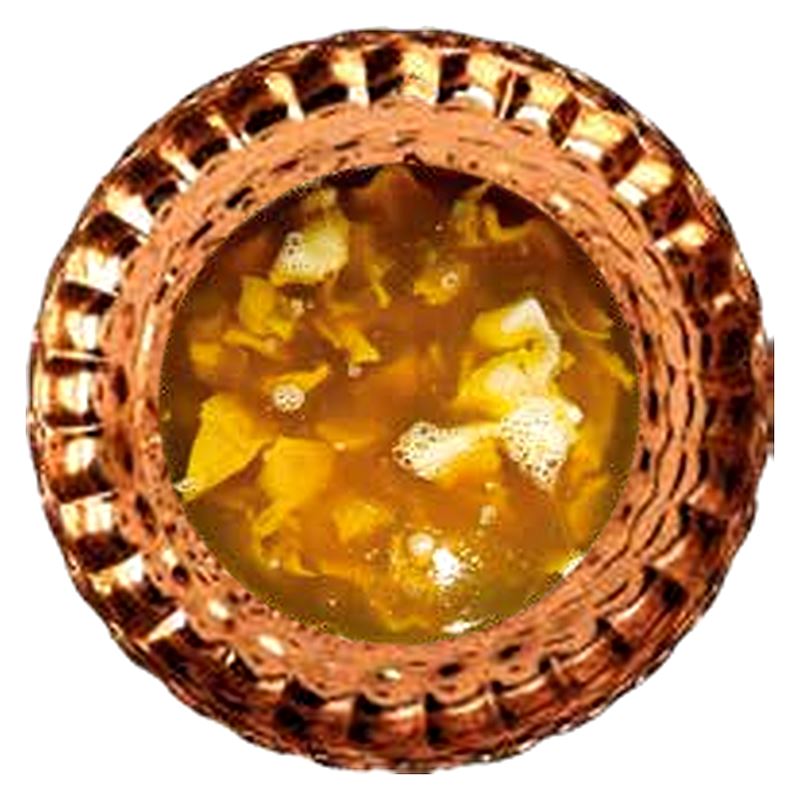
Why does some of a kalle pache order hold up so much better than the rest?
Everything on the platter came out of the same pot, but not as the same material. An order is three substances sharing one tray — dense muscle, springy lining and set gelatin — plus the brain, which is closer to a custard than to meat.
That difference decides the next morning. Muscle already cooked soft, like tongue or the meat, has little left to lose. Gelatin behaves the opposite way but predictably: it firms as it cools and loosens with gentle heat, so what looks ruined in the container is usually just cold. What loses is whatever has no structure to fall back on: brain is held together by almost nothing, and warming it twice leaves you with something else.
The useful question is not how to store kalle pache but what is worth keeping at all, and the texture of each part answers that better than any rule.
Which parts are at their best only while they are hot at the table?
Brain. The clearest case on the tray. It arrives pale, trembling and barely holding its shape, and that fragility is the whole pleasure of it; it does not survive being moved twice. Lift it with a flat spoon, squeeze lime over it and eat it first. Ordering brain to keep is ordering it wasted, so order it fresh every time.
Eye and the special mix. The eye is one small piece, eaten whole by whoever claimed it. The special mix is the parts combined on purpose, brain included, so it inherits the shortest life on the platter. Both are tonight dishes.
Which parts are just as good warmed through the next morning?
Tongue is the champion: dense, even-grained, clean to slice, and one of the few things genuinely good cold as well as hot. Thin slices, a little broth, lime.
Trotters come back better than people expect. They set solid overnight, which alarms first-timers, but warmed gently in their own broth they slacken again and the gelatin coats everything near them.
Tripe is built for this: sirabi is springy rather than soft, so there is no delicate structure to lose. Cut it into strips and it warms evenly.
Meat, and meat-and-fat, behave like any slow-cooked lamb: fine the next day, far better with broth over them than dry.
| Part | Hot at the table | The next morning |
|---|---|---|
| Brain | Eat it first | Not worth keeping |
| Eye | Eat it first | Not worth keeping |
| Special mix | Excellent | Not worth keeping |
| Tongue | Excellent | Excellent, hot or cold |
| Trotters | Excellent | Good, warmed in broth |
| Tripe | Excellent | Good, cut into strips |
| Meat / meat-and-fat | Excellent | Good, with broth over it |
| Broth and soup | Excellent | Often the best of it |
| Sangak | Best fresh | Repurpose it |
| Torshi | Alongside | Keeps in its own jar |
What happens to the broth overnight, and what can you do with it then?
It sets. Left to cool it becomes a wobbling jelly you could almost slice, and plenty of people decide theirs has gone wrong and pour it away. It has not: that is the collagen out of the trotters doing what collagen does, a sign the broth was the real thing. Warm it gently and it runs again.
Broth is the most useful thing to keep, because it rescues everything else. A ladleful over reheated tongue and tripe turns last night's remains into an actual bowl, and broth with fresh bread torn into it is a complete breakfast on its own. If you know you want broth to work with, order extra soup rather than hoping some is left.
Do the bread and the torshi keep alongside it, or on their own?
On their own, always, and they behave in opposite ways. Sangak is at its best in its first hours out of the oven, while the crust still cracks and the middle is soft. It stales quickly, and no warming brings that hour back. It is not wasted: dried, torn or toasted, yesterday's sangak is arguably more useful than fresh. What it should never do is spend the night in broth — tilit is made in the bowl and eaten from it.
Torshi is the only thing in the order designed to keep. Pickles live in their own acidic liquid and keep sealed in a jar, which is why seer torshi only improves with age. Keep it in that jar rather than on the plate or in the broth: torshi that has swum in broth all night loses the sharpness that was the point of it.
How should all of this change what you order in the first place?
Order the fragile things for tonight and put the weight of the order into the durable ones. If it is just you and you want to eat twice, a single dish of tongue or tripe with extra soup serves you better than a platter with a brain on it. If you are ordering for a table that will not finish everything, let the surplus sit in the parts that travel to morning: tongue, tripe, meat, trotters and broth.
Then there is the honest alternative: keep nothing at all. The kitchen runs around the clock, and a scheduled order lets you pick a time tomorrow morning for a fresh bowl to arrive — brain and all. Order tonight for tonight, at the size the table will genuinely eat, and book the morning separately. Every part comes as a single portion on our menu and order page, for delivery across Dubai, pickup, or a table here.
What general precautions are worth taking before you keep any of it?
Keep this simple. Set aside whatever you mean to keep early, before it has sat out and been picked over. Cool it without leaving it standing at room temperature, cover it well and keep it properly cold. Store the broth with the solid parts, but keep the bread and torshi apart. Warm it through gently and thoroughly rather than briefly. Warm once, and finish what you warm.
Beyond that, use your own judgement and follow local food-safety guidance, which is more reliable than any generalisation we could make. If something looks, smells or feels wrong, do not eat it. We would far rather send a fresh bowl than have you talk yourself into an old one. The practical side of keeping and warming is covered separately, and the number is +971 4 321 8882 if you would rather ask.
