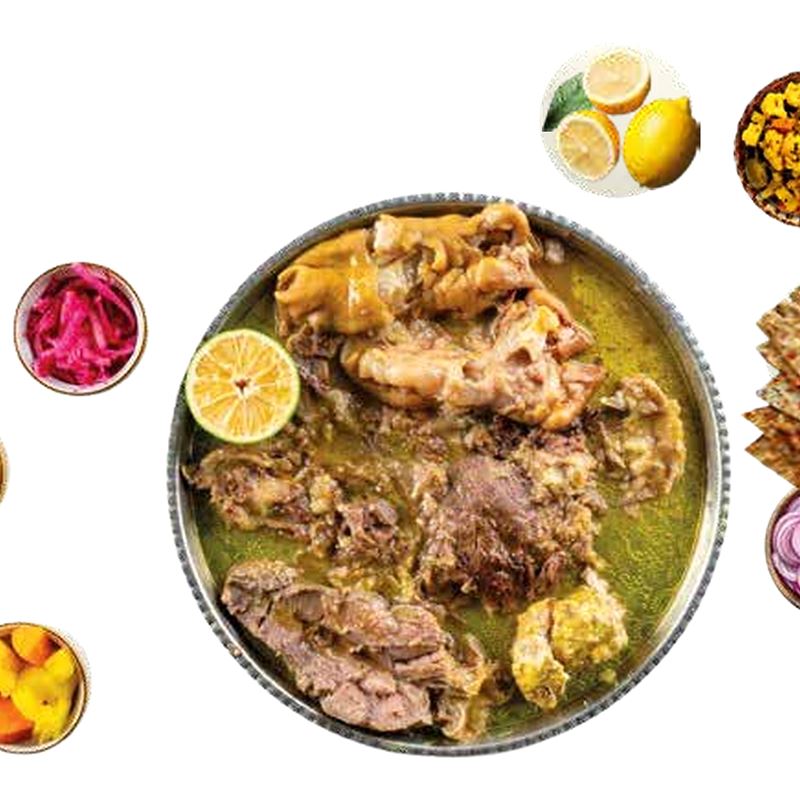
People ask us this in a slightly guilty voice, as though the honest answer might offend somebody. It will not. Yes, something changes. We would rather describe the difference plainly than pretend there is none, and then say where delivery is the better call anyway.
What actually changes between a bowl put in front of you and a bowl that has crossed the city?
Three things, and none of them is the cooking. The lamb is the same lamb, out of the same pot, seasoned the same way. The journey touches temperature, steam and timing.
Temperature is the obvious one. Steam is the quiet one: a sealed container keeps the moisture an open bowl lets go, and it settles on the lid and on the bread. Timing is the one nobody thinks about: in the dining room the dish reaches you the moment the kitchen calls it ready, and at home when your door opens, which is not always the minute you are ready to sit down.
Why does temperature matter more for this dish than for most others?
Because kalle pache is mostly broth, gelatine and fat, and all three notice a change in heat. A sandwich that has cooled a little is a slightly cooler sandwich. Kalle pache that has cooled a little is a subtly different dish: at its hottest the broth is loose and glossy, the fat a bright film on top, the meat leaving the bone with no resistance. As it comes down, the broth thickens, the fat sets paler, and the textures firm up.
None of that is spoilage or a fault. It is the same behaviour that sets leftovers solid in the fridge overnight, the mark of a properly made broth. But it does mean the dish has a narrower window at its best than a grill or a rice plate. It happens at the restaurant too, only slower, as we set out in what changes as it cools.
What happens to the broth and to the layer of fat on the way?
The broth thickens slightly. It is full of gelatine drawn from bone and skin over a very long simmer, and gelatine is why it sets when cold and loosens when hot. A stir and gentle heat put it back.
The fat is the visible one. In the room it is a thin, moving, golden layer. In a box it cools from the outside in, and by the time the lid comes off it may have knitted into a paler film. Newcomers sometimes read that film as a fault. It is not: the same fat in a different state, and it returns to liquid the moment the broth is properly hot. There is more in the layer of fat explained and why the broth sets like jelly. At your end it is short work: into a pot quickly, gentle heat rather than fierce, one stir before you serve, and reheating and storing covers the rest.
What does sangak do differently straight out of the oven rather than folded into a bag?
This is the honest gap, and it is wider than the one in the bowl. Sangak has a dry, blistered surface and a soft interior, and that contrast is the point of it. Fresh from the oven it tears with a slight crackle, holds its shape around a piece of tongue, and takes a dip in the broth without collapsing.
Folded warm into a bag, sangak steams itself. It is still good bread and still warm, but it turns soft instead of crisp, and the strength that let it wrap a mouthful goes with it. For tilit, where the bread is torn into the broth anyway, this hardly matters. For eating brain off a folded strip, it does. Two things help: open the bread bag first so the steam escapes, then give it a short spell in a dry pan, which brings much of the crust back.
Which parts of the menu travel best, and which are most worth eating in the room?
Broadly: the more liquid something is, the better it travels; the more delicate its texture, the more it repays eating where it is made.
| On the menu | How it travels | Why |
|---|---|---|
| Soup and brain soup | Excellent | Sealed liquid holds heat better than anything else we send. |
| Trotters, meat, meat-and-fat | Very good | Gelatine-rich and forgiving; a gentle reheat restores them. |
| Tripe and tongue | Very good | Firm textures, not hanging on a knife-edge of heat. |
| Platters for three or six | Very good | One big vessel cools far slower than several small ones. |
| Deezi | Good, with a caveat | Two stages, broth then pressed solids; that sequence belongs to a table. |
| Brain | Best at the source | The softest thing we cook, most changed by a wait. |
| Eye | Best at the source | Small, particular, traditionally eaten straight away. |
| Sangak | Softens in the bag | Its own steam takes the crisp edge off. |
So is delivery a compromise, and when is it clearly the better choice anyway?
A small compromise on the bread, a smaller one on the bowl. Against that, delivery wins outright in a long list of ordinary situations. It wins at four in the morning when nobody is putting shoes on. It wins with a sleeping child in the house, or someone unwell, or a night shift ending at an odd hour. It wins when six people would rather sit at their own table. And it wins when you want the food at a set hour, because a future time can be chosen for the order, so a dawn delivery can be placed the night before.
Pickup sits between the two: order and pay first, then collect from Jumeirah with the bread as fresh as it gets. If you are weighing all three, delivery, pickup or dine-in goes through it properly.
Our suggestion is not to switch. Keep ordering as you do, and once, when you are passing Jumeirah anyway, eat a brain and a piece of bread at the table and judge for yourself.
How do we pack an order so the gap stays as small as it can be?
The kitchen runs 24 hours and nothing is portioned in advance, so your order is built when it comes in. Broth and the parts you chose go into a sealed container that holds heat. Bread is bagged on its own rather than steaming inside a hot dish. Torshi and doogh travel separately and cold, which is how they should reach the table anyway. Larger orders go as one shared platter rather than a stack of small boxes. The rider calls on arrival, and answering quickly matters: the food does not improve on a lobby counter. The packing is described in full in how it arrives hot.
The kitchen is open 24 hours a day, seven days a week, the lamb is halal, and delivery across Dubai, pickup and dine-in are all open to you. We are at 64 Jumeira Street, Jumeirah 1, on +971 4 321 8882, and everything is on the menu whichever way you eat it.
