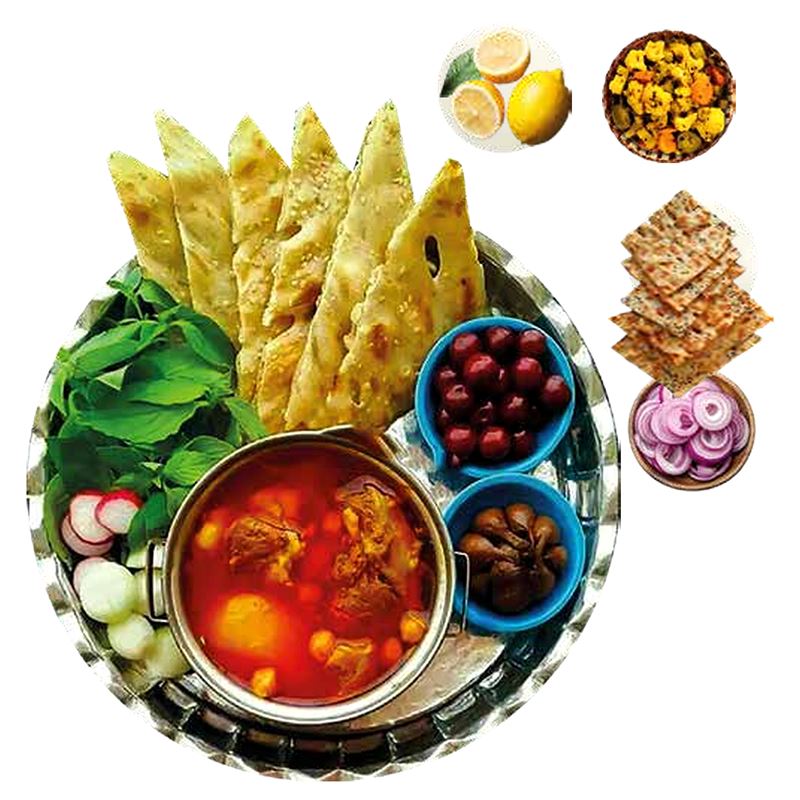
You ordered generously, the bowl was better than expected, and now there is broth in the fridge and a couple of pieces nobody got to. The freezer is right there, quietly offering to solve the problem. So: can kalle pache be frozen? The answer comes in two halves. The broth freezes far better than most people expect; the parts vary enormously, and one of them is changed the moment it thaws.
What we will not hand you is numbers. How long anything keeps depends on your freezer, on how the food was handled and on how fast it cooled — none of which we can see from here. Use your own judgement, follow the food-safety guidance that applies where you live, and if anything looks or smells wrong, throw it out. If your leftovers are only a day old, freezing may not be your question at all: reheating and storing covers the short term, and second-day ideas covers the rest.
Does the broth handle the freezer better than the parts do?
Yes, by a wide margin, and the reason is structural rather than culinary. Freezing grows ice crystals inside food, and they push through whatever delicate architecture is there: cell walls, fine membranes, the fibres that hold moisture in place. When it thaws, that architecture no longer holds and the water runs out. It is why a thawed strawberry slumps.
Broth has almost none of that architecture left; hours of slow simmering already dismantled it. What remains is water, dissolved gelatine, fat, salt and the aromatics it cooked with — onion, turmeric, garlic. That is a solution, not a structure, so ice forms in it freely without wrecking anything that mattered. The parts are the opposite: meat, tongue, tripe and trotters are still tissue, each holding moisture in the way that gives it its feel, and ice crystals cut through exactly that. Nothing becomes inedible, but the fine detail of texture is negotiable in a way the broth's is not. In short: the more liquid a thing is, and the more thoroughly cooking has already collapsed it, the better it freezes.
What does freezing do to a broth that sets like jelly?
Our broth sets in the fridge because the long simmer turns collagen from bone, skin and trotters into gelatine, and gelatine builds a fine mesh that traps water — why it sets is a good sign, not a strange one. Freezing puts that mesh under pressure: ice crystals form in the water the gelatine holds and shove the strands into denser clumps. On thawing the mesh does not always rebuild evenly, so you get a watery pool at one end of the container and a rubbery mass at the other, as though it had split. Cooks call this weeping. It is physics, not spoilage.
The remedy is unglamorous and completely effective: warm it gently and stir. The gelatine melts back into solution, the separated fat re-emulsifies, and within minutes on a low flame you have a glossy, unified broth again. Judge it warmed and stirred, not by how it looks in the container — and by smell too, because none of this replaces your own senses. The top notes fade as well: garlic, onion and turmeric come back duller, which fresh lime, garlic and hot bread fix at the table.
Which parts change most in texture, and which barely notice?
The same logic holds all the way down: the more delicate the structure, the more the freezer costs.
| Item | Takes the freezer | What changes |
|---|---|---|
| Broth / soup | Very well; the best candidate by a distance | May weep until warmed and stirred |
| Trotters | Well; freezes happily | Very little, collagen already collapsed |
| Tripe | Well; forgiving | Keeps its spring, may firm slightly |
| Tongue | Reasonably; slice after reheating | A touch drier and firmer |
| Meat / meat-and-fat | Reasonably; warm it inside the broth | Slightly drier, more fibrous |
| Deezi | Reasonably, but best fresh | Beans and meat soften further |
| Brain | Poorly; order it fresh | Loses its custard smoothness |
| Eye | Poorly; order it fresh | Same delicate family as brain |
| Sangak bread | Very well, if frozen while fresh | Almost nothing |
| Torshi | No reason to; keep it in the fridge | The crunch does not come back |
| Doogh | Poorly; not worth it | Separates |
Brain is the one people most want to save and least should. Its appeal is a smooth, custard-like softness held in a very fine structure — exactly what ice crystals dismantle. Brain soup sits between the two: the broth half survives, the brain in it does not. If you have brain left over, eat it today; the texture guide explains what you would be losing, and leftover sangak has uses of its own.
How should it be cooled, packed and brought back?
Cautious, common-sense handling, and a starting point rather than a rulebook: local food-safety guidance has the last word.
- Cool it promptly. A deep pot holds heat stubbornly and shallow containers shed it much faster; nothing still hot should go straight into a freezer.
- Pack the portions you will actually use, and keep broth and parts separate where you can, since they want different treatment on the way back.
- Push the air out and lay packages flat, which thaw more evenly. Leave a little headroom, because liquid expands as it freezes.
- Label everything with the date, and when in doubt, throw it out.
Coming back, thaw it in the fridge rather than on the counter; the safer route is also the kinder one. Warm it in a pot, unhurried, stirring as the gelatine melts back in, and add the parts near the end, just long enough to heat — boiling them hard is what makes reheated meat stringy. Reheat once, and only what you are about to eat. Then rebuild what was never going to survive a freezer: fresh sangak torn hot, fresh torshi, a wedge of lime, raw onion. Those sharp, bright things are what make it taste like the dish rather than like leftovers.
When is it simply better to order fresh instead of freezing?
More often than the freezer would like you to believe. Brain and eye should always be ordered fresh, and anything delicate belongs in the same category. The dish is at its best in its first hour, when the broth is silky and the bread still warm; a frozen bowl is a decent meal, but a fresh one is what people cross Dubai for.
So the practical answer is usually to plan the order rather than preserve food. Our kitchen is open 24 hours a day, and a scheduled order lets you choose a future time to receive it: if you want a bowl at dawn on Friday, ask for it at dawn on Friday. Ordering to the size of the table is the other half — there is a single dish as well as a double dish and the platters. Have a look at the menu, and if only the broth appeals, soup on its own is a complete order.
We are one kitchen at 64 Jumeira Street, Jumeirah 1, with delivery across Dubai, pickup and dine-in, open around the clock, seven days a week; our lamb is halal, in line with UAE law and standards. To ask about a particular part, call +971 4 321 8882.
