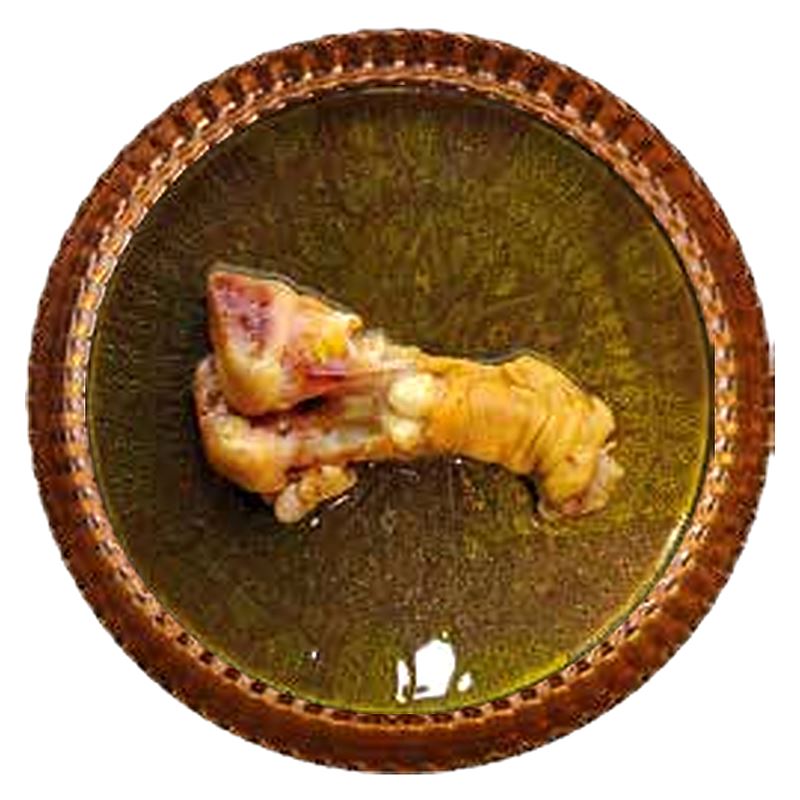
You poured the last of the broth into a container, and the next morning it came out of the fridge in one wobbling piece on the spoon. The first thought is nearly always that something has gone wrong with it. Nothing has: that block of jelly is gelatine, and it is one of the clearest signs you will get that the pot was cooked long and gently. This piece stays on the physics of it, not on health.
Is jellied broth a sign that it has gone off?
No. What has set is gelatine, and gelatine gets there by cooking, not by spoiling. Spoiled food announces itself with a sour smell and a sharp taste. Gelatine does the opposite: clean, neutral, and gone the moment you warm the pot. A broth that sets was full of dissolved gelatine while it was hot. You simply could not see it, because gelatine is invisible in a hot liquid.
What is actually happening inside the pot?
Heads, bones, skin, tendon and trotters are held together by collagen, a tough, rope-like protein that works as the scaffolding of an animal. It does not dissolve in water and it is not pleasant to chew.
Give it heat, water and a lot of time, though, and those ropes unwind and break into shorter pieces. The shorter pieces are gelatine, and gelatine is soluble. Hour after hour it leaks out of the bones and the skin and spreads through the liquid as loose strands, which is why the broth thickens slightly, darkens and starts clinging to the spoon.
The key word is gentle. A hard boil clouds the broth and drives water off faster than the collagen converts; a low, patient simmer is what does the work. That is exactly why kalle pache is traditionally an overnight dish, put on late and served at dawn.
Then it cools. Below roughly body temperature the loose strands find each other again and link into a three-dimensional mesh, trapping the water inside it. What you turn out of the container is mostly water held in a net of protein. That is a gel, and hot it is invisible again, which is why you never see it in the bowl. You feel it instead.
So why are trotters in the pot at all?
They are there for structure more than flavour. Of everything in the pot, pacheh, the trotters, carry the highest proportion of skin, tendon, cartilage and connective tissue for their weight. There is little meat on a trotter and an enormous amount of collagen.
That is why a pot built on trotters gives a broth with body, and why broth from lean meat alone stays thin however good the meat and however long you cook it. If you have wondered why a dish bothers with a cut carrying so little meat, the jelly in your fridge is the answer. Our introduction to the dish covers what else goes in.
Does a firm set really prove a long cook?
Mostly, and it is one of the few quality signals you can check yourself at home. Gel strength depends on two things: how much connective tissue went into the pot, and how long it was given to convert. There is no shortcut: you cannot rush the conversion with higher heat, and you cannot fake body into a thin broth afterwards.
So a firm set tells you the pot held real bone, skin and trotters, and sat on low heat for a long time without being topped up with water to stretch it. A broth that stays completely liquid in a properly cold fridge usually means one of two things: rushed, or diluted. We will not overclaim it, though. A good set is a strong signal, not a verdict.
Mine set softly. Was it a bad batch?
Probably not. Here are the honest reasons a good broth can set softly:
- What you ordered. A bowl of Soup on its own has a different ratio of liquid to connective tissue than a portion served with trotters and cheek. If you chose the lightest way to start, a softer set is exactly what to expect.
- You thinned it at the table. Hot water, or a lot of soaked Sangak, changes the ratio in your bowl. That is normal eating, not a flaw.
- Where it sat in the fridge. A door shelf runs warmer than the back of a shelf, and gelatine sets by temperature. Give it longer, or move it.
- Animals vary. Batches genuinely differ; a softer set one week and a solid one the next is normal.
What is not normal is a broth that is watery and stays watery every single time.
What is the pale layer on top?
Cold from the fridge you will often see two layers: an ivory cap and darker jelly underneath. The cap is fat, which solidifies opaque and greasy and lifts off in a sheet with a spoon. Beneath it is the gelatine gel, translucent and springy. Skim for a lighter bowl, leave it for a richer one; skimming does nothing to the set, because the set was never about fat.
Is this why my lips stick together?
Yes. Fat feels slippery. Gelatine is faintly tacky, and it is what makes your lips cling for a second after a spoonful of good broth. It is the same body that makes the liquid feel round and full rather than watery. The full taste picture covers what sits around that texture.
How do I turn it back into broth?
Warm it gently in a pan and it melts back into liquid exactly as it was, with nothing lost either way. Avoid a hard boil, and add a splash of hot water if it comes back thicker than you like. Reheat it properly hot before eating, and use your own judgement about how long you keep leftovers.
What you observe, and what it means
| What you observe | What it means | What to do |
|---|---|---|
| Sets firm, holds its shape on a spoon | Plenty of collagen, converted slowly, not diluted | Nothing. This is the sign you want |
| Sets softly, wobbles but slumps | Normal variation, a lighter portion, or thinned at the table | Check where it sat in the fridge |
| Stays liquid when properly cold | Usually a rushed cook, or stretched with water | A fair reason to ask questions |
| Ivory cap over darker jelly | Fat separated on top of the gel | Skim it, or leave it for a richer bowl |
| Melts back when warmed | Expected; gelatine is reversible | Warm gently, thin with hot water |
| Lips stick after a spoonful | Gelatine coating the mouth, not fat | Enjoy it. That is the body of the broth |
Does the jelly mean it is good for me?
We are staying out of that on purpose: a firm set tells you how the broth was cooked and nothing more, and whether this food suits you depends on you and your circumstances. This is not medical advice. Please ask your doctor or a registered dietitian. The longer discussion is kept separate, in our piece on what is and is not known.
How do I order a broth like this in Dubai?
Shaun the Sheep is a kalle-pache kitchen at 64 Jumeira Street, Jumeirah 1: one kitchen, no branches, open 24 hours a day, every day, delivering across Dubai. For the part of the pot carrying the most collagen, order Trotters (pacheh) by the bowl, or take a platter: the Single Dish, the Double Dish, the Full Dish, or the Khan's Platter, which includes eight trotters alongside lamb cheeks, brains, tongues, eyes and bread. Sangak, torshi, Doogh and tea sit alongside. If unsure, the singles guide walks through each bowl.
Ordering runs through our website: delivery, pickup or dine-in, no account and no sign-up, just your name and phone number, plus your Dubai area and a pin on the map for delivery. Payment is by secure online card at checkout, delivery is free over AED 300, and you can schedule an order up to about two days ahead. Once you have paid, the kitchen confirms and sets an estimated time, your order gets its own page to follow, and the rider phones you on arrival. If an order cannot be accepted it is refunded automatically to the card that paid, with the reason shown on that page. For anything else, call the kitchen on 04 321 8882, our only contact channel.
