Half the name, and most of the work
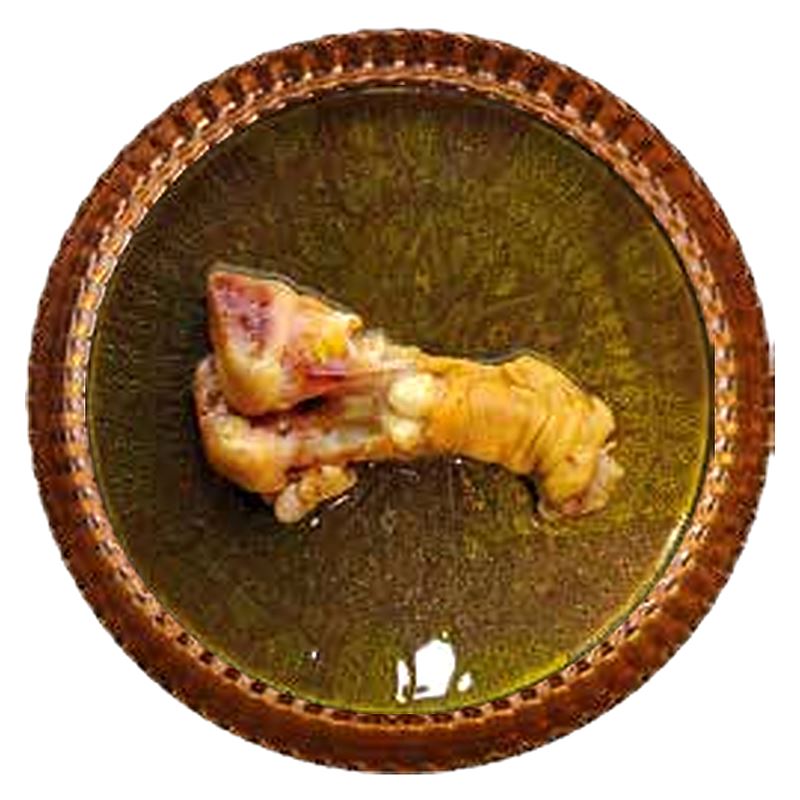
Kalle pache is two words, and each is an ingredient. Kalle is the head. Pache is the trotters, the lower legs and feet of the lamb. Almost everything written about the dish leans on the head, where the parts with names live: eye, brain, tongue, cheek. In the kitchen the ratio is reversed. A head can be split, cleaned and set aside in a morning; the trotters decide when the pot may start, and they are why a cook says fourteen hours, not four.
Singeing and scraping: the first hour
Below the knee, a lamb's leg is skin, tendon, bone and hair, and the hair cannot be shaved off: the surface is ridged and folded around the joint, so a blade skids and misses the creases. It is burned off instead: each leg is turned over a flame until the fine hair curls, catches and disappears and the skin tightens to a dark bronze.
Then the scraping, under cold running water with a blunt knife. The scorched layer lifts as a grey-black film and comes away in sheets; underneath, the skin is pale and slightly rubbery. The work goes against the grain and into every fold, where stubble survives.
The hooves, and the blanch nobody sees
The hoof comes off here. The horn capsule loosens once it has been through the heat and is knocked or twisted free; some cooks take the last joint off entirely instead. Nothing edible is lost: the hoof is keratin, like a fingernail.
The trotters then soak in cold water, changed more than once, until it runs clear. Then the blanch: fresh cold water, brought up slowly and held while a grey foam of coagulated blood and loose protein climbs the sides. The pot is poured away, the trotters rinsed, and only then does the real cook begin. That first water is what separates a clear broth from a muddy one.
Why the trotters set the clock
A pot is planned around its slowest part. Brain is a matter of minutes; tongue softens in a few hours; cheek takes longer. The trotters need the whole stretch, because what cooks in them is not muscle but connective tissue: tendon, ligament and skin wrapped tight around small bones.
Collagen does not soften quickly. Held at a bare simmer for hours it unwinds and dissolves into gelatin, and there is no shortcut: raise the heat and the water boils hard, fat emulsifies into the liquid and clouds it, and the skin shreds instead of going silky. So the trotters go in first and everything else is timed around them, as set out in how kalle pache is made.
The division of labour inside the pot
Head and trotters do two different jobs, and neither can do the other's. The head carries the meat and most of the flavour: cheek, tongue, the sweet scraps around the skull, the marrow, the fat that renders slowly and carries the aromatics through the liquid. A broth made from heads alone is full on the tongue and thin in the mouth, closer to a good stock than to kalle pache.
The trotters carry almost no meat. What they give is body. As their collagen dissolves it thickens the broth without flour or cream, and makes it cling to the back of a spoon and leave a faint tackiness on the lips. That lip-stick feel is one way a Persian cook checks the pot without tasting it: press your lips together, and if they pull slightly, the trotters have done their job. A broth built on trotters alone has the body and not the depth. More on that texture in what kalle pache tastes like.
On the table in Jumeirah
Shaun the Sheep is open around the clock, so a fourteen-hour broth is on the menu at any hour. Trotters are on the menu as a single portion for anyone who wants that texture on its own, next to eye, brain, meat, tongue, tripe, lamb cheek, brain soup, soup and the special mix; our guide to the singles explains each one. There are platters too, from the Single Dish for one to the Khan's Platter for six, and every order comes with sangak, torshi, lime, onion and green pepper.
We are open 24/7 in Jumeirah, for dine-in and for delivery across Dubai, and an order can be placed for a future time, waiting at dawn. Website orders are card prepay only, there is no cash on delivery, and delivery is free over AED 300. Call 04 321 8882, or start from the menu.
