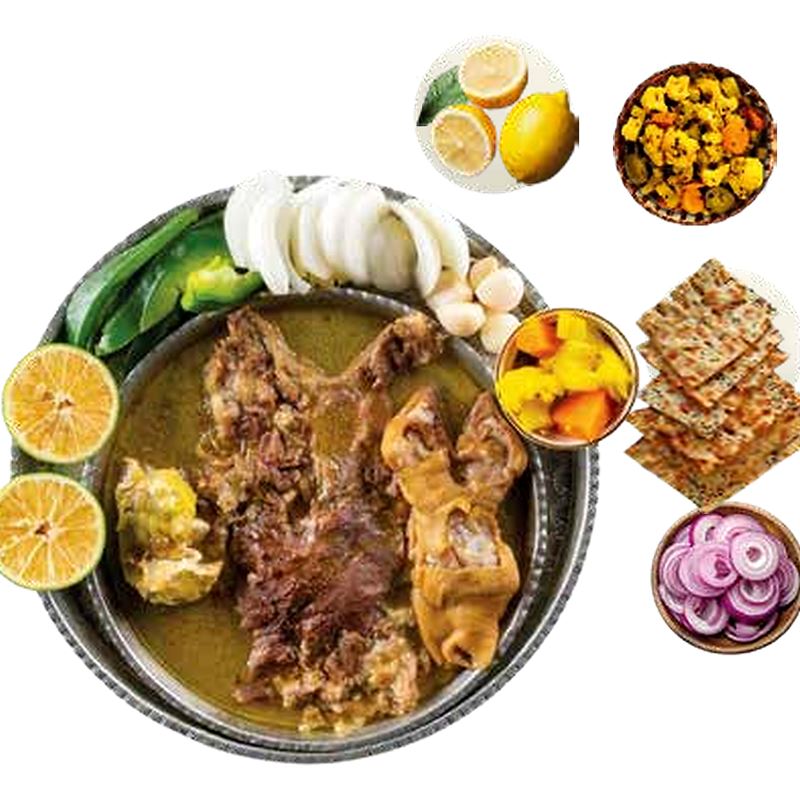
Kalle pache is a traditional Persian dish of lamb head and trotters, slow-simmered for around 14 hours until the meat falls apart and the broth turns the colour of strong tea. Making it well is less a recipe than a nightly ritual, and at Shaun the Sheep in Jumeirah it begins in the dark, hours before the first customer walks in.
What is kalle pache, exactly?
The name joins two Persian words: kalle (head) and pache (trotters). Across the Gulf and Iraq the same dish is known as baja (الباجة), while trotters cooked on their own are called paye. It is one of the oldest restorative foods in Persian cooking, prized for the deep, gelatinous broth that only bones and slow time can produce.
Why does it start before dawn?
Kalle pache is traditionally a dawn dish, eaten at breakfast when the broth is at its freshest and richest. To have it ready by morning, the work has to start the night before. In our kitchen the heads and trotters are cleaned entirely by hand before dawn — a patient job of scrubbing, singeing and rinsing that removes every impurity so the finished broth is clean and pure. Nothing about this stage can be rushed; it is the difference between a broth that tastes muddy and one that tastes bright.
How is kalle pache cooked for 14 hours?
Once cleaned, the pieces go into a heavy copper pot with only a few honest ingredients: onion, turmeric and garlic. The pot is brought to a gentle simmer and then left almost alone for about 14 hours. This long, low cooking is what dissolves the collagen from the bones and trotters into the liquid, giving kalle pache its signature body and silk.
Roughly every hour, the pot is skimmed — the foam and impurities that rise to the top are lifted away. This hourly skimming is the quiet secret of a good broth: it keeps the liquid clear and the flavour clean rather than heavy. Hour by hour the broth deepens in colour until it glows the shade of strong, well-brewed tea.
What is served with kalle pache?
The dish arrives the way it has been eaten in Tehran for generations. You choose your cuts — brain, tongue, trotters, tripe, cheek or a Special Mix — alongside a bowl of the golden broth. With it come warm sangak, the traditional stone-baked flatbread perfect for tearing and dipping, and our garlic torshi aged seven years, whose sharp, mellow bite cuts through the richness. A glass of cold, salted doogh completes the table. If you are new to the dish, you can order a smaller platter online and start with the milder cuts.
| Element | Its role in the dish |
|---|---|
| Copper pot | Even, gentle heat for the long simmer |
| Onion, turmeric, garlic | The only aromatics — clean, classic flavour |
| Hourly skimming | Keeps the broth clear and light-tasting |
| Sangak bread | For tearing, dipping and soaking up broth |
| Seven-year garlic torshi | Sharp contrast to the rich meat and fat |
Is kalle pache good for you?
Kalle pache has long been valued as a restorative food. Because it is drawn from bones and trotters, the broth is naturally rich in collagen and gelatin, along with protein and minerals, and many people find a bowl deeply warming and satisfying, especially in the cooler months. These are traditional observations rather than medical claims — but they are a large part of why the dish has endured for so long.
How can I try authentic kalle pache in Dubai?
You do not need to wake before dawn to taste the result of a 14-hour simmer. Shaun the Sheep is open 24 hours, every day, at 64 Jumeira Street, Jumeirah 1. You can order kalle pache online for delivery across Dubai, pick it up, or reserve a table for a proper sit-down feast. Communal platters serve one, two, three or six people, so the whole table can share.
