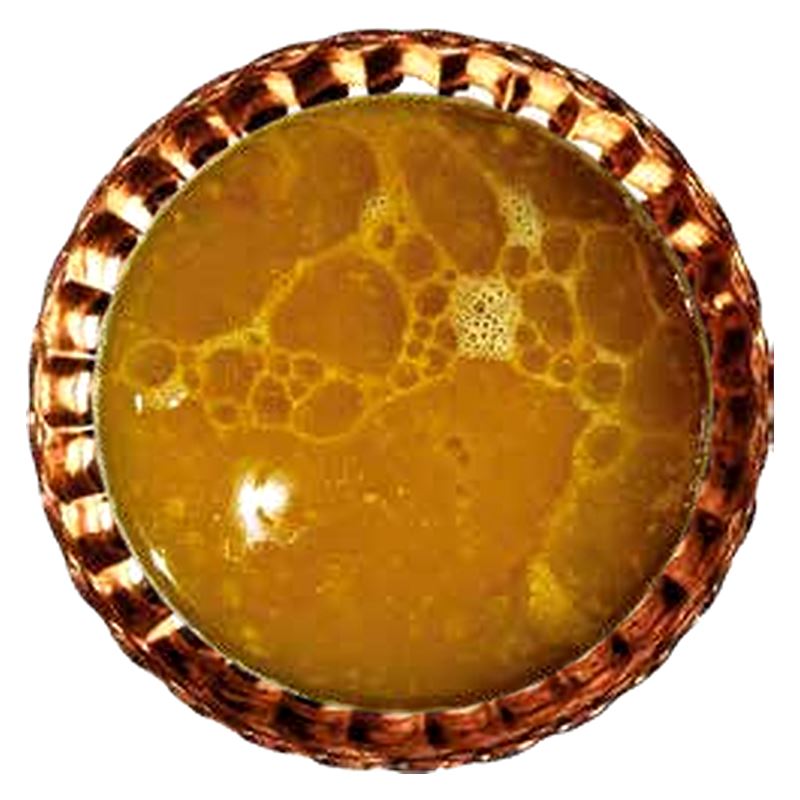
Why the bowl looks pale, not clear
Kalle pache arrives the colour of warm milk. Why is this broth pale and cloudy rather than clear like a consomme? The cloudiness is not a fault: it is the signature of a broth built from skin, bone and connective tissue over a very long, gentle simmer. In stock-making, clarity and body pull against each other, and this dish chose body.
The grey foam of the first hour
Lamb head and trotters go into cold water and the pot comes up slowly. Long before it boils, a grey-brown foam gathers at the surface. It is neither dirt nor fat, but soluble protein, mostly blood proteins and albumin left in meat and bone, which stays dissolved while the water is cold and coagulates into fine grey flecks as it heats, roughly in the sixty to seventy degree range.
It is skimmed off with a shallow ladle, several times over the early hours, for two reasons. Taste: that scum carries a faintly metallic, livery edge. And texture: left in the pot, the moving water breaks it into particles too fine to strain out, and they stay suspended, greying the liquid rather than leaving it a clean pale ivory. This patience is part of how kalle pache is made.
Gelatin, fat, and where the milkiness comes from
Then comes the long part, about fourteen hours at a bare simmer. The first thing to leave the solids for the water is gelatin. Skin, trotters, tendon and the joints of the head are thick with collagen, a tough protein that unwinds only under sustained wet heat. As it unwinds it becomes gelatin, which thickens the liquid and coats the spoon. Chill leftover broth and it sets to a soft, wobbly jelly: that is the gelatin.
The second is fat, rendering steadily out of skin and marrow. In a still pot it would settle on top as a clear golden layer, but a simmering pot is never still. Convection currents tear that layer into droplets, and gelatin and dissolved protein wrap the droplets and stop them merging back together. The result is an emulsion: fat carried through the water as particles too small to see one by one, yet big enough to scatter light in every direction. Scattered light is what the eye reads as pale and opaque; milk looks white for the same reason.
Why a hard boil clouds any stock
When a stock turns cloudy, heat is the first thing to check. A rolling boil churns fat into the liquid, drives emulsification, and grinds softened proteins into fine particles that never settle. That is why classical stock method insists on the barest shiver at the surface.
Kalle pache is held low too, but for fourteen hours, and time does patiently what a hard boil does roughly. The low heat is there for control, not clarity: collagen converts fully instead of the meat seizing and going stringy, and skimmed scum is not shattered back into the pot.
Clarity is another dish's goal
A consomme earns its clarity through deliberate work. Egg white and lean minced meat are stirred into cold stock; the proteins coagulate into a raft that traps suspended particles, and the liquid is ladled out through it. Each of those steps removes exactly what kalle pache is made of. Clarity costs body, and for a dish traditionally eaten at dawn with sangak, body is the point. The flavour side of that trade is covered in what kalle pache tastes like.
What to look for in your own bowl
Colour: pale ivory to greyish white, not brown and not translucent. Surface: a few coin-sized pools of golden fat rather than one solid sheet, since most of it is dispersed, not floating. Feel: the broth should coat the back of a spoon and leave a faint tackiness on the lips, which is gelatin, and the clearest sign of a long simmer.
At Shaun the Sheep in Jumeirah, soup and brain soup are on the menu as singles, alongside eye, brain, meat, tongue, trotters, tripe, lamb cheek and the special mix, served with sangak, torshi, lime, onion and green pepper. If you are weighing one part against another, there is a guide to choosing a single. The kitchen runs 24/7 for dine-in and delivery across Dubai, pre-orders are welcome, payment on the website is card prepay only, and delivery is free over AED 300. Phone 04 321 8882.
