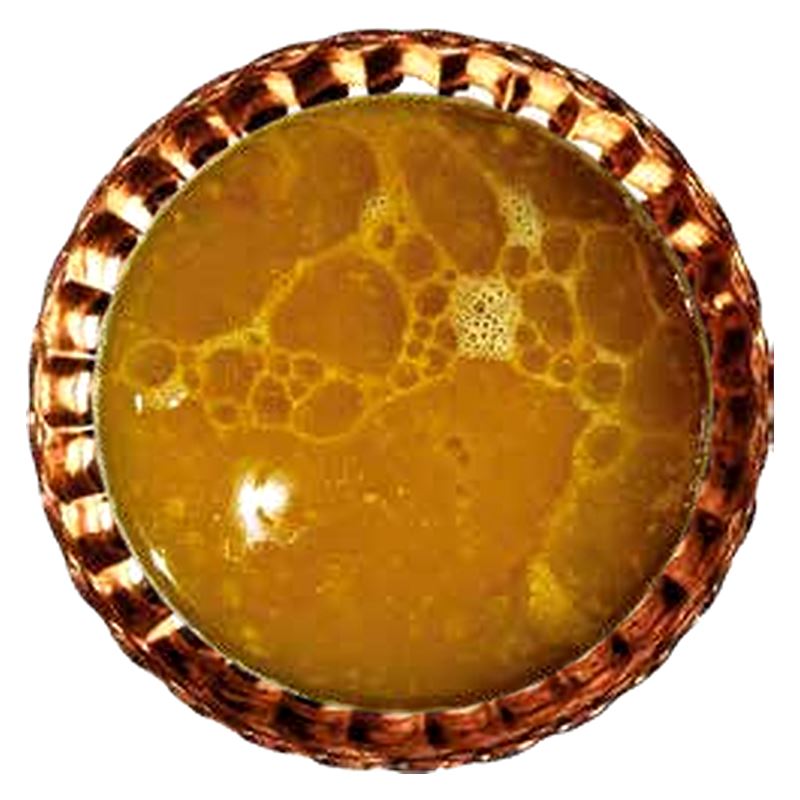
"Does it smell?" is the question that stops a lot of people from ever trying kalle pache, and it is the one they are least likely to ask out loud, because nobody wants to sound rude about a dish other people clearly love. So here is the straight answer: yes. Kalle pache has a real aroma. Anyone who tells you it has no smell is setting you up for a surprise you will meet about three seconds after you lift the lid.
The useful part of the answer is the next sentence. The strongest smell belongs to the cooking, not to the bowl, and the cooking is the part you are not doing when you order. That single fact is why plenty of people who genuinely love this dish stopped making it at home years ago.
How strong is "strong", honestly?
Kalle pache is lamb, the head and the trotters and the cuts around them, simmered for many hours until the broth turns rich and full-bodied. Hours of that in a closed apartment kitchen produce a heavy, meaty smell that settles into curtains and hallways and is still faintly there the next morning. That is the smell people are actually worried about, and they are right to worry about it. It is real.
What reaches you in a bowl is a smaller, later, cleaner version of the same thing. The pot has been strained and finished; what rises is steam carrying the deep savoury note of long-cooked lamb. Warm, meaty, a little sweet at the edges. Present while you eat, and gone not long after you clear the table and open a window.
What does the aroma actually smell like?
Comparisons help more than adjectives, so: it sits in the same family as a serious bone broth or a slow-simmered lamb stock. It is stronger than chicken soup. It is nothing like a strong cheese, nothing sour, nothing fishy, nothing chemical or sharp. It is the smell of meat that has been cooked for a very long time, which is exactly what it is.
If you have eaten a rich lamb stew, or a beef broth that sat on the stove all day, you already know roughly where this lands. If your only reference is the idea of offal, the reality is milder than the idea. That is the pattern we hear most: people brace for something confronting and find a bowl of deeply savoury soup instead. There is more on the flavour side of it in what kalle pache actually tastes like.
Why does some kalle pache smell barnyard-y and some doesn't?
This is the fair version of the worry, and the answer is preparation rather than luck. Most of the heavy, animal edge people associate with offal comes from three fixable things: incomplete cleaning, the scum that rises in the first stage of a long simmer, and holding cooked broth badly afterwards.
A kitchen that cleans and trims thoroughly, blanches and throws that first water away, then keeps skimming the surface as the pot works, produces a broth that reads clean. A kitchen that skips those steps produces something else entirely from the same ingredients. There is no trick to it: patience and repetition, done overnight. Our kitchen at 64 Jumeira Street is open 24 hours a day, every day, which makes this the main job, not a weekend project.
If I order it, will my apartment smell?
A little, briefly, and far less than if you cooked it yourself. Here is the honest split, worry by worry.
| The worry | The honest reality | What helps |
|---|---|---|
| "It will fill my whole flat" | The heavy smell comes from hours of simmering. That happens in our kitchen; what reaches you is a finished, closed, hot container. | Eat near an open window or with the extractor on. The serving aroma clears quickly. |
| "It will linger for days" | Serving aroma fades in hours, not days. Once the empty containers are out of the room, most of the source is gone. | Bin the containers outside, wipe the table, let some fresh air through. |
| "It will smell gamey or barnyard-y" | That edge comes from under-cleaned parts and unskimmed broth, not from the dish. A well-made broth smells clean and savoury. | Start with the broth-forward options and squeeze lemon over the bowl. |
| "My flatmates or colleagues will hate me" | Fair, and worth respecting. It is a noticeable aroma in a shared space, especially an office. | Ask first. Eat in the kitchen rather than at a desk, and keep lids on until you sit down. |
| "I will not get it off my hands" | Trotters and brain are hands-on for some people, so this one is real too. | Bread and cutlery do most of the work; lemon and soap handle the rest. |
| "I will open it and regret it in front of guests" | Unlikely, but a genuine first-time fear. | Start with Soup only, or Meat and Lamb Cheek, the gentlest bowls on the menu. |
What if I would rather it never entered my home at all?
Then don't bring it home. You can collect the order yourself, or reserve a table and eat it with us at 64 Jumeira Street, where the aroma stays in the room it was cooked in. A Kettle of Tea afterwards is dine-in only, which is a small argument for eating in anyway. Both options sit on the website next to delivery.
What do people at the table do about it anyway?
These are habits rather than fixes for a problem. Tables in Iran and across the region have been doing them for generations because they simply taste right: a hard squeeze of lemon over the bowl, Mixed Torshi or Garlic Torshi alongside, fresh chili or pickled green chili for whoever wants the lift, plenty of Sangak Bread to work with, and hot Black Tea afterwards. Honestly, an open window on the far side of the room does more for the air than any of them.
Kalle pache is a rich dish, and how often it suits you depends entirely on you. Nothing here is medical advice and we are not qualified to give any. If you have questions about fat, cholesterol, digestion, or how often something like this fits your diet, please ask your doctor or a registered dietitian.
Is there a version that smells least?
Yes, and it is the one most first-timers should begin with anyway: Soup, the abgoosht broth on its own, by the bowl. It is the same broth without the pieces that make people nervous, and it is the gentlest thing on the aroma front too. After that, Meat (goosht) and Lamb Cheek (bonagoosh) read as ordinary slow-cooked lamb to most people. Brain (maghz), Tripe (sirabi) and Eye (cheshm) have the strongest personality; they are wonderful, and they are simply not where most people begin. The soup-only route and the guide to choosing a single go into it properly.
How do I order without a fuss?
Everything happens on the website. There is no account, no sign-up and no app, just your name and phone number, plus your Dubai area from the list and a pin on the map if you want delivery. You can also choose pickup, or book a table for dine-in. Payment is by secure online card at checkout, and that is the only method. Delivery is free over AED 300. The site is in English, Arabic and Farsi, with a switcher.
Once you have paid, the kitchen confirms the order and sets an estimated time. Your order gets its own page that keeps you updated, and the rider phones you on arrival rather than wandering the building. If the kitchen cannot take an order, it is refunded automatically to the card that paid, with the reason shown on that page. And if you would rather ask a human whether tonight is a good night to start, call 04 321 8882. The phone is the way to reach us, at any hour, because the kitchen does not close.
You can also schedule an order for a future time, up to about two days ahead. Some people use that deliberately, setting it for a moment when the flat is quiet.
The smell is real. The heaviest part of it belongs to a pot that simmers all night, and that pot is ours, not yours.
