Is kalle pache a men's food?
No. It is a breakfast, and breakfast does not have a gender. The picture most people carry — a small shop before sunrise, a room of men eating quickly before work — is a real picture. It is just a picture of an hour rather than of a dish. Change the hour and the room changes with it.
That is the honest answer, and it is the whole answer. But the perception is strong enough to keep people away from a food they would probably like, so the rest of this is about where it came from and what to do if it is the thing standing between you and a bowl.
Where does the men-only picture come from?
Two things feed it, and neither is about taste.
The first is the hour. Kalle pache belongs to the early morning, and the early morning belongs to whoever has to be somewhere by seven. A shop that opens before the working day tends to fill with people whose working day starts then. That is a fact about shift patterns, not about who enjoys lamb broth.
The second is the photograph. The kalle-pazi shop at dawn is one of the scenes people photograph most, and the frame that travels is usually the same one: steam on the window, a tiled counter, a row of men on stools with their coats still on. Far fewer pictures are taken of a family eating the same food around a spread at ten in the morning, so that version of the scene travels much less. We have written about the myths that stick to this dish, and this one is close cousin to all of them.
Does a room of men before work say anything about the food?
It says something about who is awake. A room at five in the morning is made of people whose day has already started or has not yet ended — a shift finishing, a delivery route beginning, someone with an early flight, someone who never went to bed. That is a description of a schedule.
Walk into the same kind of room at a different hour and the crowd is not the same, for the same reason a gym at six and a gym at eight look nothing alike. The kitchen here runs twenty-four hours a day, seven days a week, which means no hour has to be your hour. There are just the hours you might prefer.
Where does the family sofreh fit in?
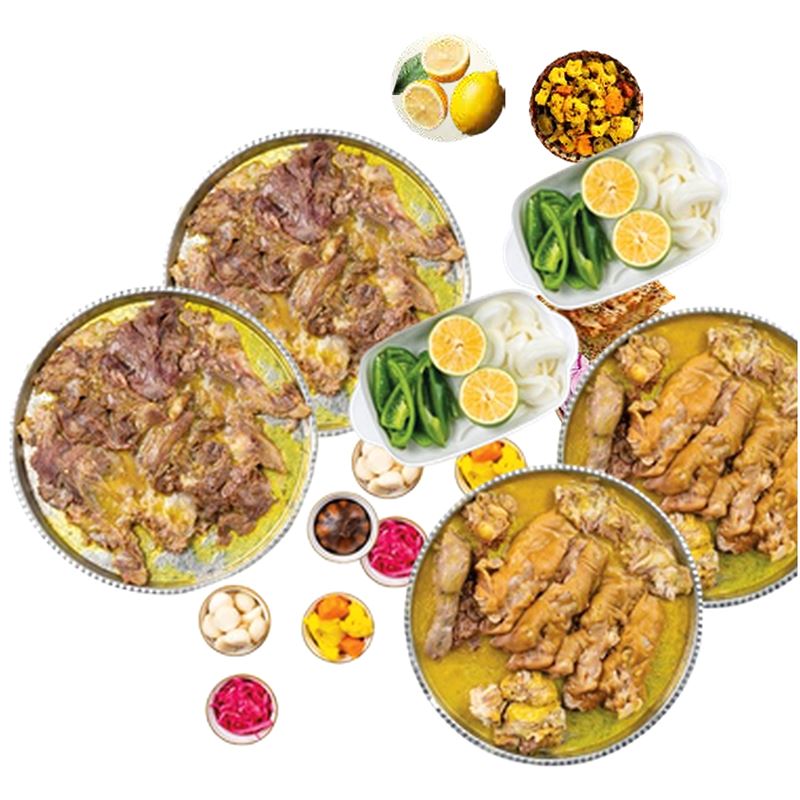
Right in the middle of the picture, where it has always been. Kalle pache is a sofreh dish as much as a shop dish: a spread laid on the table for the whole household, bread torn and passed around, bowls in the middle, the same food in front of everyone sitting there. It is a breakfast families eat together, and nothing at that table is set aside for one half of the room.
That is the half of the tradition the photographs miss. If the shop version is the one you have seen, the table version is worth reading about — how a shared sofreh actually works explains what goes in the middle and how a platter gets divided.
Is there anything about the dish itself that is gendered?
Read the menu and there is nothing to assign. Eye, Brain, Meat, Tongue, Trotters, Tripe, Lamb Cheek, Brain Soup, Soup, Special Mix. Those are parts and textures. Some are rich, some are lean, some are soft enough to eat with a spoon, some have real bite. The only thing being sorted is appetite.
The platters work the same way. Single Dish, Double Dish, The Full Dish and The Khan's Platter are sized by how many people are eating. Nothing on the list is aimed at anybody in particular: the sizes are about headcount and the parts are about appetite, and that is the end of it.
If the perception is what is stopping you, what changes it?
Ordering something mild, in a situation you control. Here is the practical version.
- Start liquid. Soup is the broth with no texture to get past. It is simmered for about fourteen hours, and it is the easiest place to begin. Brain Soup is the richer version of the same idea.
- Then the easy meat. Lamb Cheek and Meat read like ordinary slow-cooked lamb, because that is what they are.
- Bring the sides. Sangak Bread to tear, Mixed Torshi or Garlic Torshi to cut the richness, Tea after. The sides are half the meal, not decoration.
- Leave the rest. Eye, Tongue and Tripe can wait for a second visit, or never happen. Nobody is keeping score.
Who should you come with the first time?
With whoever you already eat other food with. A first bowl goes better with company, mostly because someone else can order and you can taste across the table without committing to a whole dish you are unsure about.
If there are children in the group, they often take to the broth and the bread before anything else — how a gentle first taste works for kids and families covers what to hand a child and how much. If it is two of you, or you are wondering which hour makes the room feel easiest, our honest answer about bringing someone here goes through timing properly rather than repeating it here.
What if you would rather try it away from a dining room?
Then skip the room entirely. The same menu goes out for delivery across 141 Dubai areas, with the fee for your area shown at checkout, and for pickup if you would rather collect it. You can also schedule an order for a future time, including before dawn, so a first taste can happen at your own table with nobody watching.
If you want to eat in, we are at 64 Jumeira Street, Jumeirah 1, open around the clock, and the entrance is wheelchair accessible. The site orders in English, Arabic and Farsi. For anything specific about your visit, call 04 321 8882 and ask.
