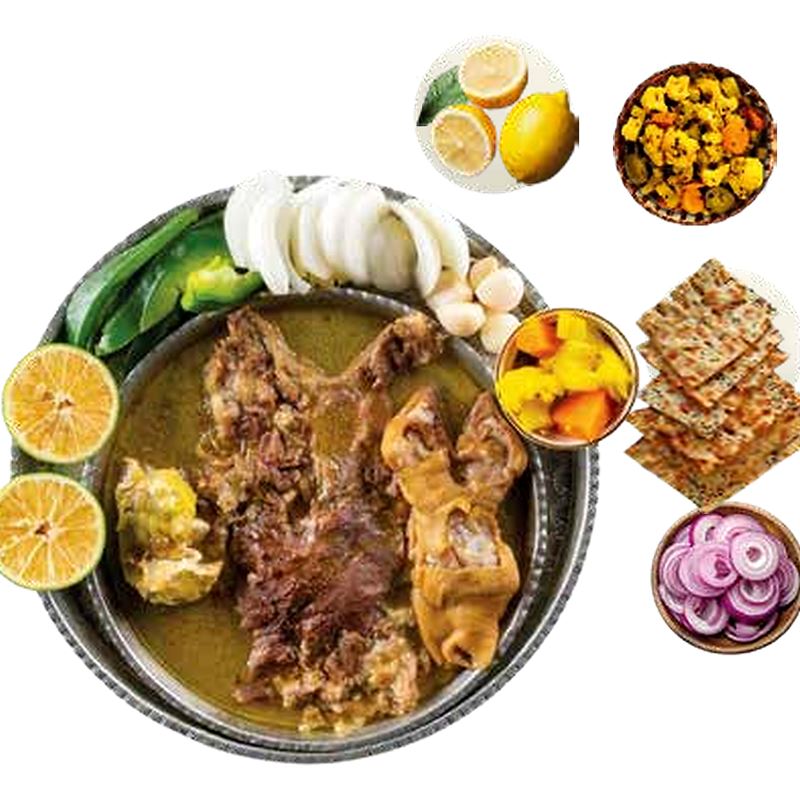
You enjoyed it, you want it again, and then a small voice asks: is this too rich to be eating often? That is a completely fair question, so here is the honest answer at the top — there is no single correct number of times per week, and this article is not going to invent one for you.
Any restaurant that hands you a tidy number is guessing, and a guess about your body is worth nothing. What we can offer instead is what actually helps you decide for yourself: how the dish has traditionally been treated in Iran, what kind of food it honestly is, and how much the portion changes the picture.
This is not medical advice. We cook; we are not doctors or dietitians. If you have any health condition, are pregnant, take medication, or have been told to watch anything in your diet, please ask your doctor or a registered dietitian before making kalle pache a regular habit. Nothing on this page treats, prevents or cures anything.
Can you just tell me how many times a week is fine?
No — and we would be doing you a disservice if we tried. A sensible frequency depends on your age, your health, your medication, how active you are and everything else you eat in a week. None of that is visible from a kitchen. The same plate that sits comfortably in one person's week is a poor idea in another's, and only someone who knows your history can tell you which one you are.
What we will say is that the question itself is a good sign. People who stop to ask it usually already have the instinct that matters: this is a dish worth planning for, not one to drift into by default.
Why has it always been an occasion food in Iran?
Kalle pache is a dawn dish. It simmers all night and is traditionally eaten early — often on a day off, when there is nowhere to be afterwards and a long, slow morning is part of the plan. That rhythm was never designed as a health rule; it grew out of the hours the cooking takes and the shape of the working week. But it leaves behind something useful anyway: for generations this has been food people looked forward to rather than food they ate on autopilot.
None of that is a rule, and it is certainly not a gate. If you want it on a Tuesday afternoon in Dubai, order it on a Tuesday afternoon — our kitchen is open 24 hours and people do order it then. We only mean the traditional rhythm is a sensible guide, and borrowing it costs nothing.
What kind of food is it, honestly?
Plain description, no marketing: it is slow-simmered lamb — head and trotters — and the deep broth they give up over many hours. It is rich. It is fatty in places. It is high in protein and it fills you in a way an ordinary lunch does not. It never pretended to be light, and you should be sceptical of anyone who tells you otherwise. If you want the full picture of what is in the pot, our guide to what kalle pache actually is walks through it.
It is also not one single thing. The broth is one experience; brain is soft and very rich; trotters are gelatinous; tongue and lamb cheek eat much like ordinary tender meat. So the words kalle pache tell you less than the specific bowl in front of you does.
We will not publish fat or cholesterol figures: we do not measure them, and you should not trust a restaurant that pretends it does. If that detail matters, a dietitian is the right person to ask. Again: this is not medical advice.
Does what I order change the answer?
More than anything else does. A bowl of Soup and The Khan's Platter are the same cuisine and completely different meals. Here is a rough map of how the choice shifts the question.
| How you're eating it | What that actually is | What to consider |
|---|---|---|
| Soup only | The abgoosht-style broth, with bread on the side | The smallest way into the dish. Still a rich lamb broth — but a bowl, not a board of parts. |
| One single: Tongue, Lamb Cheek or Meat | One part, one bowl | Eats much like an ordinary portion of tender lamb, and you choose exactly which part. |
| Brain or Eye on its own | The softest, richest parts | Small by nature and very rich; many people take them alongside something leaner. |
| Trotters | Gelatinous, long-cooked, sticky on the lips | Filling out of all proportion to its size. |
| Single Dish or Double Dish | One or two items with bread | A full meal in its own right. Worth a thought about what else the day holds. |
| The Full Dish or The Khan's Platter | Three items, or six — the Khan's is 4 lamb cheeks, 8 trotters, 2 brains, 3 tongues, 4 eyes and 5 breads | Built for a table, not for one person. Sharing is the entire point of it. |
| Late at night, after you have already had dinner | A second meal | The doubling-up matters at least as much as the dish does. |
If you are still working out which bowl suits you, our guide to choosing a single is the shortest route there.
How do people who order regularly pace it?
No prescription here — just patterns we notice, for whatever they are worth.
- They keep it an event. A weekend dawn, a day off, guests in town, the first cool morning of the year. The anticipation is half of it.
- They order smaller mid-week. A bowl of Soup, or one single, instead of a platter. Same dish, different weight. There is a whole piece on the soup-only approach if that appeals.
- They share the big ones. The Full Dish and The Khan's Platter are meant to land in the middle of a table.
- They order sharp things alongside. Mixed Torshi, Garlic Torshi, fresh chili, raw onion. The sourness and the bite cut through the richness on the palate — that is a matter of taste, not a health claim.
- They plan it. A scheduled order for a future time, up to about two days ahead, turns the meal into a plan instead of an impulse.
- They swap it out sometimes. On mornings when they want the ritual but not the richness, there is an Omelette, Sangak Bread and tea.
What if I just love it and that is the whole reason?
Then that is a legitimate reason, and we are not going to lecture you out of it. Food is not only fuel; a dish you look forward to does something a nutrition label cannot describe. The only thing worth watching is the drift — where an occasion quietly becomes a default nobody chose. That is yours to notice, and a professional's to advise on if your health is in the picture.
What if I have not even tried it yet?
Then frequency is not really your question yet. Start light — Soup on its own, or a single you like the sound of — and see how the second time feels before worrying about the tenth. Our first-timer's guide covers the bread, the torshi and the order of operations.
When you decide today is the day
Everything is on the website. There is no account, no sign-up, no password and no app — just your name and phone number, plus your Dubai area from the list and a pin on the map if you want delivery. Payment is by secure online card at checkout, and delivery is free over AED 300.
Once you have paid, the kitchen confirms and sets an estimated time, your order gets its own page to follow, and the rider phones you on arrival. If the kitchen cannot take an order, it is refunded automatically to the card you paid with, and the reason appears on that page. You can also choose pickup or dine-in and reserve a table — the Kettle of Tea is dine-in only.
One kitchen, 64 Jumeira Street, Jumeirah 1, delivering across Dubai, open 24 hours, every day. Questions about an order go to 04 321 8882. Questions about your health go to your doctor or a dietitian — that part we cannot do for you.
