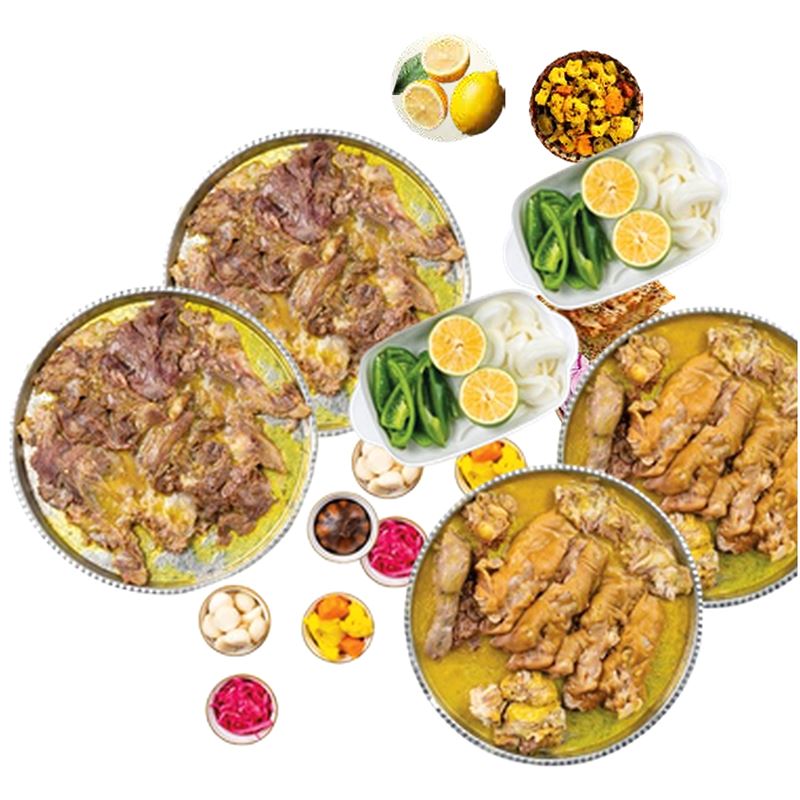
You probably have one kalle pache question you would rather not say out loud. Maybe it is what part of the animal is that, exactly; maybe it is is it rude if I skip the brain; maybe it is the quiet one underneath — will everyone be able to tell I have never eaten this before?
Every one of those is fair. Kalle pache is built out of parts most menus never name out loud, so of course it arrives with a list of things to check first. Here is that list, answered straight — no teasing, and no suggestion that you should already have known.
What parts am I actually eating?
The honest answer in one line: the head and the feet of a lamb, simmered long and slow until the broth turns thick and savoury. Kalle is head, pache is trotters — nothing is hidden in the wording.
The reassuring part: every piece is sold on its own, by the bowl.
- Soup — the abgoosht broth alone, no parts in it.
- Brain (maghz) and Brain Soup — soft and mild, closer to a set custard than to meat.
- Trotters (pacheh) — the feet: silky, gelatinous meat around small bones.
- Tongue (zaban) — lean and firm; the closest to ordinary meat.
- Lamb Cheek (bonagoosh) — tender cheek muscle, easy to like if you enjoy slow-cooked lamb.
- Eye (cheshm) — yes, the eye. Some order it on day one, plenty never do.
- Meat (goosht), Tripe (sirabi) and Special Mix (mojoon) — head meat, stomach lining, and a mixture in one bowl.
There are platters too — Single Dish, Double Dish, The Full Dish and The Khan's Platter, for one, two, three and six — arriving as a set spread. If there is a part you would rather not meet yet, build your order from the singles instead. For the fuller story, read what kalle pache actually is, or the menu guide.
Is it weird that I don't want the brain?
No. It is one of the most common sentences said about this menu: leave it out and order the parts you like. Texture is a real thing, not a character flaw, and plenty of people love the rest of the dish and have never touched it. If you are weighing up the milder parts, the guide to picking a single lays them side by side.
Can I just order the soup?
Yes, and it is a complete order, not a half one. Soup is its own item — not a starter you are expected to upgrade from. Broth, Sangak bread, a little torshi, and you have eaten the heart of the dish without meeting a single part. The soup-only route is written for exactly this.
Do I use a spoon, or bread?
Both, and the order is up to you. The spoon is for broth. The bread does three jobs: you tear it, drop pieces in to soften, and use it to pinch up the softer parts instead of chasing them with cutlery. There is no correct hand position and no rule you can break by accident.
How do I eat it without making a mess?
Partly you don't, and that is not a failure — trotters are sticky by nature, and that gelatin is the point. What helps: sleeves pushed back, napkin on your lap rather than under the bowl, bread torn over the plate, and bread doing the carrying. The first-timer walkthrough goes step by step.
What do I do with the bones?
Put them on the side of your plate, or on a piece of bread if there is no side plate. The meat slides off the small trotter bones once you press, which is why fingers are ordinary here rather than impolite.
Is it rude to leave something on the plate?
No. You are allowed to try one bite, decide it is not for you, and leave the rest; nobody keeps score. Order singles rather than a platter the first time and anything you leave is one small bowl.
Will it be obvious I have never eaten this before?
Maybe — and it matters far less than it feels like right now. Everyone who grew up with this dish was once a guest holding a spoon and hoping for the best; curiosity has never been an embarrassing look. If you would rather practise privately, order delivery and eat at home with nobody watching.
What do I call the parts when I am ordering?
You do not have to pronounce anything. Every item on the website is written out in English, Arabic and Farsi, and you simply tick what you want. If you would rather call 04 321 8882, plain description works perfectly well: "the cheek one", "just the soup", "no brain, please".
Is it too rich for me?
It is a rich, fatty, long-simmered dish and we will not pretend otherwise. Whether it suits you depends on you: your health, your medication, what your doctor has said about fat or cholesterol, and how you feel after heavy food. This is not medical or nutritional advice and we are not qualified to give it — for any health question, ask your doctor or a registered dietitian. We will not tell you how many times a week is fine; that is not a number anyone can hand out from a menu. Practically: Soup alone is the lightest way in, torshi and fresh chili are the traditional companions, and tea afterwards is customary.
Do I have to eat it at dawn?
No. The dawn habit is real and lovely, but it is a custom, not a rule. The kitchen is open 24 hours a day, every day, so kalle pache at three in the afternoon is as legitimate as at sunrise. You can also schedule an order for a future time, up to about two days ahead.
Is the lamb halal?
The lamb is sourced to the UAE halal standard, and that is the honest way to put it. We are not a religious authority and we do not issue rulings about what anyone should or should not eat. If you follow a particular standard of your own, call 04 321 8882 and ask what you need to know before ordering.
The worry, and the plain answer
| What you are quietly worried about | The plain answer |
|---|---|
| "I don't know what I'd be eating." | Head and trotters of lamb, sold part by part. |
| "I don't want the brain." | Then don't order it. Singles force nothing onto your plate. |
| "Can I order only the soup?" | Yes, with Sangak bread — a menu item in its own right. |
| "I'll make a mess." | Some of it is built in. Sleeves up, napkin ready, bread as a tool. |
| "Everyone will know I'm new." | Possibly, and nobody minds. Or eat it at home. |
| "What if I hate it?" | Start with Soup or one single. A small order is a small risk. |
What if I try it and I simply don't like it?
Then you don't like it, and that is allowed. Not every dish is for every person, and offal in particular divides people at the same table. The sensible way to find out is a small order: Soup, or one single such as Lamb Cheek or Tongue, with bread and torshi. If it lands, the rest of the menu is waiting; if it doesn't, you spent one meal answering a question you had carried for years. If offal itself is the hesitation, the gentler way in is worth reading.
How do I order without explaining myself to anyone?
Quietly, from the website. No account, no sign-up, no password and no app — you pick your items, choose delivery, pickup or dine-in, and leave a name and phone number; a table can be reserved for dine-in. For delivery you also pick your Dubai area from the list and drop a pin on the map, because a written Dubai address often isn't enough to find a door. Payment is by secure online card at checkout, and delivery is free over AED 300. The step-by-step ordering guide has the click-by-click version.
After you pay, the kitchen confirms and sets an estimated time. Your order gets its own page, and the rider phones you on arrival. If the kitchen cannot take an order, it is refunded automatically to the card that paid, with the reason shown on that page. And if you would rather ask a person first, 04 321 8882 is the number.
