"It looks too rich for me." If that thought stops you every time, you are not wrong to have it. Kalle pache is a rich dish, and we are not going to argue you out of that. What is worth knowing is that the richness is a dial rather than a fixed setting — and at checkout, you are the one holding it.
How heavy an order feels comes down to three decisions: which parts you choose, how much of them arrives, and what you eat and drink beside them. Change those three and the same kitchen sends you either a loaded platter meant for six, or one bowl of clear broth with warm bread.
One honest note first: nothing on this page is medical advice. We can describe how the dishes taste and how people have traditionally eaten them. We cannot tell you what suits your body, your digestion or your cholesterol, or how often anyone should eat lamb — and we will not put a number on it. For any of that, please ask your doctor or a registered dietitian.
Is it really as heavy as it looks?
Some of it, honestly, yes. The photographs that put people off are almost always of a full platter — brains, trotters, tongue, cheek and eyes together, with a stack of sangak beside them. That is a shared feast laid out for a table. Eaten alone it would be too much.
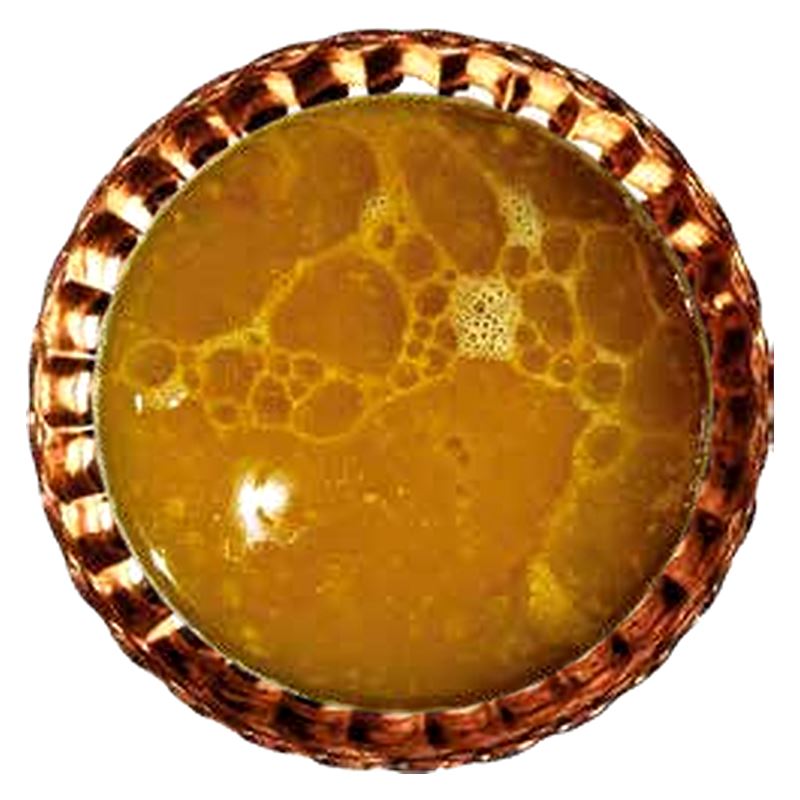
But kalle pache is not one dish. It is a family of them, and here they are sold separately, by the bowl. At one end is the Soup — the abgoosht broth on its own, clear and savoury and spoonable. At the other end are Brain and Trotters, genuinely soft, unctuous and filling. Both live on the same menu. Nobody has to start at the rich end, and nobody is judged for never going there.
Which parts sit at the lighter end of the menu?
What follows is about how these things eat: texture, weight in the mouth, fullness. It is not a nutritional claim or advice about your diet.
Soup is the lightest way in by a distance. It is broth: you drink it, or tear Sangak Bread into it. Plenty of regulars order nothing else, ever. Tongue (zaban) comes sliced and firm, mild and clean-tasting, much closer to a well-braised meat than to anything that will surprise you. Meat (goosht) is exactly what the name says — the lamb from the pot, the most familiar item on the list. Lamb Cheek (bonagoosh) is soft and deeply savoury, somewhere in the middle.
The rich end is easy to name. Brain (maghz) is famously creamy — it melts rather than chews. Trotters (pacheh) are collagen and gelatine, silky and filling. The Special Mix (mojoon) puts several of these in one bowl: a joy if you already love the dish, a lot at once if you are still finding your feet. Tripe and Eye are more questions of texture than of richness.
If this is your first time and heaviness is the worry, the honest suggestion is Soup, or Soup with Tongue. There is a whole piece on starting with the soup alone, and another on choosing between the singles.
Should I order a bowl or a platter?
Portion is the biggest lever of the three, and the one people forget while worrying about ingredients. The platters exist for tables: the Single Dish is one, the Double Dish two, The Full Dish three, and The Khan's Platter is built for around six — four lamb cheeks, eight trotters, two brains, three tongues, four eyes and five breads. There is no light way to eat the Khan's Platter alone, because it was never meant to be.
Ordering one single by the bowl is completely normal. A bowl of Soup and a Sangak is a real order, a common order, and a good one.
Do torshi, onion and the fresh extras actually help?
In terms of taste, yes — this is how the cuisine has always balanced itself. Sharp, acidic, raw things reset your palate between spoonfuls, so the fourth mouthful tastes as bright as the first. That is about flavour, not health, and we will not dress it up as more.
On the website the extras are ticked separately, so you build the balance yourself: Garlic Torshi for a hard, pungent hit of acidity; Mixed Torshi for something gentler; raw Onion for crunch and bite; Capsicum for freshness; Fresh Chili or Pickled Green Chili for heat. Take a small piece every two or three spoonfuls rather than all at the start; spread across the meal it changes everything.
What should I drink alongside?
Doogh — the salted yoghurt drink — is the traditional partner, and it works because it is not sweet. Black Tea or Tea after the bowl is the other classic, and a Kettle of Tea is available in the dining room. Water is never a wrong answer. Lemonade is on the menu and it is lovely, but a sweet drink beside rich food tends to feel cloying — treat it as a refreshment rather than a foil. Again: taste, not health.
Does the time of day change anything?
Traditionally, kalle pache is breakfast, eaten early. Many people say the same bowl feels quite different at eight in the morning than at eleven at night. Whether that is true for you is a question for a professional, not a restaurant — once more, this is not medical advice.
What we can do is make the early version easy. The kitchen is open 24 hours, every day, and the website lets you schedule an order for a future time up to about two days ahead.
Can I just share it?
Yes, and this is how the dish has been eaten all along. Four people around one Full Dish each taste several things without anyone finishing a whole brain alone — the least complicated way to make a rich table feel light.
If you find it too rich, order this instead
| If you find it too rich… | Order this instead | Add this alongside |
|---|---|---|
| The platter looks like too much food | A Single Dish, or one single by the bowl | Sangak Bread and Mixed Torshi |
| Brain feels too soft and creamy | Tongue, or Meat | Garlic Torshi and raw Onion |
| Trotters feel too gelatinous | Soup on its own | Fresh Chili and Capsicum |
| Special Mix is too much at once | One single, chosen on purpose | Pickled Green Chili |
| It feels heavy late at night | The same order, scheduled for morning | Black Tea after, not a sweet drink |
| You want the flavour, not the volume | The Full Dish split three or four ways | Extra Sangak and Doogh |
| You are unsure about offal at all | Soup, plus an Omelette for the table | Mixed Torshi, Doogh, Water |
What does a genuinely light order look like?
The cautious one: a bowl of Soup, one Sangak Bread, Mixed Torshi, a Doogh. The next step up: Soup and Tongue, Sangak, Garlic Torshi and raw Onion, Black Tea after. The shared one: The Full Dish between three, extra Sangak, both torshis and onion on the table. Still hesitating about offal in general? This piece is written for you.
How do I actually place it?
Everything happens on the website. No account, no sign-up, no password and no app — just your name and phone number, plus your Dubai area from the list and a pin on the map for delivery. Payment is by secure online card at checkout, and delivery is free over AED 300. You can also pick up, or dine in, and a table can be reserved.
After you pay, the kitchen confirms and sets an estimated time; the order gets its own page, and the rider phones you on arrival. A rejected order is refunded automatically to the same card, with the reason shown on that page. To ask something first, call 04 321 8882 — the only contact channel we have. The site reads in English, Arabic and Farsi.
A last honest word: if kalle pache still is not for you, that is a reasonable conclusion. But a bowl of broth, warm bread and a piece of garlic torshi is not a heavy meal by anyone's measure — and it is a real order, at any hour, from the kitchen on Jumeira Street.
