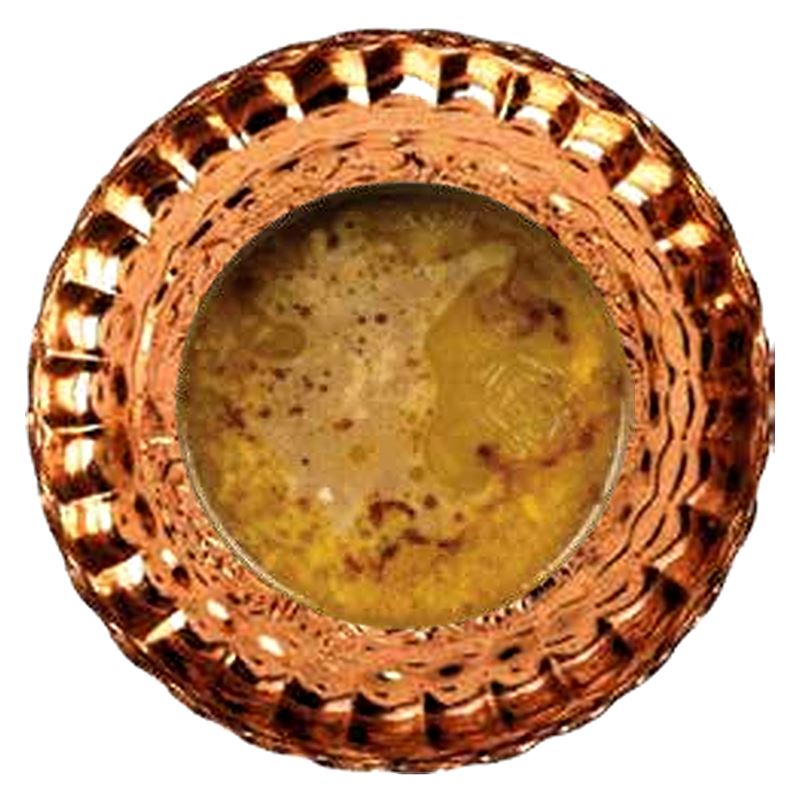
Here is the honest answer before anything else: in the tradition this dish comes from, kalle pache is a dawn meal — eaten early, before a long day of work — not the last thing you put in your stomach before sleeping. Whether a rich bowl at one in the morning suits you is a different question, and not one we can answer: people differ enormously, and none of this is medical advice.
The kitchen at 64 Jumeira Street runs 24 hours, so we will not pretend nobody eats this at midnight. Plenty of people do. What we can do is tell you what the tradition says, describe the food honestly, and offer a sensible middle ground.
Why is kalle pache traditionally eaten at dawn?
The pot decides the hour. The heads and trotters are cleaned and trimmed thoroughly, blanched with that first water thrown away, then simmered for many hours — around fourteen — and skimmed again and again. Whoever is cooking finishes in the small hours, so the food is at its best right as the sky turns. That is why the classic kalle pache house in Iran is a first-light place: it opens early, and people eat before work.
There is a logic beyond the cooking schedule. A bowl like this is heavy, warm and slow to leave you, so it belonged at the start of a demanding day, not the end of it. If you take one signal from this article, take that one: the people who built this dish into their lives ate it at the opposite end of the day from bedtime.
So is it bad to eat kalle pache right before bed?
We will not answer that with a yes or a no, because we genuinely cannot. What we can tell you is that the food is rich. The broth carries real fat, and collagen from bone, skin and trotters dissolves into it over those long hours — that is what gives it body, and what sets the liquid when it cools. Brain and lamb cheek are soft and fatty by nature. This is not a light plate, and nobody should order it expecting one.
How a person handles a rich meal late at night varies enormously — age, habit, what else you ate that day, any condition you may have — and we have no way of knowing any of it. This is not medical advice. If you have a health condition, take medication, or simply want a real answer for your own body, ask your doctor or a registered dietitian, not a restaurant blog. We will not hand you a bedtime, a portion size or a fasting rule dressed up as guidance; those are not ours to give.
Does kalle pache help you sleep, or wreck it?
Neither claim is coming from us. Some people say a warm heavy bowl makes them sleep like a stone; others say the opposite with equal confidence. We will not dress up one night's anecdote as a finding. If sleep is what worries you, that is a conversation for a doctor, not a menu. Again: not medical advice.
What should I order if it is late and I am genuinely hungry?
Now we can be useful. There is a real middle ground between skipping it and ordering The Khan's Platter at 2am, and it is mostly about scale.
Start with the Soup on its own. The abgoosht broth is the lightest way into this food: the flavour is all there, without a plate of dense cuts beside it. We wrote a whole piece on the soup-only route.
If you want the real thing, order a Single Dish rather than a platter. The Double Dish, The Full Dish and The Khan's Platter are built for a table sharing — the Khan's Platter alone is four lamb cheeks, eight trotters, two brains, three tongues, four eyes and five breads. That is a feast, not a late supper for one; this guide walks through the singles.
Reach for torshi and lemon rather than more bread. Mixed torshi and garlic torshi are sharp, and lemon cuts richness the way it is meant to. A second sangak turns a manageable bowl into a very large meal. Tea is the traditional close — the Kettle of Tea is dine-in only, so to your door it is Tea or Black Tea by the cup.
Which order fits my situation?
| Your situation | A sensible order | The honest caveat |
|---|---|---|
| Off a late shift, properly hungry, sleep is a while away | Soup on its own, one sangak, mixed torshi | Still a rich broth. If you are unsure, ask a doctor, not us. |
| It is 1am and you want the real thing, not a feast | A Single Dish, plus torshi and lemon | Still a full plate of dense, fatty food. Eat it slowly. |
| Friends at the table at 2am, nobody sleeping soon | The Full Dish or The Khan's Platter, shared | Built for a group. Split it properly rather than each ordering big. |
| You want to be asleep within the hour | Tea, sangak and torshi — or schedule the real bowl for dawn | What is right for your body is a question for a doctor or dietitian. |
| Night shift: your bedtime is 9am | Whatever you normally eat before sleeping, at your scale | Your body clock is yours. A dietitian who knows your rota beats any article. |
| You want the traditional pattern | Schedule a bowl for dawn | A custom, not a prescription for your health. |
What if my bedtime is nine in the morning?
Dubai runs on night shifts — hospitals, security, airport crews, drivers, hospitality, kitchens. If you finish at eight in the morning and sleep at ten, the whole dawn-versus-midnight framing collapses. The traditional signal is about eating before effort, not about a number on a clock, and your clock has been turned over: a bowl at 8am might be your dinner, or the dawn meal exactly as intended. We will not guess which. People on rotating shifts have the most to gain from asking someone qualified, because the question is about your schedule, not our menu. Not medical advice, and we mean it here most of all.
How does ordering at 3am actually work?
Straightforwardly. Everything happens on the website, at any hour — delivery, pickup or dine-in, and a table can be reserved for dine-in. No account, no sign-up, no password and no app: your name and phone number, plus your Dubai area from the list and a pin on the map for delivery. Both are needed — at 3am, a rider guessing a building helps nobody. Delivery is free over AED 300, and a step-by-step guide spells the flow out.
Payment is by secure online card at checkout, and that is the only method. Once you have paid, the kitchen confirms and sets an estimated time; the order gets its own page you can keep open, and the rider phones you on arrival. If the kitchen cannot take an order, it is refunded automatically to the card that paid, with the reason shown on that page.
And if dawn now sounds better, use scheduled ordering: pick a future time up to about two days ahead, place the order tonight, and have it arrive when you get up. To ask anything, call 04 321 8882 — our only contact channel, answered around the clock. The site is in English, Arabic and Farsi, with a switcher at the top.
Someone at the table does not eat meat — what then?
Be straight with them, because we will be. This is a kalle pache kitchen and there is no vegetarian main course on the menu. The only meat-free items are the Omelette, Sangak Bread, Special Sangak, Mixed Torshi, Garlic Torshi, the vegetable add-ons — capsicum, onion, fresh chili, pickled green chili — and the drinks. We will not promise anything about separate preparation or separate utensils; that is not a claim we can make honestly. If it matters to your guest, phone 04 321 8882 and ask before you order.
The short version
Tradition puts this bowl at dawn, before the day, and that is the most reliable thing anyone can tell you about timing it. If you are hungry at midnight anyway, go smaller rather than bigger — the Soup, or a Single Dish, with torshi and lemon — and leave the rest to your own body and your own doctor. The order page is open, whatever the hour says.
