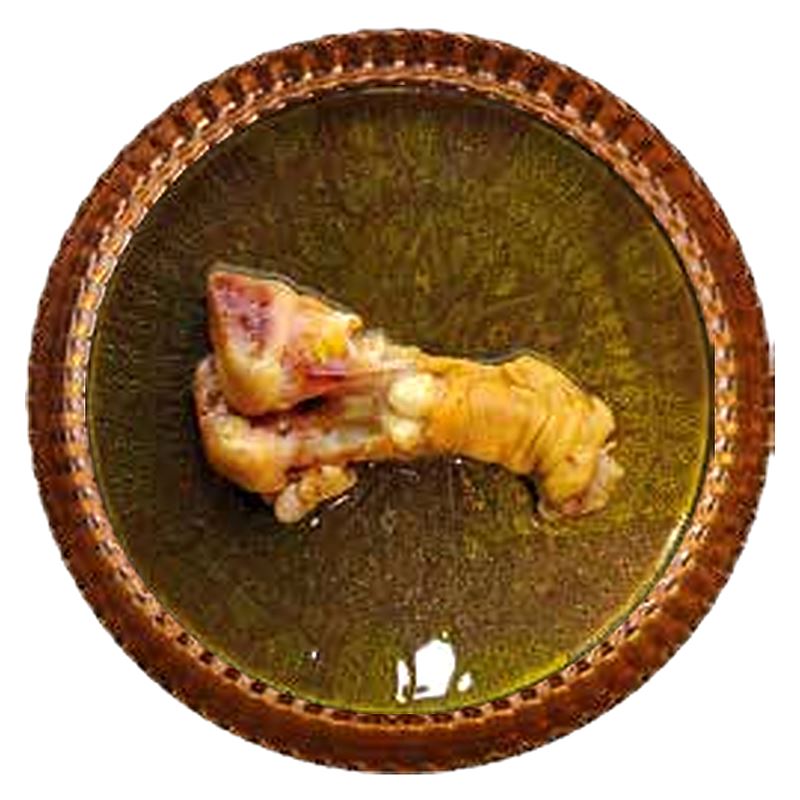
Why do older relatives often finish a bowl of kalle pache when they will not finish anything else?
Ask almost any Iranian family in Dubai living with an elderly parent and you will hear a version of the same story. Appetite goes quiet. Plates come back half full. Then one morning someone brings home kalle pache, and the bowl is empty before the tea is poured. The popularity of kalle pache for seniors is not a small miracle — it has practical reasons, and they are worth understanding.
The dish arrives warm, which matters when a slightly dulled sense of taste and smell makes lukewarm food seem like nothing at all. It is soft, so it asks almost nothing of tired teeth or a sore jaw. It is savoury and aromatic rather than bland, so it registers. It is eaten slowly, with bread, in company, which is how older people eat best. And it is familiar — for someone who grew up in Tehran, Tabriz or Isfahan, this is not a new food to be negotiated but a memory served hot. At Shaun the Sheep on Jumeira Street we pack orders every day that are obviously for a grandparent: one plain soup, a little meat, a piece of sangak. It is one of our favourite kinds of order to make.
Before anything else, one honest note. This article describes a culinary tradition and how to serve it kindly. It is not medical advice, and nothing here treats, prevents or cures a thing. Older adults often live with blood-pressure, kidney, heart, gout or diabetes considerations, and a rich, salted lamb broth is exactly the sort of food a doctor may have an opinion about. Please ask their doctor first, and if there is an allergy or ingredient question, contact us directly rather than guessing.
What is actually in the bowl?
Kalle pache is lamb head and trotters, hand-cleaned before dawn and simmered for around fourteen hours in a copper pot with nothing but onion, turmeric and garlic, skimmed by hand every hour until the broth turns the colour of strong tea. That is the whole seasoning list — no chilli, no heat, nothing sharp on a tired palate or a sensitive stomach. The lamb is halal, as UAE law and standards require. Fourteen hours of gentle heat is also why the texture is what it is: connective tissue has completely surrendered, so the meat falls apart and the broth is thick with the collagen and gelatine that make it cling to a spoon. Every cut and every soup is listed on the menu and order page.
Which parts of kalle pache are easiest to eat with chewing difficulty?
This is the question that decides whether the meal is a pleasure or a struggle, and the answer is refreshingly simple: the soups and the soft parts do all the work.
Plain soup is the gentlest thing on the table — clear, golden, warm and requiring no chewing whatsoever. Tear sangak into it, let it soak for a minute, and even a very tired eater can manage a proper meal. Brain soup is the traditional next step: mild, faintly creamy, and still essentially a liquid. Brain (maghz) itself is soft-set and almost buttery, which makes it the classic choice for someone who cannot chew — although it is also the richest thing in the pot, so a small piece is exactly the point. Lamb cheek (bonagoosh) is the best of the actual meat cuts: fourteen hours of simmering leaves it so tender it collapses under the side of a spoon. Trotters (paye) are silky and gelatinous, easy on the mouth once taken off the bone, though the bone-picking itself can be awkward for stiff hands — ask for the meat pulled off, or serve it from a shared platter yourself.
At the other end, tripe (sirabi) is springy and genuinely chewy, and it is the one part we would leave off an older relative's tray. Tongue (zaban) is smooth and lean but needs slicing thinly and across the grain to be easy; done properly it is fine, done carelessly it is work.
| Part | Texture | Chewing needed | Best for an older relative? |
|---|---|---|---|
| Plain soup | Clear liquid | None | Yes — the safest starting point |
| Brain soup | Liquid, lightly creamy | None | Yes — warming and very gentle |
| Brain (maghz) | Soft-set, almost buttery | Almost none | Yes, in a small piece — it is the richest part |
| Lamb cheek (bonagoosh) | Falls apart under a spoon | Very little | Yes — the easiest true meat |
| Trotters (paye) | Silky and gelatinous | Very little | Yes, once taken off the bone |
| Meat | Soft threads | A little | Usually yes |
| Tongue (zaban) | Smooth and lean | Moderate | Only if sliced thin |
| Tripe (sirabi) | Springy, elastic | The most on the table | Better left aside |
| Sangak bread | Chewy crust, soft crumb | Less once soaked in broth | Yes, softened in the soup |
How should you handle the salt and richness in kalle pache?
Honestly and deliberately, because this is where the dish needs the most care. Kalle pache is a fatty, collagen-heavy broth, and the traditional table around it is salty by design: seven-year garlic pickle is intense and salt-cured, mixed torshi is sharp and brined, and doogh is a salted yoghurt drink, however refreshing it tastes. Any one of these is a pleasure; all four together, in front of someone who has been advised to watch their sodium, is a lot.
Three habits help. First, reach for lemon before salt — acidity brightens a broth and does much of the same job on a fading palate. Go easy on the cinnamon too; it is a seasoning, not a spoonful. Second, let the bowl stand a minute before serving, and lift some of the fat from the surface if the meal is meant to be lighter — the flavour lives in the gelatine, not only in the fat. Third, choose the drink deliberately: hot tea at the end of the meal, or lemonade, if doogh's saltiness is not ideal today.
None of that is a health claim. If their doctor has said something specific about sodium, saturated fat, purines or protein load, the doctor's instruction wins over every sentence in this article.
How much kalle pache is the right amount, and at what hour?
Less than you would serve yourself, and earlier in the day. Appetite in older adults is usually strongest in the morning and fades towards evening, which lines up neatly with the way kalle pache has always been eaten — at dawn, as breakfast. A small bowl of broth, a soft piece or two, and some sangak is a complete meal for someone eating lightly. The trick is to serve modestly and let a second helping be an event: a person who finishes and asks for more has eaten better, and felt better about it, than one who leaves most of a large portion behind.
Practically, that means ordering singles rather than assuming a communal platter, or taking a one-person platter and dividing it. Our communal platters come sized for one, two, three or six people, so a family weekend can be one big platter for the table plus a plain soup set aside for the grandparent — which is exactly how it works in Tehran, where the eldest at the sofreh is served first, and served gently.
Why does a familiar dish matter so much for an Iranian parent far from home?
Because at a certain age, food stops being only nutrition and becomes an address. An elderly parent who moved to Dubai to be near their children is often surrounded by a language they half-speak, a street plan they do not know, and a kitchen full of somebody else's ideas. Then a bowl of kalle pache arrives, smelling of a Tehran morning, and something clicks back into place. They know how to eat this. They know which part they like. They will tell you — at length, and with authority — about a place near their old neighbourhood that did it better in 1974.
That reversal is the real gift. At the table with kalle pache, the oldest person is not the one being cared for; they are the expert, the one who knows how to break the sangak and how much lemon is correct. If you want a reason to order it for a grandparent beyond protein and softness, that is the one.
How do you arrange it in Dubai without tiring anyone out?
We are at 64 Jumeira Street, Jumeirah 1, and we are open 24 hours a day, seven days a week — which suits older people who wake at five and are hungry by six far better than a restaurant that opens at noon. If travelling is tiring, we deliver across Dubai with the fee chosen by area at checkout, and pickup is available if you would rather collect on the way home. Soup travels well: reheat it gently to steaming rather than boiling, and add the lemon at the table.
If it is a family occasion, reserve a table so nobody has to stand and wait, or simply order from the menu and start with one plain soup and a warm sangak. And one last time, because it matters: for anything to do with their health, ask their doctor. We will handle the fourteen hours in the copper pot.
