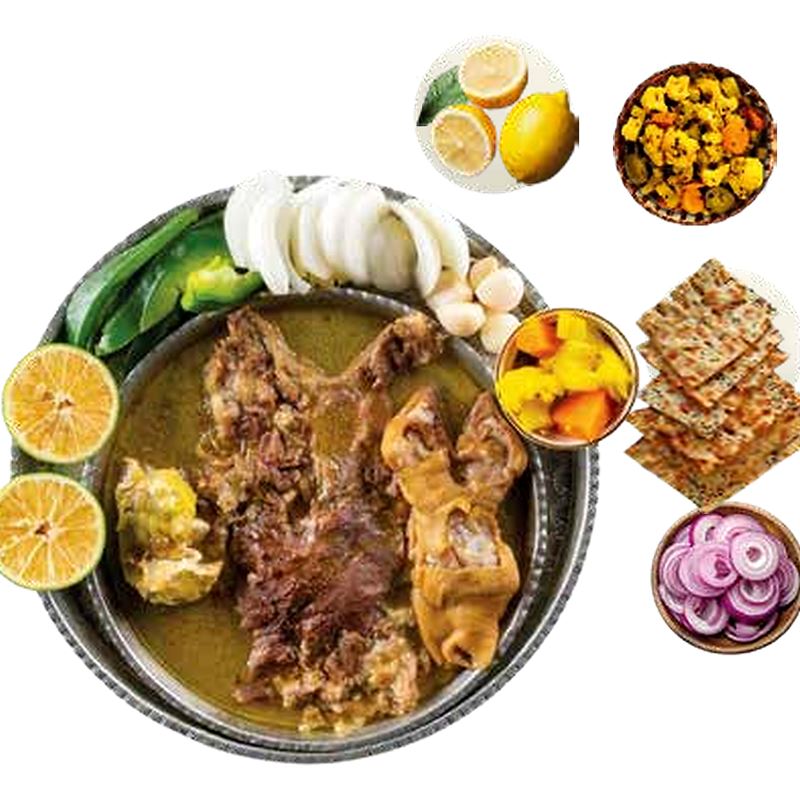
If you try kalle pache and you don't like it, then you don't like it — and that is a completely normal outcome, not a failure of taste on anybody's part. It is a strong, specific food that has divided tables for a long time, and the only real mistake is discovering your opinion through a large order: the sensible way to test it is the Soup on its own or a Single Dish, not the Khan's Platter for six people who have never tried it.
This is the honest version of a question restaurant websites usually dodge.
Is it normal to dislike kalle pache?
Yes, and nobody who grew up with it would be surprised. This is head and trotters simmered for about fourteen hours and skimmed again and again, until the bones give up everything they have. It is eaten at dawn, unapologetically savoury and rich. Food with that much character is never universally loved — even where it is a weekly tradition, someone at the table is usually having bread and tea instead.
Disliking it does not mean you have a narrow palate, and liking it does not make anyone a connoisseur; it is a question of what your mouth is used to.
Plainly: none of this is medical advice. If you have a health condition or a specific diet, ask your doctor or a dietitian before ordering rich food.
Is it the flavour or the texture that puts people off?
Almost always the texture. The flavour surprises people by being gentle: a long-cooked lamb broth, deeply savoury, not the assault first-timers brace for. What people react to is the mouthfeel — and the parts differ enormously.
- Brain (maghz) — soft and custardy; it dissolves rather than chews. The most divisive thing here.
- Trotters (pacheh) — gelatinous, sticky enough to coat your lips. That stickiness is collagen and it is the point, but unfamiliar to many.
- Tripe (sirabi) — springy, a bite that takes a few encounters to enjoy.
- Tongue (zaban) — firm, slices cleanly, tastes like good slow-cooked meat. The gentlest landing.
- Lamb cheek (bonagoosh) and Meat (goosht) — tender and familiar, closest to an ordinary braise.
- Eye (cheshm) — for most people the hesitation is the idea, not the taste.
So "I don't like kalle pache" very often means "I don't like brain". Knowing which part put you off is worth more than any general verdict: Tongue and Meat sit at the opposite end of the range from Brain. There is a texture guide and a piece on what it tastes like.
Plenty of people in Dubai know head-and-trotter dishes from other cuisines and arrive with an opinion already formed. Those dishes have their own cooks, traditions and devoted followers, and deserve that respect — we do not serve them. We cook Iranian kalle pache. The family resemblance is real, but seasoning and cuts differ from one tradition to the next, so a verdict on one does not carry over.
What put you off — and what should you try instead?
| What put you off | What is probably going on | What to try instead |
|---|---|---|
| Brain — too soft, too rich | Texture, not flavour: it melts instead of chewing | Tongue or Meat on their own |
| Trotters — sticky, coats the lips | Collagen doing what collagen does | Lamb Cheek or Meat; or the Soup by itself |
| Tripe — too chewy | A springy bite most people grow into | Lamb Cheek — tender, closest to a braise |
| The eye — the idea of it | Squeamishness rather than taste | Leave it out; nothing depends on it |
| Too rich overall | The fat arrived faster than you expected | Soup only, with torshi, onion and sangak |
| Too much at once | A six-part platter is a big first meeting | A Single Dish — one part, properly tasted |
| It had gone thick and jelly-like | Collagen sets as the broth cools; a sign of a long simmer | Eat it hot, soon after it reaches you |
| The aroma when the lid came off | It is most assertive in the first moment | Have bread, torshi and lemon within reach |
What is the smallest way to find out if it is for you?
Start small, deliberately. The Soup — broth on its own — is the lowest-commitment way in: the whole flavour of the pot, none of the textures that trip people up. Add Sangak and you have a real meal to judge it by; there is a piece on starting with soup only.
If broth alone feels too plain, a Single Dish gives you one part to meet properly instead of six to survive. Choose the one you are curious about, not the one you feel you ought to conquer; our guide to the singles walks through it. Two curious people can share one bowl and one bread.
Leave The Khan's Platter — four lamb cheeks, eight trotters, two brains, three tongues, four eyes, five breads — for the day you know you like this. Magnificent in front of people who do; a lot of food to be unsure about.
What changes the experience for most people?
Small things, and they matter more here than with most food.
- Bread, and plenty of it. Sangak is not a side; it is the cutlery, the sponge and the counterweight. Special Sangak exists, and extra Sangak is ticked separately.
- Something sharp. Mixed Torshi or Garlic Torshi cuts the richness between spoonfuls, and a squeeze of lemon is the classic move.
- Raw onion and chilli. Onion, Fresh Chili, Pickled Green Chili and Capsicum are extras you tick at checkout; raw onion does more for a rich bowl than people expect.
- Hot and early. This is at its best straight away, so order it for a moment when you can actually sit down.
- Drink with it. Doogh alongside, tea afterwards. A Kettle of Tea is dine-in only.
Does it get better the second time?
Often, yes. Much of the first bowl is spent processing what is happening; the second is judged on its own terms, and plenty of hesitant first-timers became regulars. But there is no obligation — a second try you are dreading is not worth making.
What if you order it and simply do not enjoy it?
The straight answer: there is no returns process for a matter of taste. Payment is a secure online card payment taken at checkout, and "it wasn't for me" is not something a kitchen can undo. Better to say so plainly — and it is why a small first order is genuine advice, not a sales line.
One situation is different: if the kitchen cannot accept your order, it is refunded automatically to the card that paid, with the reason shown on your order page. That is about the kitchen being unable to fulfil an order, not your opinion of the food.
What if something is actually wrong with the order?
That is a different matter, and it should be put right. A missing item, the wrong item, something clearly not as it should be — phone 04 321 8882, our only contact channel, with your name and the number you ordered with to hand. Use it before ordering too, to ask what comes with a dish or anything about paying: thirty seconds on the phone beats a bowl you regret.
How do you place a small first order?
Everything starts on the menu and ordering page. Choose delivery, pickup or dine-in — a table can be reserved if you would rather try it here at 64 Jumeira Street, Jumeirah 1. There is no account, no sign-up and no app: your name and phone number, plus the Dubai area from the list and a pin on the map if it is coming to you — both are needed, so the rider is never guessing.
Payment is by secure online card at checkout — the only method. Delivery is free over AED 300; a cautious first order will not come close, which is fine. Once you have paid, the kitchen confirms and sets an estimated time, your order gets its own page, and the rider phones the number on the order when they arrive. You can also schedule an order up to about two days ahead.
We are one kitchen in Jumeirah 1, open 24 hours, every day, delivering across Dubai, and the site reads in English, Arabic or Farsi. Try a small bowl. If it is your food, you will know within three spoonfuls; if not, you found out with a small order — a perfectly good result too.
