What is the tripe in kalle pache, and which part of the animal is it?
Tripe is the lining of the lamb's stomach. In Persian it is sirabi, in Gulf Arabic kirsha, and on a Tehran table it usually turns up alongside its close relative shirdan. Lift a piece out of the bowl and you see why everyone talks about it more than anything else on the plate: pale, ridged, patterned like a honeycomb.
That pattern is not decoration: the ridges hold the broth, which is why a piece of sirabi arrives already tasting of the pot it came from. It is also why the real question is never about flavour. Nobody worries that tripe will taste too strong. They worry that it will chew back.
Is lamb tripe chewy, and what does the bite actually feel like?
Yes, tripe has a bite; pretending otherwise would only spoil your first mouthful. But well-cooked sirabi is springy rather than tough. Press a piece against the roof of your mouth and it gives; bite down and there is a soft resistance, a gentle rebound, then it yields. Three or four chews and it is gone.
For a reference point, think of a properly cooked squid ring, or the stem of a firm mushroom: resistance that is part of the pleasure rather than an obstacle to it. People who dislike soft, falling-apart food often find tripe is the part of the platter they like best.
The flavour, by contrast, is the mild half. Sirabi is clean and faintly savoury with a soft milky note, and because it behaves like a sponge it carries the broth it sat in: onion, turmeric and garlic. Cleaned properly there is no gaminess at all, and there is no chili heat anywhere in kalle pache.
Why does tripe sometimes turn out rubbery, and what makes the difference?
Rubbery tripe is real, and anyone who has met it once remembers it. But rubberiness is not what tripe is; it is what tripe does when something has gone wrong.
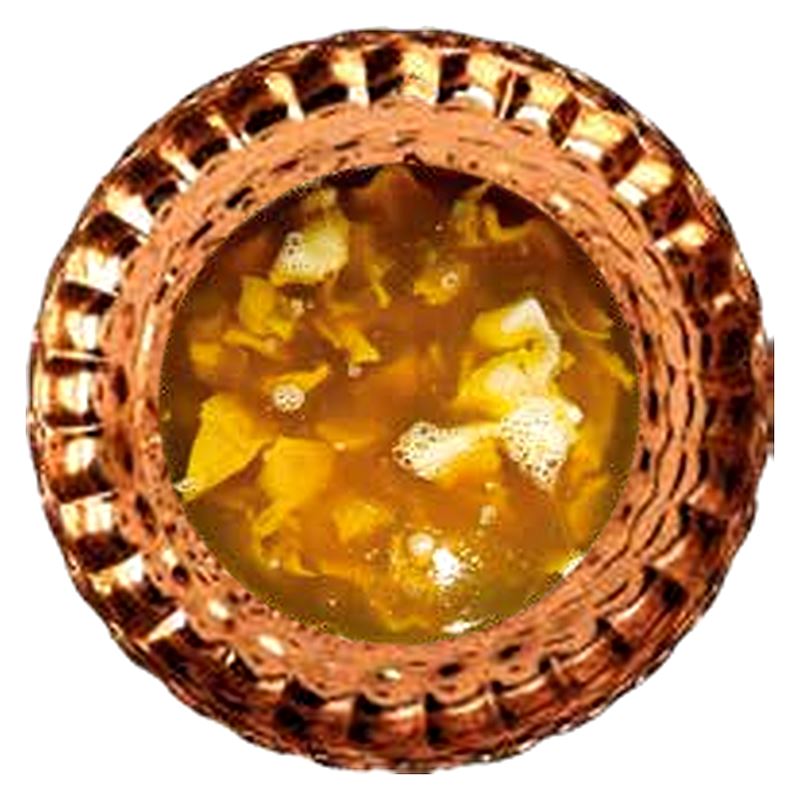
The main thing is time. Tripe is dense connective tissue and needs hours of gentle heat before it relaxes. In our kitchen the lamb simmers in a copper pot with onion, turmeric and garlic for about fourteen hours, skimmed through the night until the broth is the colour of strong tea. Rushed through a short cook, tripe stays tight and bouncy in the unpleasant way; given the full night it softens into a tender, yielding chew that keeps just enough spring.
| Feels rubbery when… | Feels tender and springy when… |
|---|---|
| The cook was rushed | It simmered slowly for about fourteen hours |
| It goes cold on a dry plate | It stays in the hot broth until you eat it |
| You bite at a whole piece | It is cut bite-sized first |
| You cut along the ridges | You cut across them into short strips |
The short version: hot, small, and cut across. Get those three right and rubbery does not happen.
How do you cut and eat sirabi at the table?
Cut first, then eat. Take a piece of sirabi from the broth and cut it across the honeycomb ridges into short strips, about the size of your thumbnail. Lifting a whole piece and biting into it is what creates the impression of a chewy food; a small cut piece is simply a springy mouthful.
Then keep it wet: sirabi is at its best in the broth, not beside it — on a dry plate it cools and tightens within minutes. Spoon broth over the pieces, tear a corner of warm sangak, and fold a strip of tripe into the bread with a shred of meat, so soft and springy land in the same bite. Season gradually: a squeeze of lime, a little crushed garlic, a pinch of cinnamon, salt to taste. The lime lifts and freshens the bite, and it is the step first-timers most often forget. Our seasoning guide goes further, and the sides guide covers sangak, torshi and doogh.
How does tripe compare with the meat, brain and trotters on the same platter?
| Part | How it feels in the mouth |
|---|---|
| Tripe (sirabi) | Springy, with a clean and satisfying chew |
| Meat | Soft shreds that come apart on the spoon |
| Tongue | Firm and sliceable, like a slow-cooked roast |
| Brain | Very soft and creamy, almost custard-like |
| Trotters | Silky and gelatinous, glossy and rich |
| Soup | Warm, savoury and entirely liquid |
Tripe is best understood in company: a kalle pache spread is deliberately a range of textures, and sirabi sits at the firm end. Brain and trotters are soft and rich; tripe is the counterweight. A bowl of only the soft parts can feel one-note by the end, whereas a few pieces of sirabi give you something to bite against between spoonfuls. Our fuller texture guide covers every part the same way.
How much tripe should you order the first time?
Less than you would think. Two or three pieces tell you everything, and most people decide by the second mouthful.
So the sensible first order is tripe as part of something else. The special mix puts a little of several parts in front of you at once, so sirabi arrives with tongue and meat beside it; a 3-person or 6-person platter does the same at a larger scale, and our guide to how much to order per person helps with quantities. If the chew is not for you, order meat, tongue and soup next time: a complete traditional bowl with no texture you did not enjoy.
Should you order it on its own, in the special mix, or on a platter?
- On its own — if you already know you like tripe, from a Persian kitchen at home or from tripe soups elsewhere in the world.
- In the special mix — if you are curious but undecided. The right answer for most first-timers, and what regulars suggest when asked.
- On a platter — if you are eating with family or friends. Sharing is how this dish is meant to be eaten.
Whichever you choose, the tripe is the same: cleaned by hand until spotless and pale, simmered through the night, served hot in its own broth. Our full sirabi guide covers how it is prepared, and how to eat kalle pache for the first time covers the rest of the table.
Order sirabi for delivery across Dubai, collect it yourself, or eat it at the table where it is hottest — and you can pick a future time when you order. Browse the menu and order page, reserve a table, or call +971 4 321 8882 and let us cut your first piece for you. We are at 64 Jumeira Street, Jumeirah 1, open 24 hours a day, seven days a week, and the lamb is halal in line with UAE law and standards.
