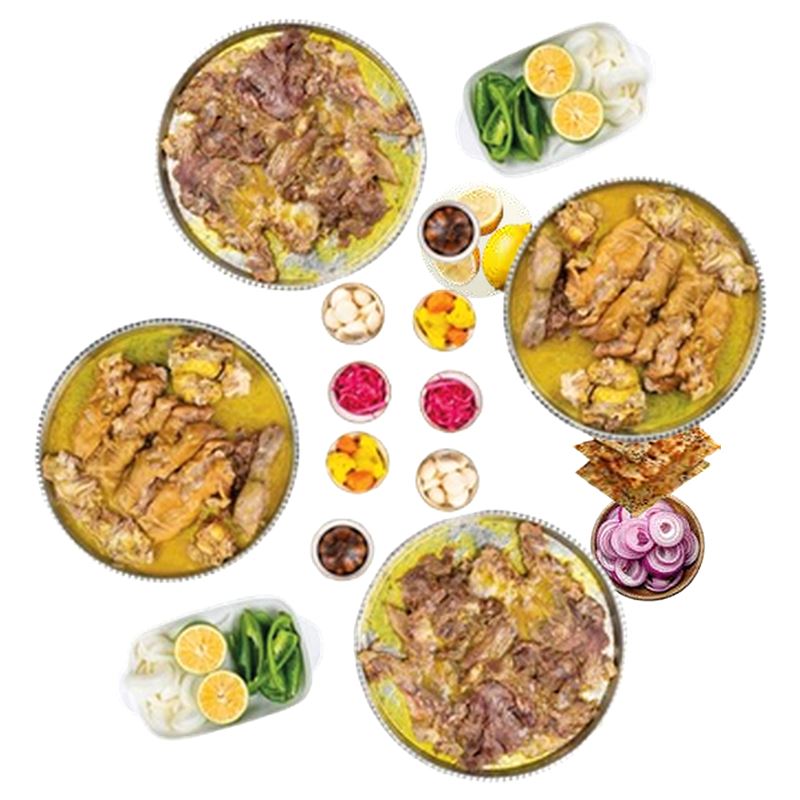
How much kalle pache should I order per person?
If you are wondering how much kalle pache to order per person, the working rule is short: one platter portion per person, one sangak per person, one torshi shared between two, and one doogh each — then add a little extra bread and a bowl of plain broth as insurance. At Shaun the Sheep, 64 Jumeira Street, Jumeirah 1, the communal platters are already sized by head count — 1, 2, 3 and 6 people — so most of the arithmetic is done for you. What is left is knowing your own table.
Kalle pache does not fill you the way a mixed grill does. The broth is deep and gelatinous and it satisfies faster than people expect, and half the pleasure of the meal is bread soaked in soup rather than meat on a fork. In practice, big eaters often finish less than they planned, while first-timers pick carefully around the cuts but go through bread and broth quickly. Order for that pattern and nobody leaves the table hungry.
Which platter size fits 1, 2, 3 or 6 people?
Our platters are portioned by head count rather than by weight — the traditional way a Tehran kalle pache house lays a sofreh:
- 1-person platter — a full breakfast for one guest: a share of the head cuts and trotters with broth. Right for a solo dawn meal or an order after a night shift.
- 2-person platter — the most common home order. Enough for a couple, or for one very hungry regular who likes something left for the next morning.
- 3-person platter — the family size. It stretches to four if two of them are children or light eaters, especially with an extra sangak.
- 6-person platter — the sharing platter proper, built for a table where everyone reaches into the middle. Most gatherings should start here.
The simplest way to scale is to count in sixes and top up: six guests, one 6-person platter; nine guests, a 6 plus a 3; twelve guests, two 6-person platters. Then adjust for appetite.
How do different appetites change the order?
Three kinds of eaters usually sit at the same table, and each one moves the numbers:
- The regulars. People who grew up on kalle pache eat the whole spectrum — brain (maghz), tongue (zaban), trotters (paye), lamb cheek (bonagoosh) — and they eat generously. Count a full platter portion each and expect a request for more broth.
- The curious. First-timers taste a little of everything and settle on one favourite, most often tongue or cheek. They eat around two-thirds of a portion but more bread than average. A Special Mix lets them sample without committing to a whole cut.
- The cautious. Guests unsure about the richer cuts are perfectly happy with plain soup or brain soup, bread and pickles. Half a portion plus a bowl of soup covers them.
If your table leans hungry, size up rather than down. Kalle pache reheats gently, and a covered container of broth is a welcome thing to find in the fridge the next morning.
How many sangak breads, and how much torshi and doogh?
Bread is not a side here, it is cutlery. Sangak is what you tear, fold, dip and use to lift the softer cuts, so under-ordering bread is the single most common mistake. Plan one sangak per person as the floor, then add one extra bread for every three guests. If your group is bread-forward, make part of the order special sangak — it carries the richer cuts well.
Mixed torshi resets the palate between rich mouthfuls, so one portion comfortably serves two people. The seven-year garlic pickle is stronger and slower: one small portion per three or four guests is plenty, because most people take a single clove and stop. Doogh should be one glass per person if your table drinks it — salted and cooling, it cuts the richness better than water does. Tea comes at the end, one pot for every three or four people, and it is the part of the meal that keeps everyone sitting and talking.
What should I order for a majlis or party of 10 to 20?
Use this grid as a starting point, then adjust for how well your guests know the dish:
| Guests | Platters | Sangak | Torshi & garlic pickle | Doogh |
|---|---|---|---|---|
| 1 | 1-person platter | 1 | 1 mixed torshi | 1 |
| 2 | 2-person platter | 2 | 1 mixed torshi | 2 |
| 3–4 | 3-person platter | 4 | 2 torshi | 3–4 |
| 6 | 6-person platter | 7 | 3 torshi + 1 garlic | 6 |
| 8–10 | 6-person + 3-person | 11 | 5 torshi + 3 garlic | 10 |
| 12–15 | Two 6-person + one 3-person | 17 | 7 torshi + 4 garlic | 15 |
| 16–20 | Three 6-person + one 2-person | 22 | 10 torshi + 5 garlic | 20 |
For twenty guests, three 6-person platters plus a 2-person platter is the cleanest combination, with a generous stack of sangak and two extra bowls of plain broth so latecomers are never served an empty ladle. If half your guests are new to kalle pache, swap one platter for singles — extra tongue, lamb cheek and meat — because those are the cuts that convert newcomers.
What should I add so nobody is short?
Three insurance items, in order of usefulness: extra sangak, extra plain soup, and a Special Mix. Bread is the first thing to run out; plain broth stretches the meal for anyone still hungry; and the Special Mix gives variety without gambling a whole platter on one cut. Together they cover almost every surprise, including the guest who arrives with a friend, and they cost far less than over-ordering platters.
Because the kitchen runs 24 hours a day, 7 days a week, timing is flexible — dawn, lunch, or three in the morning. For a large order, place it a little ahead so the platters are ready together and arrive hot; you can also schedule it for a set time. Build your order on the menu and order page and choose delivery (the fee is set by your Dubai area at checkout), pickup, or reserve a table for a dine-in gathering. The lamb is halal, as UAE law and standards require, and the broth has been simmering in a copper pot with onion, turmeric and garlic since before dawn — skimmed hourly until it turns the colour of strong tea.
One note of common sense: kalle pache is a rich traditional dish, and this guide is about portions and hospitality, not health advice. It is not medical advice. If you have a specific dietary or medical condition, ask your doctor what suits you.
