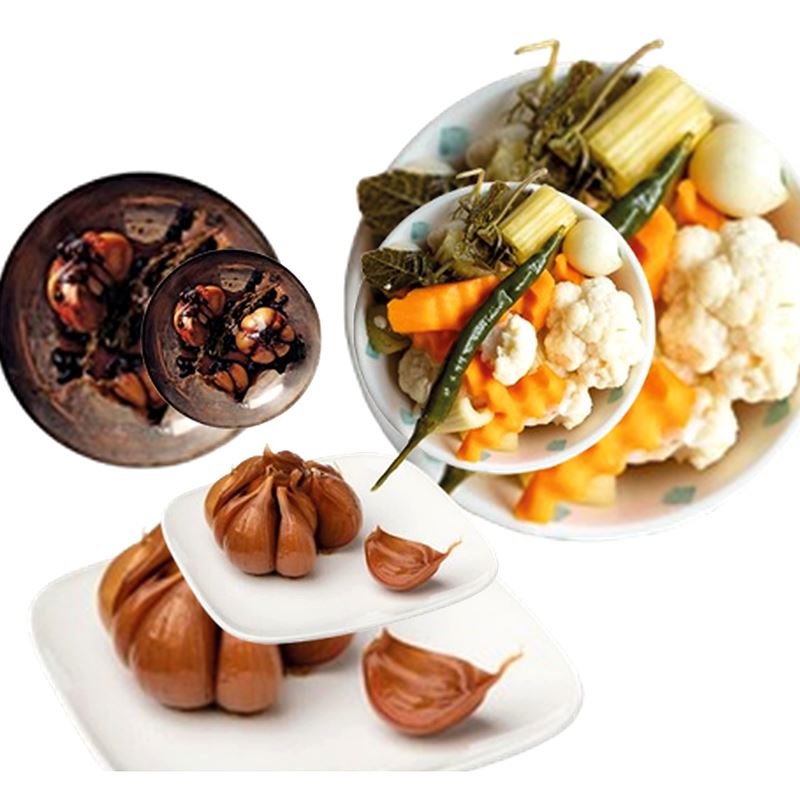
What is the difference between seer torshi and mixed torshi?
Both jars are torshi, the Persian family of vegetables kept in vinegar, but they are built on opposite principles. Seer torshi is one ingredient taken as far as it will go: whole heads of garlic, submerged and left alone for years while the vinegar works. Mixed torshi is the opposite instinct, a chopped crowd of vegetables and herbs packed young and eaten while they still snap.
| Quality | Seer torshi (aged garlic) | Mixed torshi |
|---|---|---|
| Colour | Amber through to a brown so deep it reads as black | Pale greens and creams, flecked with herb |
| Texture | Soft and yielding, closer to a soft date than a pickle | Crisp, wet, audible |
| First taste | Deep vinegar sourness, warm garlic behind it | Bright acidity, then crunch, then a green herbal note |
| How it cuts richness | By depth: a long sour line that runs under the broth | By contrast: a short sharp reset between mouthfuls |
What does aged garlic torshi taste like next to the mixed jar?
Aged garlic surprises almost everyone the first time. You brace for the burn of a raw clove and get something else entirely. Years in vinegar darken the cloves from ivory to amber to near black and soften them until they give way under a fork with no crunch at all. What age takes away is the raw heat. What it leaves is a deep, tangy, savoury sourness with the garlic humming warm underneath — strong without ever being harsh. It is why regulars call this pickle punchy and first-timers call it gentle, and why both are describing the same clove.
The mixed jar arrives from the other direction. Acidity lands first and lands hard, then the crunch, then a green herbal note behind it. Where the garlic is a long low note held under the whole meal, mixed torshi is a short sharp tap that ends cleanly and leaves your mouth ready for the next spoonful.
Which one cuts the richness better, and why does sourness help at all?
Kalle pache is one of the richest things a Persian kitchen makes. Lamb head and trotters simmer for hours until the broth is thick with gelatin, and after several spoonfuls that richness coats the tongue: the fifth mouthful stops tasting like the first. Sourness cuts that coating and hands your palate back, which is why an Iranian table never sends out a bowl this heavy without something acidic beside it.
Both jars do that job. What differs is how. Mixed torshi cuts by contrast: cold, sharp and crunchy against hot soft broth, a clean break between mouthfuls that resets the palate in a second. Seer torshi cuts by depth: the sourness is longer and rounder, and rather than interrupting the broth it lays a savoury line underneath it that keeps the whole bowl from turning heavy. The richer the plate — brain, meat and fat, trotters — the more you want at least one of them within reach.
Which should a first-timer choose, and which do longtime eaters reach for?
If this is your first bowl, order the mixed torshi. It behaves like pickles you have met before, and it does the one thing a beginner needs: keeping a rich unfamiliar dish tasting bright all the way to the bottom. A first visit asks plenty of you already, and the pickle should not be another thing to get used to.
The regulars go the other way. People who have eaten this dish since childhood ask for the seer torshi by name, and often push a clove into the broth or take it off the fork between mouthfuls of tongue. It is an acquired pleasure, and the taste that marks out someone who knows the dish. If you are two and even slightly curious, order both and compare them across one meal.
How much torshi do you need, and should a shared table order both?
Less than people expect. Torshi is punctuation, not a course. One person working through a single bowl usually eats a handful of forkfuls of mixed torshi and perhaps a clove or two of aged garlic across the whole meal, so one side dish covers one or two people comfortably. The common mistake is over-ordering: four dishes for four people leaves most of it untouched, because the rate at which you reach for it slows as the bowl empties. Appetites vary, so treat that as a starting point rather than a rule.
For three or more, order both: two small dishes cover more of the table than one large one, and give everyone a choice.
| Table size | Sensible order |
|---|---|
| One person | One torshi: mixed if you are new, seer if you know you like it |
| Two people | One of each, shared — the best way to compare them |
| Three to four | Both, with the mixed nearer the heaviest plates |
| Six | Two dishes of mixed and one of seer, spread down the table |
Placement matters. Put the mixed torshi where the richest plates are and the garlic somewhere central, and give each person their own fork so nobody reaches across a hot bowl. Torshi is eaten beside the broth rather than stirred into it — the exception being the spoonful of garlic liquid some regulars add to a plain soup, worth trying once. Both also travel well, arriving from delivery or pickup with acidity and crunch intact.
Does the same torshi suit soup, the platters and dizi?
No, and matching the pickle to what is in front of you is where this small decision pays off.
| What you ordered | What suits it |
|---|---|
| Soup or brain soup alone | Seer torshi — the bowl is gentle, and mixed torshi shouts over it |
| Single or double dish | One of each if sharing; mixed torshi if choosing one |
| Brain, meat and fat, trotters | Mixed torshi, kept close — these need resetting most |
| Tongue or meat | Seer torshi — a soft clove with a slice of tongue is a classic |
| Deezi (dizi) | Mixed torshi, near compulsory once the meat is mashed |
Our guide to seven-year garlic torshi goes deeper into the ageing itself, and sides for kalle pache covers sangak and doogh alongside them.
Where can you order torshi with kalle pache in Dubai?
At Shaun the Sheep, 64 Jumeira Street, Jumeirah 1, both seer torshi and mixed torshi sit on the menu beside every cut, from plain soup and trotters to tongue, the special mix and the platters for three or six. The lamb is halal, the kitchen runs twenty-four hours a day, seven days a week, and you can eat in, collect, or have it delivered across Dubai with the fee set by your area at checkout. Browse our menu and order page, reserve a table, or call +971 4 321 8882 and ask which jar suits what you have chosen.
