Why Does Kalle Pache Need Pickles?
Kalle pache is one of the richest bowls Persian kitchens make. Lamb head and trotters are simmered for around fourteen hours in a copper pot with onion, turmeric and garlic, skimmed hour after hour until the broth turns the colour of strong tea. It is dense with collagen, gelatin, protein and minerals, though exactly how much depends on the cut and portion you order. That density is precisely why the table around the bowl matters. After a few spoonfuls, fat and gelatin coat the tongue and quietly flatten it. Something sharp has to answer, and in Iran that answer is almost always torshi — the pickle.
Seven-Year Garlic: What Torshi Seer Really Is
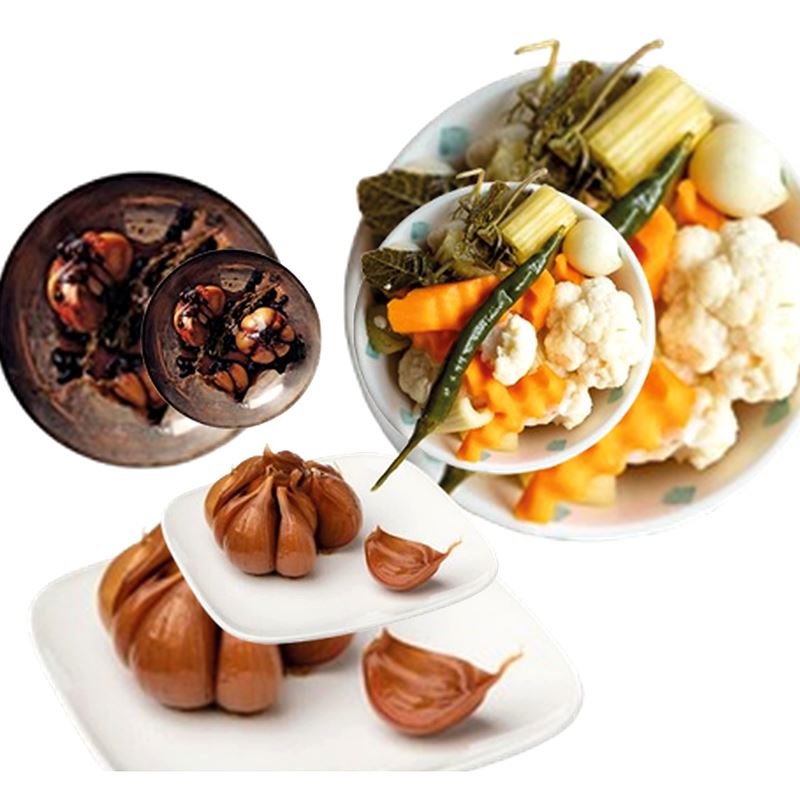
Torshi seer is whole heads of garlic pickled in vinegar and left to age. Young garlic pickle is pale and still fierce. But given time — a year, three years, and in the finest cellars up to seven years — something remarkable happens. The cloves darken through amber to a deep brown, soften until they yield like jam, and shed their raw, biting heat. What remains is sweet, round and almost balsamic, with just enough acidity to slice through a fatty spoon of broth. Aged garlic is milder, not stronger; the years are what tame it. This is a culinary tradition, savoured for flavour rather than any medical promise.
Mixed Torshi: Crunch Against Richness
Where seven-year garlic is soft and mellow, mixed torshi (torshi makhloot) is bright and busy — a chopped medley of vegetables and herbs in vinegar that stays crisp and sharp. A small forkful between bites of meat and fat resets the whole palate, so the next mouthful lands as vividly as the first. The two pickles are not rivals; they play different notes. One is a deep, quiet bass; the other is a quick, high snap.
How to Build the Perfect Kalle Pache Table
The classic Tehran breakfast is not a single dish but an arrangement. Warm sangak, the stone-baked flatbread, is torn to scoop broth or wrap a piece of tongue or cheek; our special sangak is more generous still. A glass of doogh, the salted mint yogurt drink, cools the palate and settles a heavy meal. And the two pickles carry the acidity. Each element answers a different part of the dish, as the table below shows.
| Side | What it does | Best with |
|---|---|---|
| Seven-year garlic pickle | Deep, mellow acidity; a soft sweet-sour bite | Rich meat, cheek (banagoosh), brain |
| Mixed torshi | Sharp, crunchy, resets the palate | Trotters (paye), tripe, fatty broth |
| Special sangak | Warm bread to scoop and wrap | Every cut; soaking up broth |
| Doogh | Cool, salty, refreshing | The whole table, start to finish |
A Simple Order of Operations
Start with a spoon of plain broth to warm up. Tear a piece of sangak, add a little meat, then a clove of seven-year garlic for depth. When the richness begins to build, reach for a forkful of mixed torshi to sharpen everything back up, and take a sip of doogh. Repeat, and the bowl never grows heavy. If you are new to the dish, our guide to the sides for kalle pache walks through each accompaniment in more detail.
Where to Eat Kalle Pache in Dubai
At Shaun the Sheep, a Tehran-style kalle-pache house at 64 Jumeira Street, Jumeirah 1, we serve seven-year garlic pickle, mixed torshi, special sangak and doogh alongside every cut — from plain broth and paye to tongue, cheek and the Special Mix sampler. We are open twenty-four hours, every day, with dine-in, pickup and Dubai-wide delivery. Browse the full menu and order page, or reserve a table for a proper dawn feast with the whole spread laid out. Communal platters serve one, two, three or six, so bring an appetite and the right company.
