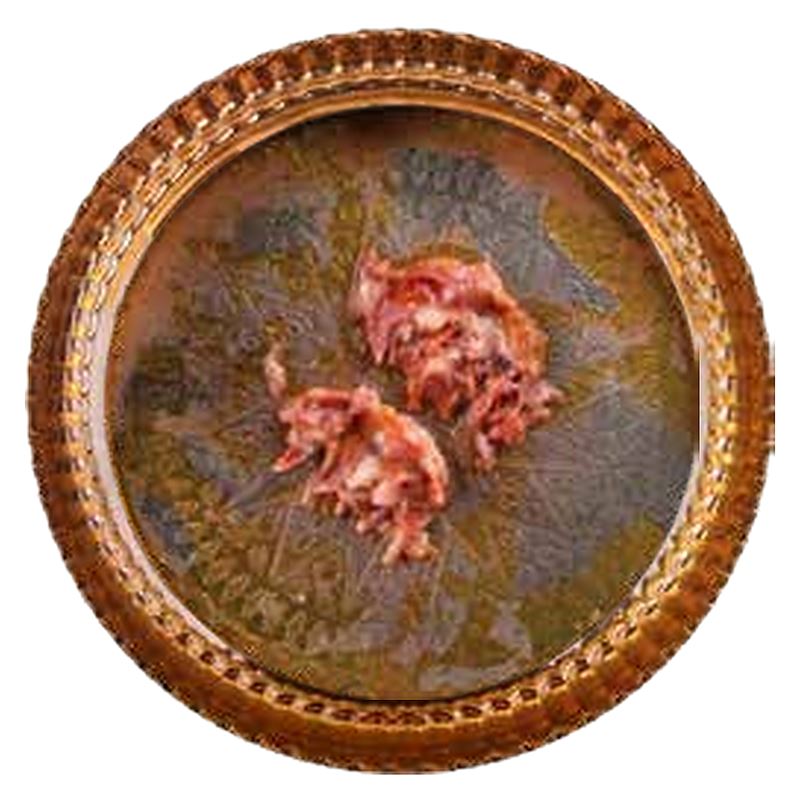
On a shared platter there is usually one small, glossy piece that spoons circle without landing on. This page is for the person doing the circling. No dare and no drum roll: only what the eye is, what it honestly tastes and feels like, how to eat one without ceremony, and how to pass on it gracefully.
What exactly arrives when you order the eye?
Less than most people picture. The eye is the smallest thing on a kalle pache table, roughly the size of a marble, and there are only two on a whole head, so nobody has ever piled it on a plate. It is cleaned carefully, then simmers overnight with the rest of the head, the same long hours in the broth as the meat and the trotters.
What lands in front of you is a small, pale round piece in golden broth, usually beside other parts rather than alone. The tiny firm lens at the centre is set aside rather than eaten; the soft part around it is what people mean by eating the eye. Nothing looks back at you. The full guide to cheshm covers the part in detail.
What does the eye taste like, and how is that different from the brain?
Mild. That is the first thing a regular says and the last thing a newcomer expects. There is no gaminess and nothing sharp: the eye has taken on the same broth as everything else in the pot, so what you taste is mostly onion, turmeric and garlic, finished with the lime and cinnamon you add yourself at the table. Kalle pache carries no chili heat at all, and the eye is no exception.
Against the brain, the difference is weight rather than strength. Brain is the richer of the two, properly buttery and creamy, and the softest thing on the table. The eye is lighter and cleaner, gelatinous rather than creamy, and the portion is so small it never gets the chance to feel heavy — which is why people who find brain too rich after two spoonfuls often get on better with it. The brain guide is the companion to this page.
What is the texture like — soft, firm, or somewhere in between?
Soft, but not soft in a single note. There is a distinctly gelatinous quality that melts the way slow-cooked collagen melts, with a little more body than brain has anywhere: the spoon meets something, without asking for a real chew. If you have eaten the sticky part of a lamb shank where the meat meets the bone, this is the same family, smaller and gentler.
The honest caveat: if it is softness itself you dislike, the eye will not change your mind, and neither will the brain. That is a preference, not a failing. Our texture guide and the parts ranked mildest to boldest go further.
| Part | How it feels | Closest familiar thing | Who tends to like it |
|---|---|---|---|
| Eye | Gelatinous and melting, with a little body | The sticky part of a lamb shank | The curious, and brain lovers |
| Brain | The softest thing on the table, smooth and creamy | Set custard or soft tofu | People who enjoy silky, rich food |
| Tongue | Firm and dense, slices cleanly | A good slow-cooked beef | People who dislike soft food |
How do you eat one for the first time without making an occasion of it?
Treat it as a mouthful, not a milestone. Four things help.
- Eat it hot, early in the meal. The soft parts firm up as they cool, and the eye changes first.
- Put bread under it. Tear a piece of sangak, lift the eye onto it with a little broth, and eat it in one; warm, chewy bread gives the mouthful a familiar shape.
- Season first, not after. Lime and a pinch of cinnamon go into the broth before the spoon does. Tasting an unseasoned bite and then deciding is how people talk themselves out of it.
- Do not announce it. Half of what makes the eye difficult is the pause and the audience. Eat it mid-conversation and it is one more good spoonful of a slow-cooked breakfast.
One spoonful is a complete answer either way. The first-timer's method covers the whole meal.
Why do people who grew up with kalle pache treat the eye as the prize of the platter?
Because there are only two, and because of who gets them. In many Iranian and Iraqi households the eye is not eaten by whoever reaches it first: it is offered — to a guest, to the oldest person at the table, to whoever loves this dish most, and being handed it is a compliment you are meant to notice. There is an affectionate old habit of giving it to a favourite child, with the folk saying that it is good for the eyes: folklore rather than nutrition, but it shows how fondly the part is regarded.
So if the eye looks strange to you, this is the thing worth knowing. At the tables this dish comes from, nobody is being brave. The eye is the good bit, and it goes to the person you are pleased to be feeding.
How do you order it, or quietly pass it to someone who will enjoy it more?
To order it deliberately, take it as a single dish, so one small portion is yours without committing to anything else; the guide to choosing a single covers that decision. It also turns up in the special mix, where you can taste it beside the other parts.
And to pass on it: pass it. Slide it across to whoever lit up when it arrived, or say nothing and leave it where it is. Nobody keeps score, and declining one small part does not mean you have failed to eat kalle pache properly. Plenty of people eat this dish regularly and have never eaten an eye, and if the dish itself turns out not to be for you, that is a normal outcome too.
What is worth having alongside it if this is your first try?
Everything beside it is a counterweight. Warm sangak is the important one: dry, blistered and chewy against something soft and rich. Seer torshi or mixed torshi reset the palate, a cold glass of doogh does the same in liquid form, and black tea is the traditional close. Sangak, torshi and doogh explains why each earns its place.
For the gentlest run-up, begin with soup or brain soup and leave the eye until last. If anything travels home with you, treat it with the care you would give any slow-cooked food: keep it cool, warm it through properly, and use your own judgement alongside local food-safety advice.
Our kitchen at 64 Jumeira Street, Jumeirah 1 runs twenty-four hours a day, seven days a week, so a first try need not fit anybody else's idea of mealtime. Sit with us in Jumeirah, collect an order yourself, or have it delivered across Dubai, and you can choose a future time when you order. The menu lists every part on its own, and questions are welcome on +971 4 321 8882 at any hour.
