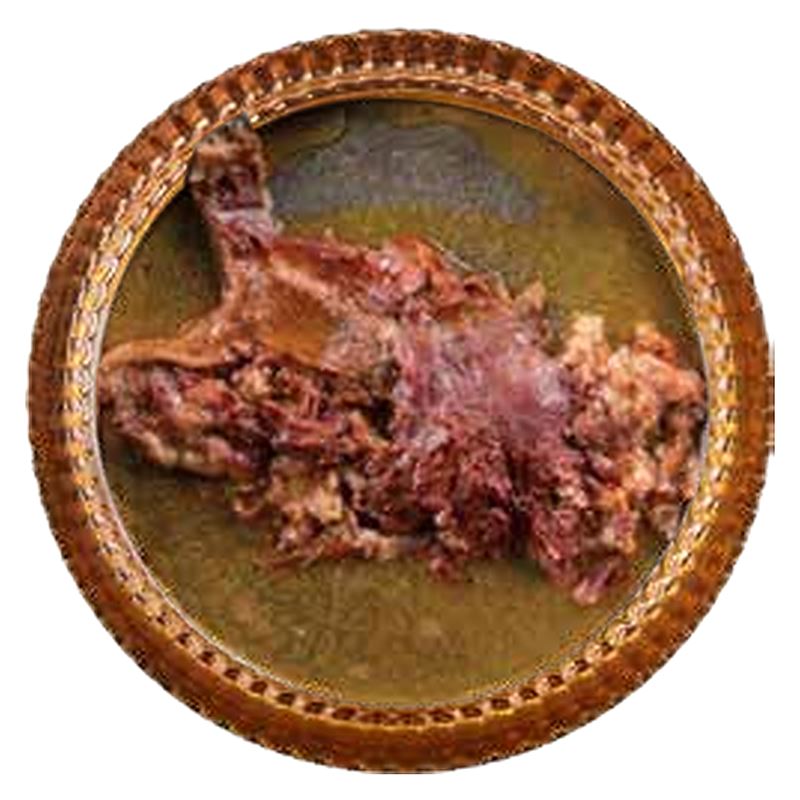
They are not the same dish, but the family resemblance is hard to miss. Sop kaki kambing is the Indonesian goat-trotter soup. Kalle pache is the Persian head-and-trotter dish we cook at Shaun the Sheep on Jumeira Street. Both are built on feet and on the cuts most kitchens set aside, both need hours of quiet simmering, and both are eaten hot, often at an hour when the rest of the city has gone still.
If sop kaki kambing is already ordinary food in your household, the thing that stops most first-timers on our menu — the soft, gelatinous, lip-coating texture of a trotter — will not stop you at all. What follows is an honest side-by-side. We cook only the Persian version, we are not authorities on Indonesian cooking, and everything we say here about sop kaki kambing is deliberately general rather than precise.
Are kalle pache and sop kaki kambing the same dish?
No. They come from two different food cultures and taste noticeably different, but they solve the same problem in the same way.
The problem is this. The feet and head of a goat or a sheep are mostly skin, cartilage, bone and connective tissue. Cook them quickly and they are close to inedible. Cook them slowly, for a very long time, and that connective tissue turns to gelatin, the broth takes on body and weight, and the meat around the joints goes soft enough to slide off with a spoon. Cooks in Indonesia worked this out. So did cooks in Iran, in the Philippines, in Vietnam, in Mexico and across the Levant. These traditions look far more like convergence than borrowing — the animal and the fire seem to have led cooks in very different places to roughly the same answer, and the family of dishes that came out of it is larger than most people realise. Dubai is one of the few cities where you can taste several branches of that family in the same week, because the people who grew up with them all live here.
What do the two dishes genuinely share?
Four things, and they happen to be the four that matter most at the table.
- The cuts. Goat or sheep trotters — feet, joints and all — plus, on our side, the head. These are the pieces a fast kitchen has no use for and a patient one builds its name on.
- The time. Neither dish can be hurried. Ours simmers about fourteen hours and is skimmed again and again. Any trotter soup worth eating has spent a long night over a low flame somewhere.
- The bowl. Hot, generous, with something starchy alongside to carry it — bread in our case, bread or rice in many Indonesian versions.
- The hour and the place. Both carry a strong association with late nights and early mornings, with market stalls, carts and small neighbourhood kitchens rather than formal dining rooms.
There is a fifth thing that is harder to name. Both are family food. Both are the kind of dish that somebody in your household made better than anyone else, and every restaurant version since gets measured against that memory. We know we are being measured, and we would rather be measured honestly than flattered.
Where do the two clearly differ?
Mostly in the character of the broth, in what comes alongside it, and in who does the seasoning.
Indonesian versions are commonly built on a distinctly spiced broth — aromatic, with a warm and faintly sweet edge behind the spice — and are commonly eaten with rice, or with bread, depending on the place and the cook. Beyond that we will not go. There are many ways to make it, they vary by region and by household, and we would rather say too little than get somebody's grandmother's version wrong.
Ours goes in a different direction. Kalle pache is a clear savoury lamb broth. Heads and trotters are hand-cleaned and trimmed, blanched with that first water thrown away, then simmered in a copper pot with onion, turmeric and garlic for about fourteen hours and skimmed over and over. Spice does not lead here. The aroma is deep rather than loud, and the flavour comes mostly from bone, gelatin and fat.
The second real difference is the head. Kaki means feet, and the Indonesian dish is built on them. Ours takes feet and head together: brain, tongue, eye, cheek, meat, tripe. That widens the range of textures in a single bowl considerably — some of it silky, some firm enough to slice, some as soft as custard.
The third difference is who finishes the bowl. We do not season it for you. Lime, cinnamon and garlic go on at the table, by the person eating, in whatever quantity that person decided long ago was correct. If you are used to finishing your own bowl at a stall, this will feel entirely familiar. For more on the flavour itself, we have written down what it actually tastes like.
How do the two compare side by side?
| Element | Sop kaki kambing — commonly associated with | Kalle pache — what we cook |
|---|---|---|
| Main cuts | Goat trotters and feet | Lamb trotters and head: cheek, brain, tongue, eye, meat, tripe |
| Cooking time | Long, slow simmering | About fourteen hours in a copper pot, skimmed repeatedly |
| Broth character | Distinctly spiced and aromatic | Clear and savoury; onion, turmeric and garlic |
| Served with | Rice or bread, depending on the place | Sangak bread, with Mixed Torshi or Garlic Torshi |
| Who seasons it | Commonly finished by the diner at the table | Finished by the diner: lime, cinnamon, garlic |
| When it is eaten | Commonly a late-night and market food | Traditionally early morning; we cook it 24 hours a day |
| Where it is eaten | Stalls, carts, small neighbourhood places | Our one kitchen on Jumeira Street, plus delivery and pickup |
The column headings are deliberate. We can tell you exactly what we cook, because we cook it. About sop kaki kambing we can only tell you what it is commonly associated with, because we do not cook it and will not pretend otherwise.
Will the texture be a problem for me?
Almost certainly not, if trotters are already part of your food.
The most common reason a newcomer struggles with kalle pache is texture rather than flavour. A well-cooked trotter is soft, slippery and rich, the broth coats your lips, and what is left in the bowl sets into something close to jelly as it cools. For somebody raised on grilled meat, that is a genuine surprise. For somebody raised on goat-trotter soup, it is simply what dinner feels like. The gelatin behind it is the same gelatin that gives your own home broth its body — the mechanism is explained in why the broth sets like jelly, and there is a fuller walk-through in our texture guide.
None of this is medical advice. If you have a health condition or any dietary concern, ask your doctor or a registered dietitian rather than a restaurant.
What should I order first?
Start with Trotters on their own, or go straight to The Full Dish if you want the whole picture in one sitting.
Trotters is the most direct bridge from sop kaki kambing: the same cut, cooked a different way, with nothing else in the bowl to distract you. It is the cleanest possible comparison and the fairest test of whether our broth is for you.
If you would rather see the full range, the platters are the efficient route, and all of them include bread:
- Single Dish — lamb cheek, one trotter, half a brain, half a bread.
- Double Dish — lamb cheek, two trotters, half a brain, tongue, one eye, a whole bread.
- The Full Dish — two lamb cheeks, meat, four trotters, a whole brain, tongue, two eyes, two breads.
- The Khan's Platter — four lamb cheeks, two meats, eight trotters, two brains, three tongues, four eyes, five breads. Sized for a table rather than one person.
Singles can be ordered on their own as well — Eye, Brain, Meat, Tongue, Trotters, Tripe, Lamb Cheek, Brain Soup, Soup, Special Mix — with Sangak Bread, Special Sangak, torshi, capsicum, onion, fresh chili or pickled green chili alongside. Customising here means choosing which parts and which items you order; there is no notes field, and anything unusual goes through the phone. The full list is in our menu guide, and the head parts get their own explanation in the guide to brain, tongue and trotters.
What do people drink with it?
Tea, mostly. We serve Tea, Black Tea and a Kettle of Tea for a table that means to sit a while, plus Doogh, the savoury yoghurt drink that turns up on Iranian tables beside exactly this kind of food. Water, Lemonade and soft drinks are there too, and there is an Omelette on the menu for anyone at the table who is not ready for a trotter yet.
How is it actually cooked?
Slowly, in water, over a long night.
The heads and trotters are cleaned and trimmed by hand. They are blanched first and that first water is thrown away. Then they go into a copper pot with onion, turmeric and garlic and simmer for about fourteen hours, skimmed again and again through the night. What comes out has enough gelatin in it to set as it cools. For the long version, how kalle pache is made walks through it, and what kalle pache is covers the background for anyone meeting the dish for the first time.
Is any of this halal-relevant?
Both dishes matter to communities in Dubai for whom that question is not an afterthought, and we take it seriously without pretending to be scholars.
Our lamb is sourced to the UAE halal standard. That is the accurate statement, and we do not decorate it with anything further. We do not issue rulings, interpretations or opinions on anyone's practice — questions of that kind belong to people qualified to answer them, not to a kitchen. We set out what we can and cannot say in is kalle pache halal.
Do you serve sop kaki kambing?
No. We cook one thing, in one kitchen, and it is the Persian dish.
We are not going to add a version of somebody else's national dish to the menu and call it authentic. What we can offer an Indonesian or Malaysian household in Dubai is the nearest honest relative: the same cuts, the same patience, a different broth, and a kitchen that is open when you actually want it. If comparisons interest you, we have done the same exercise with Filipino bulalo.
How does ordering work in Dubai?
Online, prepaid by card, with no account to create. You choose your items, pay securely by card online, and the order gets its own page. The kitchen accepts it and sets an estimated time, and the rider phones you on arrival. There is no cash on delivery and no paying on arrival, and there is no sign-up, no password, no saved card or address and no order history.
We deliver across Dubai, and delivery is free on orders over AED 300; below that the fee varies by area. Pickup and dine-in are both available, and tables can be reserved in advance. The kitchen runs 24 hours a day, seven days a week, so the traditional early-morning bowl is genuinely available at that hour, and so is the late one. Scheduled orders are real too: you can pick a future time up to about two days ahead.
There is no cancel or edit button. If you need to change or stop an order, phone 04 321 8882 immediately — it is our only contact channel. If we cannot fulfil an order, we reject it with a reason and the refund is issued automatically. Step by step, it is laid out in how to order online, and the delivery side is covered in kalle pache delivery in Dubai.
If you already know what a trotter tastes like after a long night on the fire, you are not a beginner here. You are trying a different accent of a language you already speak.
Find us at 64 Jumeira Street, Jumeirah 1, or order from the menu whenever the hour suits you. If you have eaten sop kaki kambing your whole life and want to tell us how our broth reads to you, the phone is the way, and we would genuinely like to know. And if you want to see where our bowl sits among the other slow-cooked bowls in this city, we have written that down as well.
