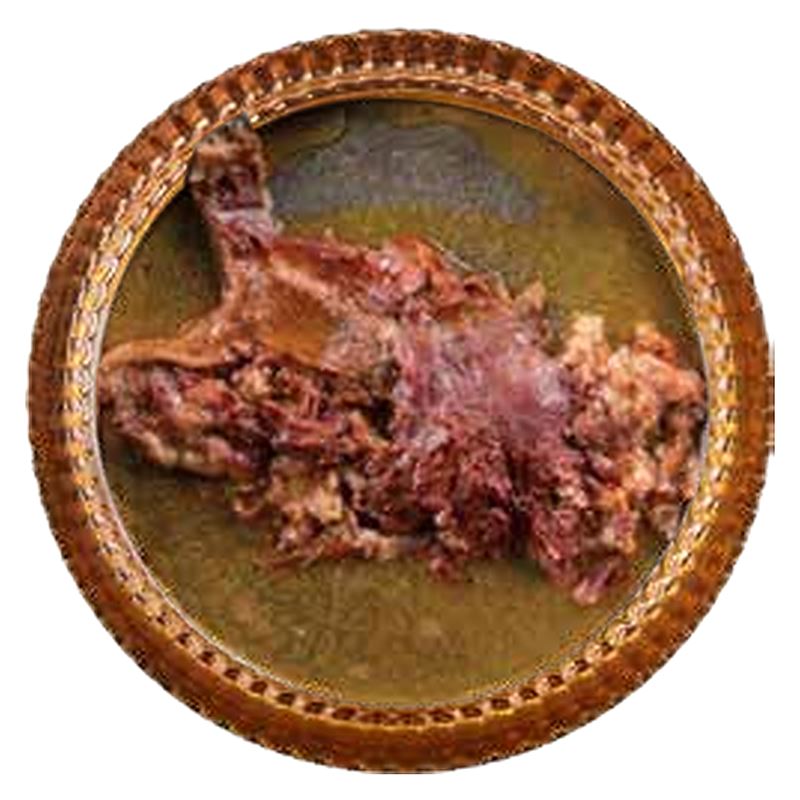
Nigerian cow leg pepper soup and Persian kalle pache begin in the same place: the leg and the foot. These are the cuts that are mostly bone, skin and connective tissue, the ones that give nothing at all for hours and then give everything at once. From that shared starting point the two dishes travel in opposite directions. Pepper soup is commonly built on serious chilli heat and aromatic West African spice blends. Kalle pache is gentle and deeply savoury by design, and the sharpness is added by the person eating it, at the table, rather than by the cook.
So if you have eaten cow leg your whole life and you are wondering whether kalle pache is for you, the short answer is yes, with one adjustment. The texture will be familiar from the first spoonful. The heat you have to bring yourself, which at Shaun the Sheep means adding Fresh Chili or Pickled Green Chili to the order.
What do kalle pache and Nigerian cow leg pepper soup have in common?
The foundation. Both dishes are built on collagen-rich cuts, the leg and the foot and the joints, and both depend on a long slow simmer to turn that collagen into gelatin. That is the whole trick, in a kitchen in Lagos and in a kitchen in Tehran alike. It is why both bowls have body that a quick stock never gets, why both are eaten properly hot rather than warm, and why in kalle pache the broth is rich enough to leave your lips faintly tacky after a few mouthfuls. As the bowl cools the body of the broth changes, and anyone who grew up with either dish knows that without being told.
There is a second thing they share, and it matters more than any technique. Both come from food cultures that treat the cuts other kitchens throw away as the good part. Head, foot, tongue, tripe: none of these are novelty items in Persian or in West African cooking. They are what you put in front of people you care about. Someone who grew up eating cow leg does not need the idea explained and does not flinch at a bone in the bowl, which is rarer than it sounds and exactly why this comparison is worth writing down. Why other kitchens moved away from those cuts is its own story, and why Western kitchens stopped cooking offal traces how abattoirs and pre-wrapped supermarket trays did it.
We should also say plainly what we are and what we are not. We are a Persian kalle pache kitchen in Jumeirah. We cook the Persian version and nothing else. We are not authorities on Nigerian cooking, and pepper soup varies a great deal between households, regions and cooks, so everything we say about it here is kept general on purpose. If your mother makes it differently, your mother is right.
Is kalle pache spicy the way pepper soup is spicy?
No, not as it leaves our pot. Kalle pache is seasoned for depth rather than for heat. The pot carries onion, turmeric and garlic and very little else, and what comes out of about fourteen hours of simmering is meaty, round and faintly sweet from the onion. That is not the same thing as bland, and the difference is worth insisting on. It is savoury in a slow, mouth-coating, filling way: the flavour of the meat itself rather than of a spice cabinet. But if your reference point is a bowl that brings your forehead out in a sweat, this will land differently, and it is better to know that before you order. We go through it properly in our guide to whether kalle pache is spicy.
Neither approach is the adventurous one and neither is the safe one. They are two answers to the same question: how do you take hours of collagen and bone and make it taste like something you want again tomorrow. One answer is to meet the richness head on with chilli and aromatics. The other is to let the meat do the talking and hand the seasoning to whoever is holding the spoon.
How do I bring the heat back into kalle pache?
You add it yourself at the table, which is how a Persian table works anyway. Lime, cinnamon and garlic go into your own bowl, in your own quantity, adjusted as you eat rather than fixed for you by the kitchen. On top of that we sell Fresh Chili and Pickled Green Chili as add-ons, for exactly this kind of eater. Order a portion of each, work them in a little at a time, and you can take kalle pache a long way towards the heat you are used to. The Pickled Green Chili brings sourness along with its heat, which suits a rich broth; the Fresh Chili is cleaner and sharper. Garlic Torshi and Mixed Torshi do a related job, cutting through the richness. Our add-ons guide walks through all of them, along with Capsicum and Onion.
How is kalle pache actually cooked?
Slowly, and with a great deal of cleaning first. Heads and trotters are hand-cleaned and trimmed, which is the unglamorous part and most of the work. Then they are blanched and that first water is thrown away, the step that decides whether the finished broth comes out clean or heavy. After that comes the long simmer: about fourteen hours in a copper pot with onion, turmeric and garlic, skimmed again and again as it goes.
Anyone who has cooked cow leg properly will recognise the logic even though the seasoning is nothing alike. You cannot rush a leg. You cannot skip the skimming. The full method is written up in how kalle pache is made, and the flavour it produces is described in what does kalle pache taste like.
How do the two dishes compare side by side?
They share their cuts, their patience and their texture, and they part company on heat, on aromatics and on who does the seasoning. The pepper soup column is kept general on purpose, because that dish changes from one household to the next.
| Point of comparison | Cow leg pepper soup (commonly) | Kalle pache at Shaun the Sheep |
|---|---|---|
| Main cuts | Cow leg and foot; goat is common too, and other versions use other cuts | Lamb head and trotters: Eye, Brain, Meat, Tongue, Trotters, Tripe, Lamb Cheek |
| Cooking | Simmered until the leg is tender; timing varies by household and cut | Blanched with the first water discarded, then about fourteen hours in a copper pot |
| Aromatics | Aromatic West African spice blends, varying by region and cook | Onion, turmeric and garlic |
| Heat as served | Commonly hot, sometimes very hot | Not hot at all as it leaves the kitchen |
| Who seasons it | The cook, in the pot | The diner, at the table: lime, cinnamon, garlic |
| Texture | A lighter-bodied broth with gelatinous meat eaten off the bone | A rich gelatinous broth, soft meat, bones worth going back to |
| Eaten with | Varies widely by household and occasion | Sangak Bread or Special Sangak, Mixed Torshi, Garlic Torshi |
| What to order here | Not a dish we cook | Trotters first, then The Full Dish |
I already eat cow leg, so what should I order first?
Trotters. That is the direct answer and the shortest route from one bowl to the other. Trotters are the part of kalle pache that does what cow leg does: the sticky, gelatinous, gnaw-it-off-the-bone texture that is the entire reason anyone cooks that cut in the first place. Order Trotters with Sangak Bread and a Fresh Chili on the side and you have a plate that sits very close to home.
After that, The Full Dish brings the range together, head and trotter parts in one spread, and The Khan's Platter is the largest of them, which is what to order when several of you are eating. Special Mix is a good middle path when you want a little of everything without committing to a full platter, and Single Dish and Double Dish are the smaller platters. Soup and Brain Soup are the gentlest way in, useful when someone at the table is new to all of this. We set the differences out properly in our platter guide, and there is a broader introduction in what is kalle pache.
Order bread with it, always. Sangak Bread or Special Sangak, flat and chewy and made for tearing and dipping, is the main tool for getting broth from bowl to mouth. And when the meat is off the bones, do not push them aside: we wrote about what to do with them. We also compared kalle pache and Filipino bulalo, another dish built on the same patience.
When do people eat kalle pache in Dubai, and can I order it ahead?
Traditionally early in the morning, and yes, you can book a time in advance. Kalle pache is a morning dish in Iran, eaten at the start of the day, and plenty of families in Dubai keep that habit. It is not a rule anyone enforces, though, and our kitchen runs twenty-four hours a day, seven days a week, so the dish is there whenever it suits you. If you want it for a particular moment later on, place a scheduled order and pick a future time up to about two days ahead. There is more on the dish in this city in kalle pache in Dubai.
Is the lamb halal?
Our lamb is sourced to the UAE halal standard. That is the specific, honest answer, and we go into what it means for a kitchen like ours in is kalle pache halal.
How do I order kalle pache in Dubai?
Everything starts on the menu page. Choose your parts and your items, choose delivery, pickup or dine-in, and pay by card online. Payment is secure online card prepay only: there is no cash on delivery and no paying on arrival. There is no account to create and no password to remember, because it is guest checkout. Delivery covers Dubai and is free on orders over AED 300; below that the fee depends on your area.
Once payment goes through, your order gets its own page. The kitchen accepts it and sets an estimated time, and that page is where you follow it. The rider phones you on arrival, so keep your phone to hand. If the kitchen cannot fulfil an order it rejects it with a reason and the payment is refunded automatically.
Customising your order here means choosing which parts and which items you want. There is no notes field for kitchen or delivery instructions, so anything that needs saying to a human goes by phone. There is no cancel or edit button either: if you need to change or stop an order, call 04 321 8882 straight away, which is our only contact channel. The kitchen is at 64 Jumeira Street, Jumeirah 1, and there is one kitchen only, with no branches. Tables can be reserved if you would rather eat with us. Step-by-step instructions live in how to order online, and the delivery specifics are in kalle pache delivery in Dubai.
Two kitchens thousands of kilometres apart looked at the same bone and decided it was worth most of a day's attention. That is not a coincidence. It is what happens when cooks respect an animal enough to use all of it.
One note before you go: this article is about food and cooking, not health. Nothing here is medical advice. If you have questions about your diet, ask your doctor or a registered dietitian.
