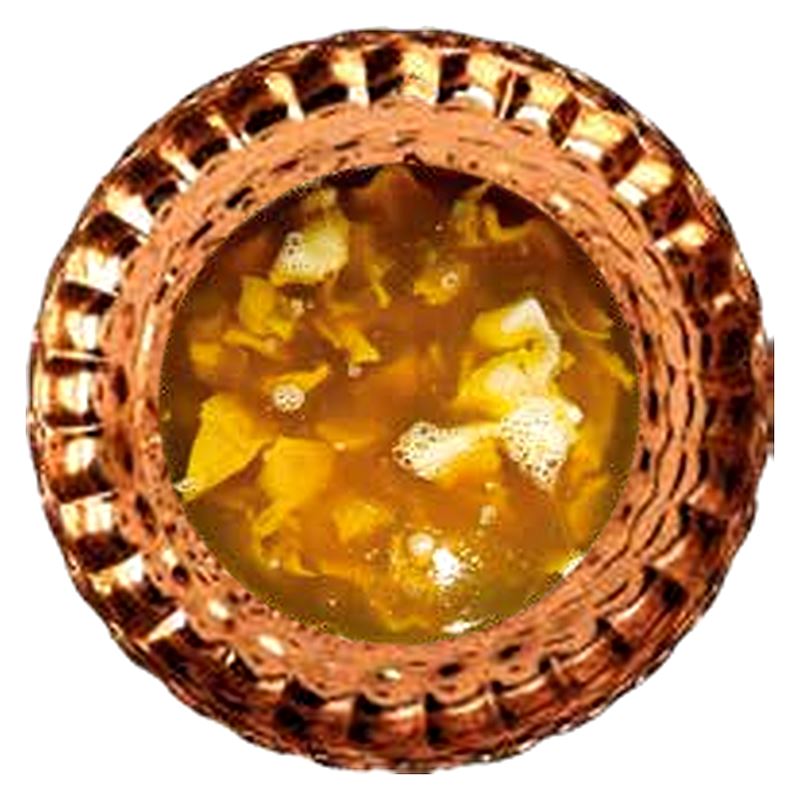
Patsas and kalle pache are cousins, and of all the dishes readers ask us to set beside kalle pache, these two are the closest. Both are built on tripe and trotters. Both come out of a pot that has been on the heat all night. Both are traditionally eaten in the small hours, before the working day begins, at shops that do this one thing and little else. If you grew up on patsas, you will know the shape of the meal before the bowl arrives.
The clearest difference is the finish. Patsas is commonly seasoned by the person eating it, with garlic and vinegar. Kalle pache is also seasoned by the diner, but with lime, cinnamon and garlic. Same cuts, same hour, same patience, a different last ten seconds. We cook the Persian version and only the Persian version, at our kitchen on 64 Jumeira Street in Jumeirah 1, Dubai, open 24 hours a day. We are not authorities on Greek cooking, so everything written here about patsas is kept general on purpose.
What is patsas, and what is kalle pache?
Patsas, in the broadest honest terms, is a Greek soup of tripe simmered for a long time, commonly with trotters or other gelatinous cuts, served very hot and adjusted at the table by the person eating it. Beyond that, recipes differ by household and by region, and we are in no position to arbitrate between them. Greek and Cypriot readers will have a family answer, and the family is right.
Kalle pache is the Persian dish whose name is simply a list of its contents: kalle is the head, pache is the trotters. It arrives as parts rather than as one fixed bowl. You choose what you want, from Eye, Brain, Meat, Tongue, Trotters, Tripe and Lamb Cheek, or you take Soup or Brain Soup, or a platter carrying several parts at once. The full explanation is in what kalle pache actually is.
Why do patsas and pache sound like the same word?
Because they are commonly traced back to the same word. Language historians take Greek patsas to Turkish paca, and that in turn to Persian pache, the trotter. The word travelled the roads the dish travelled, taking a new spelling at each border. So this is not two peoples arriving at the same idea by accident. It is one very old habit: do not waste the head and the feet, give them time, eat the result early.
Do the two soups really use the same cuts?
To a large extent, yes: tripe and trotters sit at the centre of both traditions, and both treat those cuts as something that rewards hours rather than heat. The trotters give the broth its body, that faint stickiness on the lips that tells an experienced eater nobody took a shortcut. The tripe gives the chew.
Where the two part company is the head. Kalle pache includes it, and that is no small detail: Lamb Cheek, Tongue, Brain, Eye and the meat off the skull are each a separate item you can order alone. As patsas is commonly described, the head is not usually part of it. The two dishes overlap almost completely on the lower half of the animal, and kalle pache carries on upward.
Why do both dishes belong to the dawn hour?
Because the pot sets the clock, not the customer. A pot like this is cleaned and started in the evening and is only properly ready when the night is over, which is why the tradition formed around the same window in both countries: the hour when bakers, drivers, market porters, nurses coming off a shift and people opening a shop want something hot before the day begins. Nobody scheduled that. The cooking time chose it.
The shop culture matches too. In Greece the soup has its own specialist address, the sort of place often called a patsatzidiko, which sells this and little else. Persian cities have exactly the same institution: one dish, done for decades, by people who do nothing else. Finding that habit repeated so precisely across such a distance still surprises us. In Dubai the instinct survives, and we stay open around the clock so the hour becomes your choice rather than ours. There is more in why kalle pache is eaten at dawn.
What is the real difference between kalle pache and patsas?
The finish, and it is very nearly the whole difference. In many Greek kitchens patsas is sharpened by the diner with garlic and vinegar, and that sour-and-allium hit is the signature of the bowl. We use no vinegar. Our seasonings are lime, cinnamon and garlic, and this part matters: the kitchen does not add them. They come to the table with the food and you add them yourself, spoonful by spoonful, exactly the way vinegar goes into a bowl of patsas.
Cinnamon is the surprise, and it is not there for sweetness. A small amount lifts the fat and gives the broth a warm edge, working the way a bay leaf works in a stock rather than the way cinnamon works in a dessert. Lime does the job vinegar does in your version, cutting the richness, but it lands rounder and more fragrant than sharp. Garlic, happily, is common ground.
Season one spoonful at a time and taste in between. The broth changes character quickly, and it is much easier to add lime than to take it back out.
We describe the taste in detail in what kalle pache tastes like.
Is the cooking method similar?
The two methods rhyme, though we can only vouch for ours: the heads and trotters are cleaned and trimmed by hand, blanched once with that first water thrown away, then simmered about fourteen hours in a copper pot with onion, turmeric and garlic, skimmed again and again through the night. Those aromatics build the broth; they do not season your bowl, because that job is yours at the table. The long version is in how kalle pache is made.
We will not walk through the Greek method step by step, because we do not cook it and would get a detail wrong. But the principles a patsas cook knows, thorough cleaning, patience with the skimming and no shortcut on the hours, govern our pot too.
How do kalle pache and patsas compare side by side?
The kalle pache column is what we cook and can vouch for. The patsas column is general only, because versions differ and we would rather be vague than wrong.
| Point of comparison | Kalle pache (what we cook) | Patsas (commonly described) |
|---|---|---|
| Core cuts | Head and trotters: tripe, trotters, tongue, cheek, brain, eye, meat | Tripe, commonly with trotters or other gelatinous cuts |
| Texture | Gelatinous broth; tripe with a soft, springy chew | Gelatinous broth; the same tripe chew |
| The simmer | First water discarded, then about fourteen hours in a copper pot, skimmed repeatedly | Long and slow, commonly overnight |
| Who seasons it | The diner, at the table | Commonly the diner, at the table |
| Table seasoning | Lime, cinnamon, garlic | Commonly garlic and vinegar |
| Traditional hour | Before sunrise, when the pot is ready | Very early morning |
| Where it is eaten | Dedicated kalle pache houses | Dedicated shops that sell little else |
| Where to start with us | Tripe first, then Special Mix | Not something we cook |
I grew up eating patsas, so what should I order first?
Order Tripe. This is the one place where a Greek, Cypriot or Balkan reader has a real head start: the texture that stops most newcomers, the soft and faintly springy chew of tripe, is one you have known since childhood. You are not learning anything new, only meeting a familiar ingredient dressed differently. There is a longer guide to lamb tripe on our menu.
After that, take Special Mix, the honest way to find out which parts you like, because it puts several in front of you at once. Trotters will feel like home, Lamb Cheek is the easiest thing on the menu for anybody, and Tongue is closer to a good slow braise than to anything intimidating. Brain is the one to decide about later. For a table, the platters, Single Dish, Double Dish, The Full Dish and The Khan's Platter, are in the platters guide.
Whatever you take, add Sangak Bread and a torshi. Mixed Torshi or Garlic Torshi does much the same job vinegar does in patsas: a sharp pickled bite between spoonfuls that resets the palate. To drink, Doogh if you like a salted yoghurt drink, or Black Tea.
Do you serve patsas at Shaun the Sheep?
No. We cook the Persian version only, and we are not going to put a Greek name on a Persian pot: no vinegar finish, no Greek recipe on our menu. If what you want today is patsas exactly as your family makes it, we are honestly not that. If you want the same comfort, cuts and hour in a different accent, that is precisely what we do.
What about the Cypriot and Balkan relatives?
They exist, they are relatives, and we will be careful with them. Cyprus has its own long-simmered tripe tradition, and across the Balkans tripe soups are eaten under several names, shkembe chorba among them. The resemblance is plain: the same cut, the same long cooking, and in many places the same sharpening with garlic and vinegar at the table. Beyond that we will not go, because the details change from one town to the next.
The same pattern turns up much further afield. We have written about kalle pache and Mexican menudo and about kalle pache and Korean seolleongtang. None of these is a contest. They are what happens when people in very different places refuse to waste an animal and find that time is the only technique that works.
Is kalle pache a heavy meal?
It is rich, and it is meant to be. The body in the broth comes from the trotters, the bread is filling, and a full platter is a substantial meal. People generally eat it slowly, as the main event of the morning. How it fits your own diet is a question for a professional, not for a kitchen: this is not medical advice, and if you have any health condition or dietary concern, please ask your doctor or a registered dietitian. Our lamb is sourced to the UAE halal standard, and we cover that in is kalle pache halal.
How do I order kalle pache in Dubai?
Order from the menu page, choose your parts, and pay by secure card online. Checkout is guest checkout: no account, no password, nothing to sign up for. Payment is card prepay only, so there is no cash on delivery and nothing to pay the rider. Customising here means choosing which parts and items you want; there is no notes field for the kitchen, so to ask about anything, phone 04 321 8882, our only contact channel.
We deliver across Dubai and delivery is free on orders over AED 300. You can also collect or eat in, and tables can be reserved in advance. After you pay, the order gets its own page: the kitchen accepts it and sets an estimated time, and the rider phones you on arrival. Step-by-step instructions are in how to order online, and the practical details in kalle pache delivery in Dubai.
If dawn is the hour you want, you can schedule the order for a future time up to about two days ahead. To change or cancel anything, phone 04 321 8882 straight away, because there is no self-service edit button. If the kitchen cannot fulfil an order, it rejects it with a reason and the payment is refunded automatically. For a wider look at the dish in this city, see kalle pache in Dubai.
