Book it as a scheduled order, and set that schedule the moment the hour is fixed. At checkout you can choose a future receive time up to about two days ahead. That is the honest planning window — not weeks, but comfortably enough to lock in tomorrow's lunch or a gathering the morning after next. For twenty people that is the tool to use. Ordering live and hoping the timing lands is fine when there are two of you; at twenty it turns a fixed appointment into a guess.
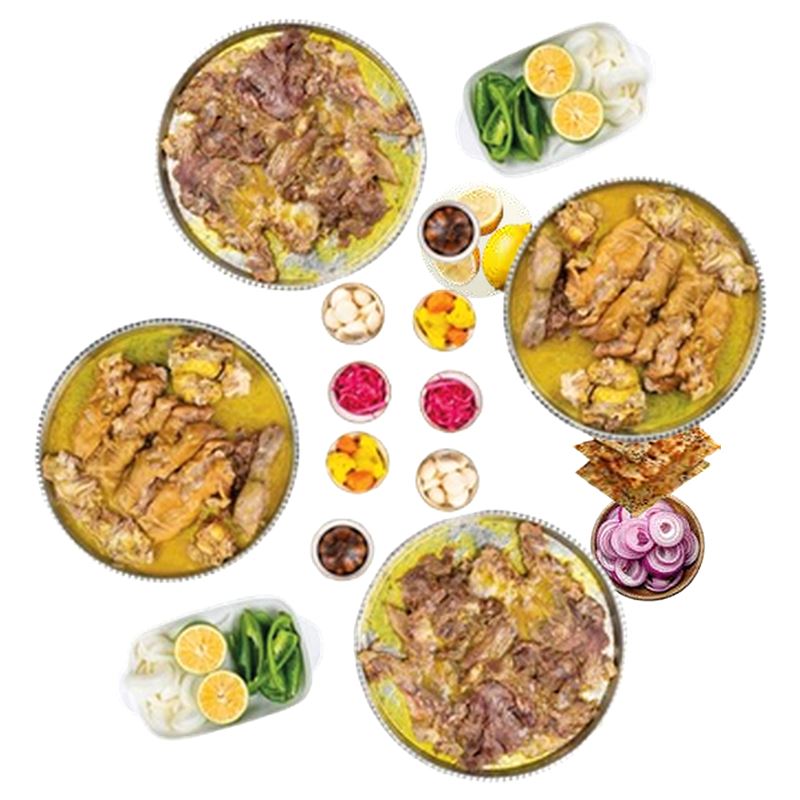
The other half of the question — what twenty people actually looks like on an order — is simpler than it sounds. The cleanest starting build is four of The Khan's Platter, one for every five people, which happens to land on exactly twenty breads. Adjust from there with The Full Dish and with singles for whoever wants one specific part. Every number below is worked from the platter contents on the menu, so you can check the arithmetic instead of taking our word for it.
How far ahead can you actually schedule a large order?
About two days, and that is the whole scheduling fact — there is nothing hidden behind it. The kitchen runs 24 hours a day, seven days a week, so opening hours are not the constraint. The only limit is how far into the future the receive time reaches. Open the checkout early enough to see how that window falls across your day, and book as soon as the hour is settled.
A large order travels exactly the same path as a small one. You build the basket, choose the receive time, pay online by card, and the order is booked. As the slot comes round the kitchen accepts it and sets an estimated time. There is no promise beyond that estimate, and when the food reaches you the rider phones. If you would rather see the screens before you start, the step-by-step ordering guide walks through them.
The argument for booking early is simply room to move. Set it two days out, and if something changes at your end you have two days in which to phone 04 321 8882 about it. Place it an hour before twenty people walk in, and you have whatever is left of that hour.
Why schedule instead of ordering live?
Because a table of twenty has a fixed start time and a live order does not. We never state a delivery time in minutes or hours, and we are not going to start here — what you get is an estimate the kitchen sets when it accepts the order. An estimate is a reasonable thing to build a quiet dinner around and a poor thing to build twenty guests around. A booked receive time changes the question from when will it arrive into this is the time I asked for.
There is a quieter reason too. A large order is almost always organised by one person who is doing five other things at once: the address, the seating, the cousin driving in from Sharjah who is already late. Scheduling lifts the food off that list a day or two early. If your slot is dawn or the first hours of the morning, the pre-order guide for early hours covers that case in detail.
What does twenty people look like in real menu items?
Start from the platters, because the arithmetic there has already been done for you. This is exactly what each one carries:
- Single Dish — lamb cheek, 1 trotter, half a brain, half a bread
- Double Dish — lamb cheek, 2 trotters, half a brain, tongue, 1 eye, a whole bread
- The Full Dish — 2 lamb cheeks, meat, 4 trotters, whole brain, tongue, 2 eyes, 2 breads
- The Khan's Platter — 4 lamb cheeks, 2 meats, 8 trotters, 2 brains, 3 tongues, 4 eyes, 5 breads
The first thing to notice is that The Khan's Platter is almost exactly two Full Dishes: four lamb cheeks against two plus two, two meats against one plus one, eight trotters against four plus four, two brains against one plus one, four eyes against two plus two. The difference is one extra tongue and one extra bread. So you can move between the two builds freely and land on nearly the same food, which helps when you would rather have several serving platters spread down a long table than four large ones at one end.
| Build for twenty | Lamb cheeks | Meat | Trotters | Brains | Tongues | Eyes | Breads included |
|---|---|---|---|---|---|---|---|
| 4 × The Khan's Platter | 16 | 8 | 32 | 8 | 12 | 16 | 20 |
| 3 × The Khan's Platter + 2 × The Full Dish | 16 | 8 | 32 | 8 | 11 | 16 | 19 |
| 2 × The Khan's Platter + 4 × The Full Dish | 16 | 8 | 32 | 8 | 10 | 16 | 18 |
The top row is simply one Khan's Platter for every five people, which is the easiest ratio to carry in your head. Per head it works out at one bread, a little over one and a half trotters, four fifths of a lamb cheek, four fifths of an eye, three fifths of a tongue, two fifths of a brain and two fifths of a meat portion. Treat that as arithmetic rather than a recommendation — appetite varies enormously, several of your twenty will eat one part and leave the rest, and how much to order per person is the better place to argue quantity.
What about the people who want one specific part?
Order it as a single. The singles are Eye, Brain, Meat, Tongue, Trotters, Tripe, Lamb Cheek, Brain Soup, Soup and Special Mix, and adding two or three of the parts your table actually competes over is the simplest fix for a build that is otherwise fine.
One detail worth catching before you pay: Tripe, Soup, Brain Soup and Special Mix appear in no platter at all. If someone specifically wants tripe, or wants a bowl of soup rather than a share of a platter, it has to be added as a single or it will not be there. Omelette is on the menu too, and is a sensible thing to have on the table if one or two of your twenty do not eat offal. The full menu guide goes part by part, and what kalle pache tastes like is the honest primer for guests who have never had it.
How much bread do you actually need?
Less than most people add, because the platters already carry it. This is the commonest mistake on a large order: four platters go into the basket, twenty Sangak go on top, and forty breads arrive for twenty people. Count first.
| Item | Bread already included |
|---|---|
| Single Dish | half a bread |
| Double Dish | 1 bread |
| The Full Dish | 2 breads |
| The Khan's Platter | 5 breads |
Four Khan's Platters therefore arrive with twenty breads: one a head before you add anything. If yours is a bread-heavy crowd, add a few Sangak Bread on top rather than a second full round. Special Sangak is on the menu as well, and extra Sangak exists as an add-on. The point is that the top-up should be a small deliberate decision rather than a reflex.
What else belongs on a table of twenty?
The things that get forgotten are the sharp ones. Mixed Torshi and Garlic Torshi matter far more at a long table than at a table for two, because one bowl in the middle never reaches the far end. Order enough that something sharp is within arm's reach of everybody, and take both kinds rather than doubling up on one.
Then the add-ons: Capsicum, Onion, Fresh Chili and Pickled Green Chili. These are what people reach for between mouthfuls, and across twenty heads a single portion of onion is gone in the first few minutes.
For drinks, order a Kettle of Tea rather than twenty separate teas. It is the more sensible unit for a table and it keeps the pouring going without twenty line items on the order. Tea, Black Tea, Doogh, Lemonade, Water and soft drinks are all there if you want a mixed spread.
One thing you do not have to organise at all is seasoning. Lime, cinnamon and garlic go on at the table, added by the person eating rather than by the kitchen. At twenty that is a gift, because nobody has to agree with anybody. Everyone builds their own bowl.
Should you phone before placing a very large order?
If you have a question, yes, because there is nowhere to type one. There is no kitchen-instructions box, no delivery-notes field, no chat, and nothing can be attached to the order. Anything you want to ask has to be asked out loud.
04 321 8882 is the only contact channel we have — no email, no messaging app, no contact form — and it is the number for a kitchen that runs around the clock. It is also the only way to change or cancel anything, since there is no self-service edit or cancel button anywhere. Wrong address, wrong platter, a time that has to move: phone straight away rather than hunting for a button on screen.
Worth knowing in advance: there is no account and no order history. After payment your order gets its own page. Keep that page open, or keep the link, because that is where the status lives.
What does delivery look like for an order this size?
Like a normal delivery, only heavier. We deliver across Dubai, and delivery is free over AED 300 — a threshold an order for twenty will pass without your having to think about it. Payment is secure online card prepay only, which also means nothing is settled at the door and the rider is not collecting anything.
Three boringly practical things decide whether a large drop-off goes smoothly. One address, entered properly, for the place people are actually sitting rather than the building next to it. One phone number on the order. And one person who will answer it — the rider phones on arrival, and there is no notes field in which to explain the gate code, the tower name or which lift to take. If you are the organiser and you will be mid-conversation with twenty guests, put down the number of somebody who will not be. Our Dubai delivery guide covers the rest.
Pickup is the other route, and some organisers prefer it for a very large order because it puts the timing in their own hands. Dine-in is there too if the twenty are coming to us instead.
What if the kitchen cannot fulfil it?
Then it rejects the order with a reason, and the refund is automatic. We are not going to tell you that any given size is guaranteed, because that is not ours to promise — a kitchen is a real place with real limits on a real night. What we can tell you is that you will be told why, and that you will not have to chase anybody for the money.
Which is the last and best argument for booking early. If a build cannot be made, you would far rather learn it with a day in hand than with twenty people already seated.
An order of operations for the organiser
- Fix the time and the address before you touch the menu. Everything else follows from those two.
- Open the checkout early and see how far the receive-time window reaches for your day.
- Build the body of the order from platters — four Khan's Platters, or one of the mixed builds above.
- Count the bread the platters already include before adding any Sangak.
- Add Mixed Torshi, Garlic Torshi, onion and the chilis generously, spread along the table.
- Add a Kettle of Tea and whatever cold drinks suit the group.
- Add singles for anyone with a specific part in mind, remembering that Tripe, Soup, Brain Soup and Special Mix live nowhere else.
- Phone 04 321 8882 with any question before you pay, since there is nothing to type it into.
- Pay online by card, then keep the order page — it is your only record.
- Make sure the number on the order belongs to someone free to pick up when the rider calls.
A large order rewards planning for the same reason the dish rewards patience. Heads and trotters are hand-cleaned and trimmed, blanched with that first water thrown away, then simmered about fourteen hours in a copper pot with onion, turmeric and garlic, skimmed again and again. Nothing about that timeline is in a hurry, and neither should your booking be.
If this is your first time organising one, two more pieces are worth ten minutes: feeding a crowd of ten or more, and organising and splitting a group order, which matters here because one card pays online and everything else is settled between friends afterwards. If some of your twenty have never met the dish, what kalle pache actually is and how it is made will do more for them than any menu description, and kalle pache in Dubai sets the scene. Our lamb is sourced to the UAE halal standard, and there is a fuller piece on that if the question comes up.
Twenty people is not a hard order. It is an order that punishes leaving things to the last hour and rewards a plan made two days earlier, with a receive time already booked and a bread count that adds up.
