The hesitation usually sounds like this: is it in poor taste to serve kalle pache at Eid al-Adha? Or, more bluntly, as people ask on the phone: does a dish made from a head and four trotters cheapen a day about generosity? The honest answer runs the other way. The head and the trotters are not the leftovers of the qurbani table. Across a wide stretch of this region they were historically among the parts that fed people, because the rule governing that table was never take the best cuts. It was closer to waste nothing, share what you have.
Two things need saying plainly first, because this subject deserves care, not marketing. This article describes customs as customs: it issues no religious ruling, does not tell you what is obligatory, and does not instruct anyone on how qurbani is performed. Those are questions for scholars and for your own family. And on sourcing, our lamb is sourced to the UAE halal standard. We do not claim a halal certificate of our own, and we would rather say so clearly than let a vague phrase carry weight it has not earned.
Why does a dish of heads and trotters belong to this tradition at all?
Because for most of the history of eating meat, nothing was thrown away. An animal was a significant thing, and when one was slaughtered, for a festival or a birth or a vow fulfilled, the whole animal was accounted for. The prime cuts went one way; the head and the trotters went into a pot, and after long hours of low heat they gave up the gelatine that turns water into something rich enough to feed a room.
That is not a poverty story, although it is sometimes told as one. It is a skill story. Cooking a head well is harder than grilling a chop: it takes cleaning, long simmering, timing, and someone who knows what they are doing at four in the morning. Kalle pache in the Persian-speaking world, and its relatives under other names across the Arab world, Anatolia, the Caucasus and South Asia, are among the most demanding things in the home repertoire. More background: what kalle pache actually is.
So is it disrespectful to serve it at Eid?
We do not think a restaurant should tell anyone what is respectful inside their own religious practice. What we can offer is description, not judgement: using the whole animal, and giving a good share of the meat away, are among the most consistently reported features of the qurbani table across many cultures, and a dish built from parts that would otherwise be discarded sits comfortably inside the first. Whether it belongs on your table is a family decision. Some households have made the head a fixed Eid-morning ritual for generations; others have never cooked it once, and that is equally normal.
If your family has never eaten it and you are curious rather than certain, that is a reasonable place to stand. Nobody has to have grown up with a dish to enjoy it, and nobody has to eat it to belong to the day.
What about the part of the custom that is about giving food away?
This is what people mention most when they call around the holiday. Sending portions to neighbours, to relatives, to people who might otherwise not have meat that week, is an old and widely observed habit that takes different forms in different communities. A large shared dish suits it better than individual plates: a pot feeds a room, a plate feeds a person.
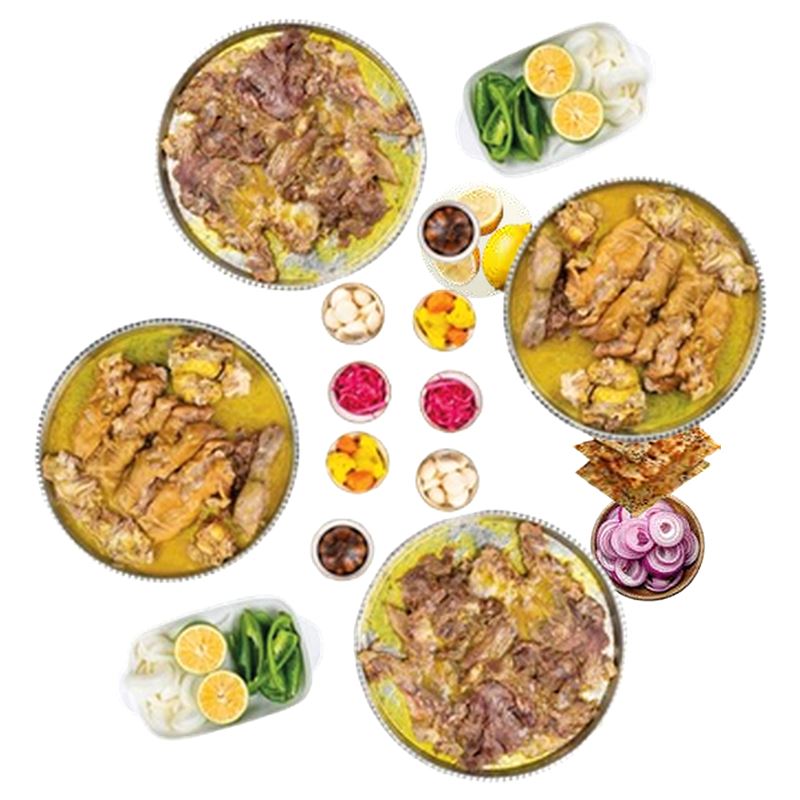
Our largest option, The Khan's Platter, is built for six and arrives as a spread rather than as servings: four lamb cheeks, eight trotters, two brains, three tongues, four eyes and five breads. That is close to how this food has traditionally appeared, in the middle of the table, with bread, everyone reaching in. Smaller households often prefer The Full Dish for three, or the Double Dish for two.
Which moment of the holiday are you actually feeding?
| The moment | What the table needs | What fits from our kitchen |
|---|---|---|
| Very early, before the family scatters | Something hot, at a fixed hour, no cooking | Soup on its own, or Brain Soup. We are open through the night |
| Late breakfast, relatives arriving | A spread that keeps expanding | The Khan's Platter for six, extra Sangak Bread, Mixed Torshi |
| Guests who have never tried it | Range, not one texture | The Full Dish plus singles: Meat, Tongue, and an Omelette for anyone who would rather not |
| Sending food to a neighbour | Something that arrives complete | Double Dish or The Full Dish with bread and torshi, to their address |
| Quiet second day, smaller group | Less volume, more comfort | Single Dish, Trotters or Lamb Cheek, with Sangak and Doogh |
| Dine-in with the family | A table, time, endless tea | Reserve a table. The Kettle of Tea is dine-in only |
Is your kitchen even open during the holiday?
Yes. One kitchen, at 64 Jumeira Street in Jumeirah 1, open 24 hours every day, including through Eid. There are no branches: every order comes out of that same kitchen and goes across Dubai from there. The phone is 04 321 8882, and it is the only contact channel we run.
I am hosting and the day is already chaotic. Can I fix a time in advance?
This is the practical worry underneath most Eid calls, and the answer is simple. You can schedule an order for a specific future hour, up to about two days ahead. Choose the time you want the food to arrive, pay by card at checkout, and the order waits until then, so you can set it the night before rather than at seven in the morning while the house fills up.
The rest works like any other day. No account, no sign-up, no app: name and phone, plus your Dubai area from the list and a pin on the map for delivery. Payment is secure online card at checkout, the only method we take, and delivery is free over AED 300. Once the kitchen confirms, it sets an estimated time and your order gets its own page. The rider phones on arrival, so keep that number to hand. If the kitchen cannot take an order, it is refunded automatically to the card that paid, with the reason shown on the order page. Full walkthrough: step-by-step ordering guide.
What if half my guests will not touch offal?
Then feed them something else at the same table and do not make a thing of it. The simplest fix is range: order a couple of singles alongside the platter, so the table offers a spectrum instead of one texture. Meat, Tongue and Lamb Cheek read as ordinary braised lamb. Soup on its own asks nothing of anybody. Sangak Bread, Mixed Torshi and Garlic Torshi are what everyone reaches for anyway. More for guests who are not into offal, and on starting with soup only.
And nobody should be pushed. The fastest way to make a guest resent a dish is to turn their hesitation into a topic of conversation. Put it on the table, say what each thing is, and let people choose.
Is it too heavy for a day that is already full of food?
For some people, yes, and it is more honest to say so. This is rich food, and on a day that often already includes several meals that matters. Only you know how your body handles it; some people order Soup on its own for that reason. None of this is medical advice. For anything about fat, cholesterol, digestion, or how often food like this suits you, please ask your doctor or a qualified dietitian. We are a kitchen, not a clinic, and we will not tell you what is safe for you or how often anything should be eaten.
The short version
Kalle pache is not a curiosity bolted onto Eid. It comes from the same instinct that has long sat behind the qurbani table: the animal was used completely, the difficult parts were cooked with skill rather than discarded, and the result was shared widely. Whether that belongs on your table this year is yours to decide. If it does, we are open through the holiday, and you can start from the homepage or call 04 321 8882.
