Why is kalle pache a favourite for Eid mornings in Dubai?
Eid is the morning the table comes back to life. For a month during Ramadan the eating happens in the dark — a quiet suhoor before dawn, iftar after sunset — and then, on the first morning of Eid al-Fitr, the whole rhythm flips. The sun is up, the fast is over, and for the first time in thirty days a family can sit down together in daylight and eat a proper, generous breakfast without watching the clock. In Iran that first Eid breakfast has always been a big one, and in a Persian household it very often means a pot of kalle pache: hot, rich, served straight from the middle of the sofreh with fresh sangak to tear and dip. In Dubai, where the extended family may be scattered across Marina, Jumeirah, Deira and Al Barsha, Eid is the day everyone finally converges on one flat — and the food has to be worthy of the reunion.
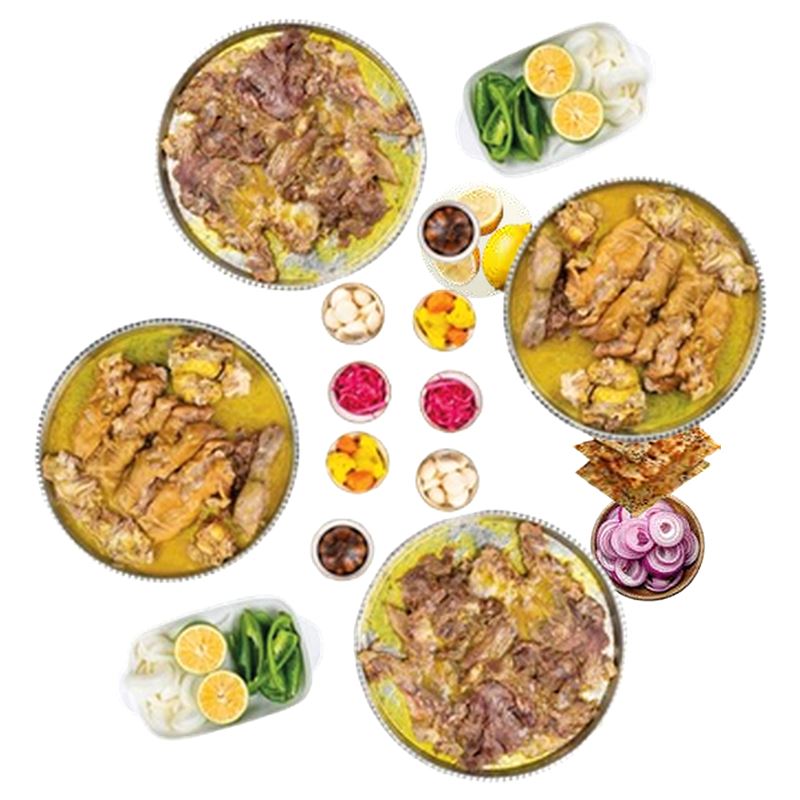
Kalle pache earns that role because it is, by nature, a communal dish. Nobody eats it alone in a hurry. You order the pieces, you pass them around, someone claims the tongue, a braver cousin goes for the brain, the children work through bread and broth, and the meal stretches across a long, slow, talkative morning. That is exactly the shape an Eid gathering wants to take.
Is kalle pache for Eid al-Fitr or Eid al-Adha?
Both, and for slightly different reasons. Eid al-Fitr closes Ramadan, and its pull is the return of the daytime feast — the celebratory morning meal after a month of fasting, when a hearty platter feels earned. Eid al-Adha, the feast of the sacrifice, carries a second meaning that suits kalle pache almost too neatly. Eid al-Adha honours the animal that is given, and the oldest ethic of the Persian kitchen is that nothing of that animal is wasted. Kalle pache is the whole-animal dish — head and trotters, tongue and cheek, the humble cuts turned into something worth gathering for. On the morning after the sacrifice, a dish built on respect for every part of the lamb feels less like a novelty and more like the point.
How much kalle pache should you order for an extended-family Eid?
The honest answer is: more than you think, because Eid appetites are large and everyone wants to try a bit of everything. Our platters come sized for one, two, three or six people, and the six-person platter is the natural centre of an Eid order — one or two of those, then a few singles to keep the specialists happy. Someone always wants their own plate of tongue (zaban); someone else lives for the trotters (paye) or the lamb cheek (bonagoosh); the brain (maghz) is a treat for those who know. Round it out with the Special Mix if the table can't decide.
Here is a rough guide for a Dubai gathering:
| Gathering | Suggested order | Don't forget |
|---|---|---|
| 2–3 (a small family) | One 2- or 3-person platter | Sangak, a pot of tea |
| 4–5 | One 3-person platter plus a couple of singles | Mixed torshi, doogh |
| 6–8 | One 6-person platter plus 2–3 singles | Special sangak, seven-year garlic pickle |
| 10–12 | Two 6-person platters plus a few singles | A dizi (abgoosht) for variety, extra sangak |
| 15+ (the whole clan) | Several 6-person platters mixed with singles | Pre-order ahead; plenty of tea and doogh |
Free delivery kicks in over AED 300, which most family-sized Eid orders comfortably pass, and the exact delivery fee for your area is shown at checkout before you pay. You will find every platter and single on the menu and order page.
Can you pre-order kalle pache for the Eid morning rush?
Yes, and on Eid you should. Eid morning is the single busiest breakfast of the year for a dish like this, and the kitchens that make it properly are working flat out. Because everything we serve is hand-cleaned before dawn and then simmered for around fourteen hours in a copper pot — with onion, turmeric and garlic, skimmed by hand every hour until the broth turns the colour of strong tea — there is no way to conjure a batch into existence at eight in the morning. Kalle pache is made slowly, on purpose. So the smart move for Eid is to schedule your order ahead: pick the morning and the time you want it, place it in advance, and let it be ready and on its way while you are still setting the sofreh.
We are open 24 hours a day, seven days a week, so whether the family gathers at first light or mid-morning, the timing is yours. Delivery reaches all of Dubai — every area of the city — with the fee chosen by area at checkout and shown before you pay. Payment is secure card payment online; you settle it when you order, so nothing has to be sorted out at the door on a busy Eid morning. Pickup is there too, which many hosts prefer so they can collect on the way back from Eid prayers.
How do you set an Eid sofreh at home?
A sofreh is the Persian way of laying a table: a shared cloth or surface with everything in the middle and everyone reaching in, rather than separate plated portions. For Eid, build it around the platters and then dress it generously. Order plenty of sangak, or the special sangak, because half of eating kalle pache is tearing warm flatbread and soaking it in broth. Put out mixed torshi and the seven-year garlic pickle for their sharp, bright contrast against the richness. Keep tea coming throughout, pour doogh for those who like the savoury tang, and lemonade for the children. If some of the family are not offal enthusiasts, add a dizi (abgoosht) to the order — the same slow-cooked comfort in a form that wins over the cautious.
Would you rather host Eid at the restaurant?
Not every Dubai flat can seat the whole extended family, and on Eid that is a common problem. If hosting at home is not practical, you can reserve a table and let everyone come to us instead. We are one kitchen at 64 Jumeira Street in Jumeirah 1 — not a chain, and not a branch on every corner, but a single Tehran-style kitchen that cooks through the night and delivers across the city. Dine-in means the family gets the full sofreh laid out for them, the bread arrives warm, and nobody has to do the washing up on Eid.
Is the lamb halal, and is a big Eid platter a good idea?
Yes to the first, without qualification: in the UAE all meat is halal by law and standard, and the lamb we use — head and trotters — is halal. On the second question, kalle pache has been treated for centuries as a rich, restorative morning food, said in tradition to be full of collagen and gelatin drawn from the bones during the long simmer, eaten warm and slowly with bread. We share that as culinary tradition and general interest, not as medical or dietary advice, and we make no claim that it cures, treats or heals anything. Eid feasting is generous by design; if you have a health condition, a dietary restriction, or any concern about rich food, please speak to your doctor about what is right for you.
How do I order kalle pache for Eid in Dubai?
Build your platters and singles on the menu and order page, choose delivery, pickup or dine-in, and — this is the one piece of Eid-specific advice — schedule it ahead so it lands exactly when the family sits down. We are at 64 Jumeira Street, Jumeirah 1, open around the clock every day of the year. Order early, set the sofreh, and let the reunion take care of itself. Eid Mubarak.
