How do Iranians celebrate Nowruz in Dubai?
Nowruz in Dubai is a holiday kept on Tehran's calendar and Dubai's working hours at the same time. Nowruz — literally now (new) and ruz (day) — is the Persian New Year, and unlike most new years it does not begin at midnight. It begins at the exact astronomical instant the sun crosses the celestial equator and spring starts. That moment is called tahvil-e sal, the turning of the year, and it pays no attention to office hours: it can fall at nine in the evening, at noon, or at ten past three in the morning. Families dress up, perfume the room, sit around the table and wait for the second to arrive. Because Nowruz is not a public holiday in the UAE, a household in Jumeirah or Al Barsha may be wide awake and beautifully dressed at 3am — hugging, crying a little, handing out eidi — and back at a desk by nine. One practical note for Dubai: the UAE clock runs half an hour ahead of Tehran's, so the tahvil you grew up with arrives thirty minutes later on your phone here than it did back home.
What goes on a haft-sin table?
The haft-sin is the heart of the house during Nowruz: seven things whose Persian names begin with the letter س (sin), each standing for something you want more of in the coming year. Sabzeh, a dish of sprouted wheat or lentils, for rebirth. Samanu, a dark wheat pudding stirred patiently for hours, for strength. Senjed, dried oleaster, for love. Seer, garlic, for health. Seeb, apple, for beauty. Somaq, sumac, for the colour of sunrise. Serkeh, vinegar, for age and the wisdom that supposedly comes with it. Around the seven, people arrange a mirror, candles, painted eggs, a hyacinth, goldfish in a bowl of water, and a volume of Hafez to open at random for the year's first omen. In Dubai the whole table is easy enough to assemble: sprout the sabzeh yourself about ten days ahead, and pick up samanu, senjed and nuts from the city's Iranian grocers.
Two of those seven quietly explain the Persian kitchen: garlic sits on the table as a symbol of health, and samanu earns its place purely by being cooked slowly for an absurdly long time. Persian cooking trusts patience. That is the same logic that produces a fourteen-hour pot of broth.
What is Chaharshanbe Suri, and what do people eat the morning after?
On the eve of the last Wednesday before Nowruz comes Chaharshanbe Suri, the festival of fire. Small bonfires are lit, people leap over them and call out zardi-ye man az to, sorkhi-ye to az man — "my pallor to you, your red glow to me". Children knock on doors banging spoons against bowls. Everyone eats ajil-e moshkel-gosha, the "problem-solving" mix of nuts and dried fruit. It runs very late: smoke in your hair, cold hands, three conversations at once, nobody in bed before two in the morning.
The morning after has its own quiet tradition. In Tehran, the dawn broth houses are at their busiest in exactly these hours, when people who were up all night arrive hungry, hoarse and in need of something hot. That is the oldest role kalle pache has ever played: not a feast dish, but the thing that puts a household back together after a long night.
What do Iranians eat across the thirteen days of Nowruz?
Nowruz is not one meal, it is a fortnight with a menu. Each stage has its own food and its own mood.
| Moment | What is traditionally eaten | The mood |
|---|---|---|
| Chaharshanbe Suri (fire night) | Ajil-e moshkel-gosha: nuts, dried fruit, roasted chickpeas | Loud, outdoors, very late |
| The dawn after the fires | Hot broth, fresh sangak, strong tea | Quiet, restorative, early |
| Tahvil (the turning of the year) | Sweets, chickpea cookies, baklava, endless tea | Dressed up, whole family waiting |
| New Year's night dinner | Sabzi polo ba mahi — herb rice with fish — and kuku sabzi | Green, fragrant, festive |
| Days 2–12, did-o-bazdid (visiting) | Reshteh polo, ash reshteh, sweets, fruit, more tea | Hospitality on rotation, long days |
| Sizdah Bedar (day 13) | Picnic food outdoors, ash, grilled meat, the sabzeh thrown into water | Parks, mats, the holiday closing |
Where does a bowl of kalle pache fit into Nowruz?
Honestly: not in the middle of it. Kalle pache is not a haft-sin dish and nobody serves it at the tahvil moment. It belongs to the edges — the dawn after Chaharshanbe Suri, the early morning before a day of visiting relatives across four different neighbourhoods, and the day the sweets have finally defeated everyone and someone says the word kalle pache and the whole room agrees.
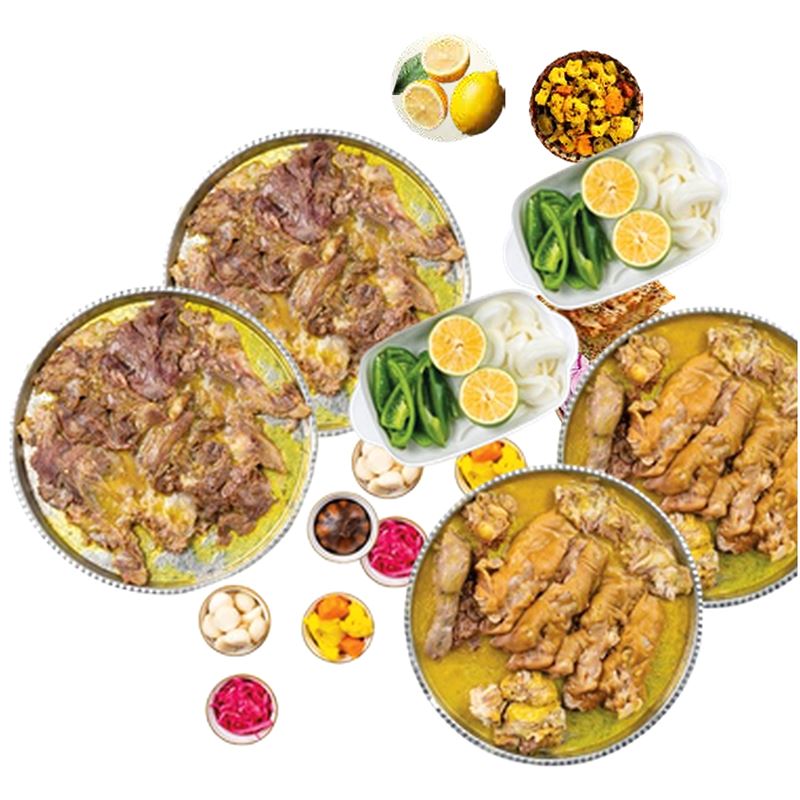
What we serve at Shaun the Sheep on Jumeira Street is Tehran-style. Everything is hand-cleaned before dawn, then simmered for around fourteen hours in a copper pot with onion, turmeric and garlic, skimmed hourly until the broth is the colour of strong tea. You can order the pieces individually — brain (maghz), tongue (zaban), trotters (pache), lamb cheek (bonagoosh), meat, tripe (sirabi), brain soup, plain soup, or the Special Mix — or take a communal platter and let the table sort itself out. It is all on the menu and order page.
How do you set a Nowruz sofreh for family in Dubai?
A sofreh is not a set of plates, it is a shared surface — cloth on the floor or a table pushed against the wall, everything in the middle, everyone reaching. Platters come for one, two, three or six people, so a gathering of nine is two platters and a couple of singles for the fussy cousins. Order plenty of sangak, or special sangak, because half the meal is tearing bread and dipping it. Add mixed torshi and the seven-year garlic pickle — which, pleasingly, is the same seer that sits on the haft-sin for health, only aged until it is black and sweet. Hot tea throughout, doogh for those who want it, lemonade for the children.
If your Dubai flat cannot hold everyone, you have two other doors. You can reserve a table and let the family come to Jumeira Street, or order delivery across Dubai with the fee set by area at checkout. Pickup works too, which is what most people choose on the morning of a busy visiting day.
Is the lamb halal, and is kalle pache wise after a long night?
Yes to the first: in the UAE all meat is halal by law and standard, and the lamb we serve is halal. As for the second — kalle pache has been treated for centuries as a restorative dawn food, rich in collagen and gelatin drawn from the bones and trotters, warm, and eaten slowly. We share that as culinary tradition, not medical advice, and we make no health claims or promises. If you have a medical condition or a dietary restriction, ask your doctor rather than a blog.
How do I order for Nowruz in Dubai?
We are at 64 Jumeira Street, Jumeirah 1, and we are open 24 hours a day, seven days a week — including the night of the fires and the morning the year turns. Build your platters on the menu and order page, choose delivery, pickup or dine-in, and give the table an hour to fill up properly. Eid-e shoma mobarak.
