Which Persian dishes get cooked because of the day, not the appetite?
More than twenty of the recipes on this blog say, in their own text, that they belong to a particular day: a wedding, a New Year table, a fasting month, the longest night of the year. Nobody had put them in one place. Every occasion below is one the recipe claims for itself.
Our piece on why lamb runs through Persian cooking already makes the connecting argument, that the sheep became the currency of important moments. This one asks what gets cooked around it.
What makes a rice dish a celebration rice rather than a weekday one?
Read the celebration recipes back to back and the same five markers appear. Not one of them is difficulty.
- Colour you can see from the door. Ruby cherries, ruby barberries, saffron gold. Our albaloo polo recipe puts it plainly: the colour alone tells you it belongs at a party.
- A garnish that costs an afternoon. Shirin polo's orange peel is slivered, boiled through two or three changes of water, then candied, and the barberries get a pan to themselves. Our recipe says that afternoon of slivering, blanching and candying is exactly why the dish belongs to weddings and feast days.
- A shape that has to be turned out whole. Tahchin is bound with yogurt and egg yolk so it sets firm and slices like a cake, then inverted onto a platter. Weekday rice never has to survive that.
- Saffron, and not a pinch of it. Most of these recipes start by blooming ground saffron in hot water until it runs deep red, not by dusting it on at the end.
- Layering instead of stirring. Cherries go into albaloo polo in layers, never stirred through, and the top layer stays plain rice. Stirring is what weekday rice gets.
For the repertoire ranked by where the work sits rather than how hard it is, see which Persian dish to cook first.
Which rice dishes do our own recipes call celebration dishes?
Seven. Here is what each says about itself.
| Dish | The occasion it claims | What marks it out |
|---|---|---|
| Albaloo polo | Weddings, Nowruz tables, unhurried Friday lunches | Sour cherries layered into ruby-red rice, nuts scattered on top |
| Shirin polo | Weddings, the Nowruz table, Shab-e Yalda | Candied orange peel, barberries and slivered nuts, the jewels |
| Zereshk polo ba morgh | Weddings, Nowruz tables, big family lunches | Barberries in butter, saffron rice, chicken braised separately |
| Baghali polo ba mahiche | Nowruz, weddings, Friday lunch with the whole family | Dill and fava rice under a lamb shank cooked until it slides off the bone |
| Tahchin | A guest you want to impress; weddings, celebrations | A saffron rice cake, turned out whole and cut into wedges |
| Sabzi polo ba mahi | Nowruz; our recipe calls it Iran's most famous festival dish | Herbs for the green of a new year, with fish alongside |
| Reshteh polo | The new year, and the night before a big undertaking | Toasted noodles; reshteh means thread, and the dish carries a wish |
What sits beside the celebration rice?
Two things, and neither is rice. Fesenjan is the stew our recipe calls traditionally a dish for weddings, Yalda night and the Nowruz table: ground walnuts and pomegranate molasses cooked down for hours until the sauce goes almost black-brown and the walnut oil rises.
The other is the cold bowl. Mast-o-khiar, yogurt with cucumber and dried mint, is everyday food, but its dressed-up form, borani, folds in walnuts, soaked raisins, dill and rose petals, and our recipe calls that the festive version you meet at weddings and Nowruz spreads. The same recipe calls the plain bowl the cool spoonful that resets the palate against char and fat.
What does the fasting month bring out of the kitchen?
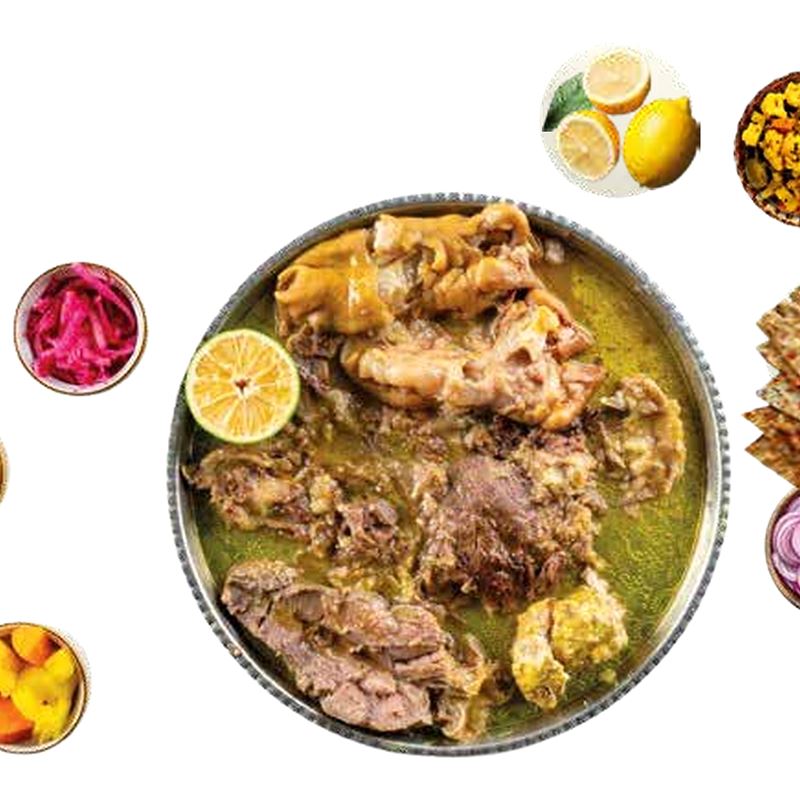
Two dishes our own Ramadan writing has never named — that writing is about kalle pache and timing it around a fast.
Zoolbia and bamieh are a pair: a lacy fried lattice and a small ridged fritter, from two completely different doughs, dropped hot into cool saffron-rose syrup and eaten with tea. The recipe calls them the two sweets Iranians most associate with breaking the fast.
Haleem is the other half of the month and the opposite of a sweet: wheat and meat beaten together until they melt into one stretchy paste. The recipe is direct about why it belongs to Ramadan: a bowl at suhoor has to carry you through a fasting day.
Which of these has nothing else on the blog ever mentioned?
Two, and they are why this article exists.
Nan-e nokhodchi is the pale, clover-shaped chickpea-flour cookie our recipe says almost every Iranian family bakes for Nowruz and that sits on the haft-sin table. Search the rest of this blog and the name appears nowhere else.
Ash-e anar has the same gap in reverse. Our Yalda article lists the red things on that table, pomegranate and watermelon and ajil, and never mentions the ruby soup made from the first of them, though its own recipe calls it a Yalda soup.
Where do nazri and the Nowruz table fit in?
Both are covered elsewhere, so this piece does not repeat them. Kalle pache during Muharram and Ashura sets out which dishes are most associated with nazri, and what Iranians eat across the thirteen days of the new year is in our Nowruz guide.
Do you have to wait for an occasion?
No. Most of these were only ever occasion food because somebody had to find the afternoon for them. Nothing stops you cooking zereshk polo on a Tuesday.
We are a Tehran-style kalle pache house on Jumeira Street and we cook none of the dishes above; the recipes are here because people ask for them. What we do cook simmers about fourteen hours and goes out twenty-four hours a day, seven days a week. Order it for delivery, pickup or dine-in, with the fee for your area among 141 Dubai areas shown at checkout, and schedule it for the hour the occasion starts.
