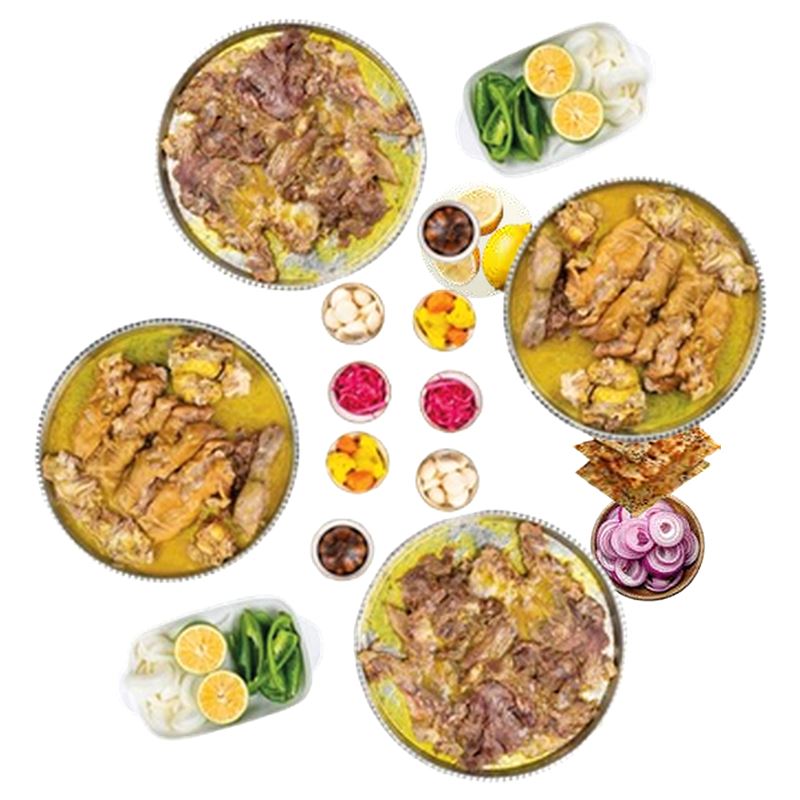
There are eight of you, or twelve, or twenty. Somebody has a birthday, or a brother is visiting, and the idea is kalle pache — not boxes sent to a flat, but eaten here at one long table, with the sangak going round. It is a good idea, and also the plan that most often comes unstuck, nearly always for one reason: nobody said a word to us until they walked through the door.
How big can a group be and still eat together in the room?
Bigger than most people assume, and not a number we will print on a page. It depends on the night: which tables are free at your hour, and whether the ones that can be pushed together come free together. A table that size is a plan, not a piece of luck — it has to be assembled before you arrive, not while nine of you stand in the doorway.
So the honest answer is the one you get on the phone: tell us the night, the hour and the number, and we will say plainly what we can do. What we will not do is promise a table we have not looked at.
Why does a weekend night need more planning than a quiet weekday one?
The kitchen is not the constraint. It runs 24 hours a day, seven days a week, and nothing about your headcount worries it.
The room is. On a quiet weekday a party of ten can nearly walk in. On a busy weekend night, seating ten together means several neighbouring tables finishing at the same moment, or those tables held for you from earlier — a decision somebody makes before you arrive. And a big group never turns up at once: four early, six on time, two lost on Jumeira Street. Tell us the shape of it and we can start the ones who are here with soup and bread.
Is it worth calling ahead, and what should you tell us?
It is worth it, and it takes a minute. We are open around the clock, so there is no wrong hour to ring: +971 4 321 8882. If writing is easier than talking, the same details reach us through the reservation page. Tell us five things.
- How many people, as a real number. "About fifteen" and "fifteen, possibly seventeen" are different problems for us.
- What hour you want to sit down. Not "the evening". An hour.
- How long you want the table. A group that eats and goes is a different arrangement from one that sits until very late.
- Who is in the group — children, elderly parents, someone who has never seen this dish, someone who will not eat it at all.
- One name and one phone number. Large groups go wrong when three people have each half-arranged something.
How do the three- and six-person platters map onto a table of eight, twelve or more?
The menu is built for this. Alongside the single parts — brain, eye, tongue, meat, tripe, trotters, meat and fat, the special mix — there is a single dish, a double dish, a three-person platter and a six-person platter, and the platters come with bread. A large table is mostly a matter of combining the last two and adjusting with singles.
| At the table | A sensible starting point | What to adjust with |
|---|---|---|
| Eight | One six-person and one three-person platter | A soup or two for lighter eaters, extra sangak |
| Ten to twelve | Two six-person platters | One at each end, not both in the middle |
| Fourteen to sixteen | Two six-person and one three-person platter | Singles of tongue and meat for anyone cautious |
| Eighteen to twenty | Three six-person and one three-person platter | Two waves, so the second half arrives hot |
This is a rich dish, and many large tables find that what actually gets eaten is less than the headcount suggested, so start near your number and add singles rather than over-ordering. Soup, brain soup and a deezi all help here, since they can go down in front of everybody first. The platters guide goes through the parts, and how much sangak you need answers the next question.
How do you keep a large table eating at the same moment instead of in waves?
- Order for the table, not per person. Twenty separate orders arrive strung out over a long stretch.
- Split the platters to both ends. A long table has no middle that everyone can reach.
- Start everybody with soup. It comes out together and gives people something to do while the rest is plated.
- Bread, torshi and doogh within arm's reach of every seat. One basket for twenty will live at one end all night.
- Say whether you want it all at once or in two waves. At eighteen or twenty, two waves usually eats better.
Kalle pache also changes as it cools, and on a long table that happens unevenly.
What is the easiest way to seat a mixed group where some have never seen the dish?
Most big weekend tables are mixed: half the group orders by part without looking, and the other half has been hearing about it all week.
Do not put the newcomers together at one end. Spread them among the people who know it — it is easier when the person beside you is already tearing bread — and aim the food that way: soup, tongue and meat toward the newer end, brain and eye toward the people who came for them. Send them the first-timer's guide beforehand, or read ordering for a mixed group.
If the hour cannot be arranged, is collecting or delivery the better fallback?
Sometimes the honest answer on the phone is that your hour is not free. If the gathering could just as easily be at somebody's home, pickup suits a group with one driver and a boot that holds platters level. If nobody wants to leave, delivery needs a full address, the map pin on the actual door and a phone that will be answered. If guests arrive at a set time, place a scheduled order: you choose the hour you want to receive it, and the kitchen works back from there.
Delivery fees depend on the area and are shown at checkout. How pickup works covers collecting, and how far ahead to order for twenty people covers eating at home.
We are at 64 Jumeira Street, Jumeirah 1, Dubai, open 24 hours a day, seven days a week, and the lamb is halal in line with UAE law and standards. For a weekend table of eight to twenty, ring +971 4 321 8882 with your number, your hour and how long you want to sit, or use the reservation page. The menu is there when you are ready.
