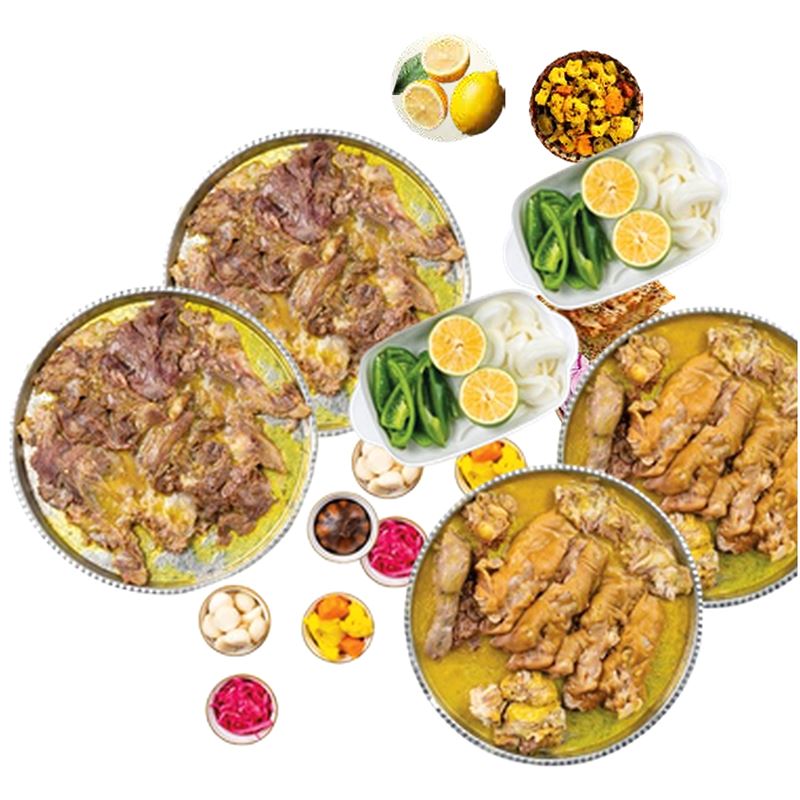
Friday in Dubai has a shape no other day has. The morning is slower, the messages stop arriving, and somewhere in the middle of the day the people who have not sat down together all week end up in the same room. That gathering has to be fed, and it rarely wants a quick meal.
Most people here file kalle pache under breakfast, and traditionally they are right. But look at what makes it a dawn dish — the long cooking, the shared plates, bread instead of cutlery, a table nobody gets up from quickly — and it is the list a Friday family lunch quietly asks for.
Why does a Friday in Dubai ask for a different kind of meal from a Tuesday?
A weekday lunch is a gap in the day: twenty minutes, one box, eaten close to a screen. Friday works the other way round. The eating is not really the point; the sitting is. Grandparents come who do not come on other days. Relatives arrive late and are fed anyway. Children run off, come back for a piece of bread, run off again. Families arriving together after prayers are in no hurry, and the table has to stretch for them.
So the food is asked to do a different job: not fast, but generous, easy to share from one dish, and slow enough that nobody feels the table is finished.
Why does a pot that has cooked all night suit a table where nobody is in a hurry?
Lamb head and trotters cannot be hurried. They are simmered for hours through the night, until the connective tissue gives way, the broth thickens on its own and the meat comes off the bone without argument. There is no fast version: a kitchen either started last night or it did not.
You do not eat a shared platter of kalle pache in ten minutes. You tear bread, take a little, talk, then go back for the piece you liked. Food that took that long carries its pace to the table.
Our kitchen runs 24 hours a day, seven days a week, so a Friday lunch is no special arrangement: there is always a pot that has been on for hours. More on that in how kalle pache is made.
Is kalle pache too heavy for the middle of the day, and how do you order a lighter version of it?
It is a rich dish and we will not pretend otherwise. It is also, and this is the part people miss, something you assemble piece by piece: ordering kalle pache does not oblige you to order the richest thing on the menu.
The light end is soup — clear, warm, savoury, an easy first bowl for anyone unsure. Tongue and meat sit in the middle, familiar in texture. Brain, meat-and-fat and the special mix are the rich end, and a little of those goes further than people expect: the dish is rich in collagen and protein, which is why a small portion satisfies. Torshi earns its place at a daytime table: the sharpness cuts the fat between bites.
A practical rule for lunch: fewer rich items than you think, more bread and torshi than you think. More in how to lighten your order and the soup-only route.
Should the family dine in, collect on the way home, or have it delivered?
All three are open on a Friday, and the right one depends on the shape of your day, not on the food.
| Your Friday | Usually the best fit | Worth knowing |
|---|---|---|
| Everyone converging on one home | Delivery | Pin the entrance you really use and keep the phone with you |
| You are passing Jumeirah anyway | Pickup | Order and pay first, then collect from 64 Jumeira Street |
| Nobody wants to host or wash up | Dine-in | Open 24 hours, so a late lunch is normal |
| Guests arriving at a fixed hour | A scheduled order | Choose the time you want to receive it at checkout |
If it is a close call, delivery, pickup or dine-in compares them properly. Delivery fees vary by Dubai area and are shown at checkout before you pay.
How do you order for a mixed table of grandparents, adults and children so everyone finds something?
Build outwards from the middle: one or two shared platters as the centre, then a few singles chosen for particular people, then bread, torshi and a drink.
| Who is at the table | A good place to start | Why it works |
|---|---|---|
| Someone who grew up eating it | Special mix, brain, eye | The parts they will look for first |
| An adult trying it for the first time | Soup, tongue, meat | Recognisable textures, a gentle start |
| Children | Soup, meat, plenty of sangak | Mild and warm; tearing bread keeps them there |
| Older guests | Trotters, soup, tongue | Soft, slow-cooked and easy to eat |
| Anyone who would rather skip offal | Deezi | A lamb stew from the same kitchen |
The 3-person and 6-person platters exist for exactly this table, and one shared platter plus a few singles beats a separate dish for everyone. See ordering for a mixed group, kalle pache for children and how much sangak you actually need.
How far ahead is it worth arranging a Friday table, and what should you say when you call?
Because the kitchen never closes, you are not racing a closing time. What you manage is your own household: when people actually arrive. For a table where the hour matters, a scheduled order is the tidy answer: choose the time you want to receive it at checkout, and it waits instead of landing while half the family is still on the road. Scheduling an order in advance walks through it.
For a larger group sitting in, a short phone call is worth it. Ring +971 4 321 8882 and say four things: how many people, roughly what time, whether there are small children or older guests, and whether anyone has never eaten kalle pache before. That last one changes our suggestions more than anything else.
What turns a Friday lunch into a table people stay at?
The dishes are only half of it; what keeps people there is the small business around them. Sangak is torn rather than cut and travels hand to hand, which keeps everyone talking. Torshi sits in the middle and gets pushed back and forth. Doogh for those who drink it. Order more bread than feels sensible: it runs out first, and a second round turns a lunch into an afternoon.
The lamb is halal. The kitchen is at 64 Jumeira Street, Jumeirah 1, open 24 hours, and the site reads in English, Arabic and Farsi. When you are ready, the singles, platters and sides are on the menu, and sangak, torshi and doogh covers the rest of the table.
