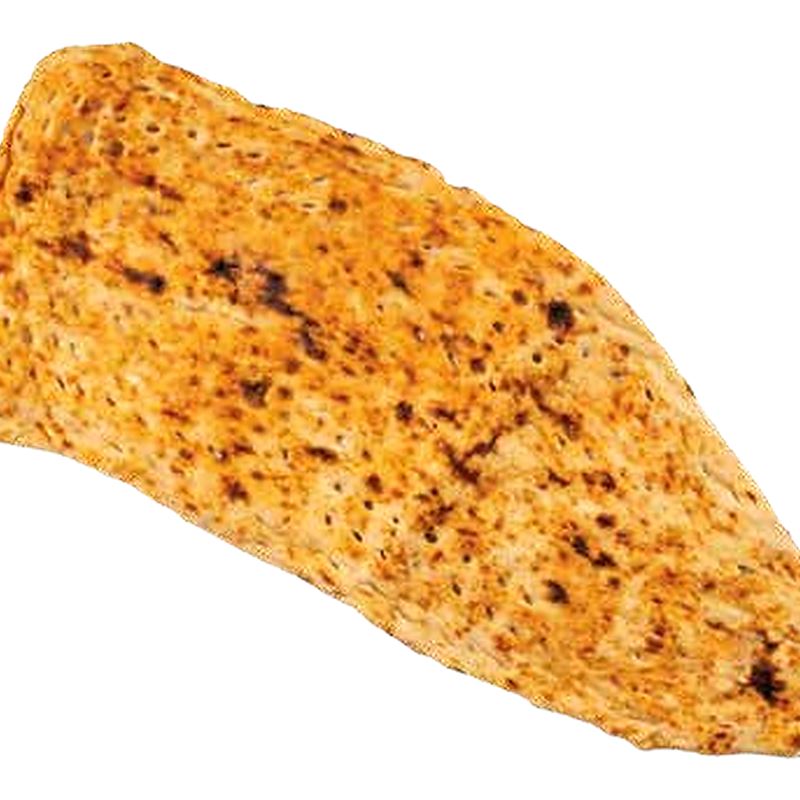
If you ordered a platter, you already have bread. Every platter on the menu includes it: a Single Dish comes with half a bread, a Double Dish with a whole one, The Full Dish with two, and The Khan's Platter with five. That one fact settles the question for most orders, because plenty of people add Sangak on top of a platter and then sit down to more bread than the table can finish.
There are three situations where adding bread is genuinely the right call: you eat tilit, you ordered singles instead of a platter, or someone at the table treats bread as the main event rather than the tool. Outside those three, what already comes with the order is usually enough. Below is the honest arithmetic, including the times we would rather you added nothing at all.
Exactly how much bread comes with each platter?
Here are the counts, straight from the menu, with nothing rounded up.
- Single Dish — lamb cheek, one trotter, half a brain, and half a bread.
- Double Dish — lamb cheek, two trotters, half a brain, tongue, one eye, and a whole bread.
- The Full Dish — two lamb cheeks, meat, four trotters, a whole brain, tongue, two eyes, and two breads.
- The Khan's Platter — four lamb cheeks, two meats, eight trotters, two brains, three tongues, four eyes, and five breads.
Read that list once before you order and you are already ahead of most people. If you want the four platters compared as platters rather than as a bread question, we set them side by side in our guide to the Single, Double, Full and Khan's.
Why is bread built into the platters at all?
Because with kalle pache the bread is not a side dish, it is cutlery. You use it to lift the cheek meat, to catch the brain, to wipe the last of the broth out of the bowl, and to carry a slice of pickle over from the torshi. A platter with no bread is a platter you have to eat with a fork, which is a different and much less pleasant meal.
That is also why the counts climb the way they do. The Khan's Platter does not carry five breads to the Single Dish's half by accident; it arrives with four lamb cheeks, eight trotters and three tongues, and every one of those wants something underneath it. If the dish is new to you, the basics of what kalle pache actually is make the bread logic obvious, and what it tastes like explains why every mouthful wants something plain alongside it.
What is tilit, and why does it change the maths?
Tilit is tearing bread into the broth and letting it soak, and it is the single biggest reason a table runs out of bread. Dry bread used for scooping lasts a long time. Bread torn into hot broth vanishes — a whole Sangak can go into one bowl and the bowl can still look like it wants more.
So the real question is not how many people are eating. It is how many of them tilit. Two people who scoop will get through less bread than one person who tears. If the ritual is new to you, we described it properly in the piece on tilit, and it is worth trying at least once — but order for it, or you will be looking at an empty bread plate halfway through.
When should you actually add Sangak?
Three cases, and between them they cover almost everything.
- Your table eats tilit. Assume the bread that came with the platter feeds the plate, not the broth. If people are tearing into their bowls, add roughly one Sangak for each person who does it. This is the case where under-ordering is the common mistake.
- You ordered singles rather than a platter. Eye, Brain, Meat, Tongue, Trotters, Tripe, Lamb Cheek, Brain Soup, Soup and Special Mix arrive as they are described — no bread. If you build your own order from singles, bread is not optional, it is the missing half of the meal.
- Someone at the table is there for the bread. Most families have one. They will eat Sangak with torshi, with the broth, with nothing at all, and they will finish the platter's share before the food is halfway gone. Add one for them and the peace at the table is worth it.
There is a smaller fourth case: you are ordering for a group whose appetites you cannot predict. Bread is the safest thing to have slightly too much of, because nobody minds a leftover Sangak the way they mind a leftover brain.
When is adding bread simply waste?
When the platter has already covered it. Two clear examples.
- A Single Dish for one person who does not tilit. Half a bread with one trotter, half a brain and a lamb cheek is a balanced plate. Adding a whole Sangak on top usually means most of it travels home in the bag.
- A table that already has five breads from The Khan's Platter. Five is a lot of bread. Unless the whole group tilits, anything on top is something you will carry out untouched.
The same goes for a Double Dish shared by two people who scoop rather than tear, and for The Full Dish between two. If your instinct is that it is better to be safe than sorry, the honest version of safe is one extra Sangak for the whole table, not one for each person.
What if you ordered singles instead of a platter?
Then nothing on your order includes bread, and this is where people get caught out. A Brain, a Tongue and a Special Mix arriving with no Sangak makes for a strange evening. As a starting point: one bread per person for a table that scoops, and one per person plus a spare if anyone tilits.
Singles are the right way to order when you know exactly what you like — someone who only wants Trotters and Tripe should not be talked into a platter. Just remember that the platter's convenience includes the bread and the freedom of singles does not. If you are still deciding, the full menu guide and how much to order per person both help.
What about Soup or Brain Soup on their own?
They come with no bread either, and they are the order where bread does the most work. A bowl on its own is a light thing to sit down to; the same bowl with Sangak beside it becomes a meal. For a table that tears, plan on one bread per person. For a table that does not, one between two is usually plenty, because scooping from a bowl uses less than you expect.
Mixed Torshi or Garlic Torshi alongside changes nothing about the count, but it does change how you use what you have — a sharp mouthful of pickle wants a piece of plain bread after it, so a table that orders torshi tends to reach for the bread a little more often.
Is Special Sangak worth it, or should you stay with plain?
Honest answer: Special Sangak is different rather than automatically better, and the two are good at different jobs. Plain Sangak is the workhorse. It is what you want for tilit, for scooping, for mopping, for every part of the meal where the bread is doing a job rather than being admired. Special Sangak is the one you order to be tasted as bread in its own right — the piece somebody picks up plain and comments on.
Which is exactly why the smart move is not to swap everything over. If a table is curious, one Special Sangak alongside the plain bread is a nicer idea than converting the whole order — you get the moment without losing the bread that is actually built for the broth. We compared them properly in Special Sangak against regular Sangak, and made the case for adding one, sparingly, in why you might add one.
A quick table: what you ordered, and what to add
Treat this as a starting point rather than a rule. You know your own table better than we do.
| What you ordered | Bread already included | If your table eats tilit | If it does not |
|---|---|---|---|
| Single Dish | Half a bread | Add one Sangak | Add nothing |
| Double Dish | One whole bread | Add one Sangak | Add nothing, or one to share |
| The Full Dish | Two breads | Add one or two | Add nothing |
| The Khan's Platter | Five breads | Add one, or one Special to try | Add nothing |
| Singles only (Brain, Tongue, Trotters and so on) | None | One per person, plus a spare | One per person |
| Soup or Brain Soup on its own | None | One per person | One between two |
How do you add bread, and what if you have already paid?
Sangak Bread and Special Sangak sit on the menu like anything else, and extra Sangak is there among the add-ons with Capsicum, Onion, Fresh Chili and Pickled Green Chili. Choose what you want on the menu page, pay securely by card online, and the order gets its own page to follow. The kitchen accepts it and sets an estimated time, and on delivery the rider phones you on arrival.
If you have already paid and then remember the bread, there is no edit button and no notes field to type into — phone 04 321 8882 straight away and the kitchen will tell you what is still possible. That number is our only contact channel, and it is answered around the clock, because we are open 24 hours a day, seven days a week. The step-by-step version of all this is in how to order online.
Does it matter whether you are eating in, collecting or getting it delivered?
A little. Bread is at its best soon after it reaches you, so at the table in Jumeirah the calculation is simple: order what you will eat now, and ask for another if the plate empties. For delivery across Dubai, which is free over AED 300, it is worth settling the bread question before you pay rather than after, since once the order is with the kitchen the only way to change anything is by phone. Pickup and dine-in are both available, tables can be reserved, and a scheduled order for a future time up to about two days ahead works the same way for bread as for everything else.
One more thing worth knowing while you plan the table: the seasoning is yours, not ours. Lime, cinnamon and garlic go in at the table, added by the person eating, which is part of why the bread matters so much — it is how you carry each adjusted mouthful. The long work happens well before that, in about fourteen hours in a copper pot. If you are new to the whole ritual, kalle pache in Dubai is a good place to start.
The short version
Bread is usually the cheapest part of your order and the easiest to over-buy. Count what the platter already brings, add for tilit and for singles, add one Special if the table is curious, and stop there. We would genuinely rather you got this right than spent more — a customer who trusts the last thing we told them is worth more to us than an extra Sangak.
