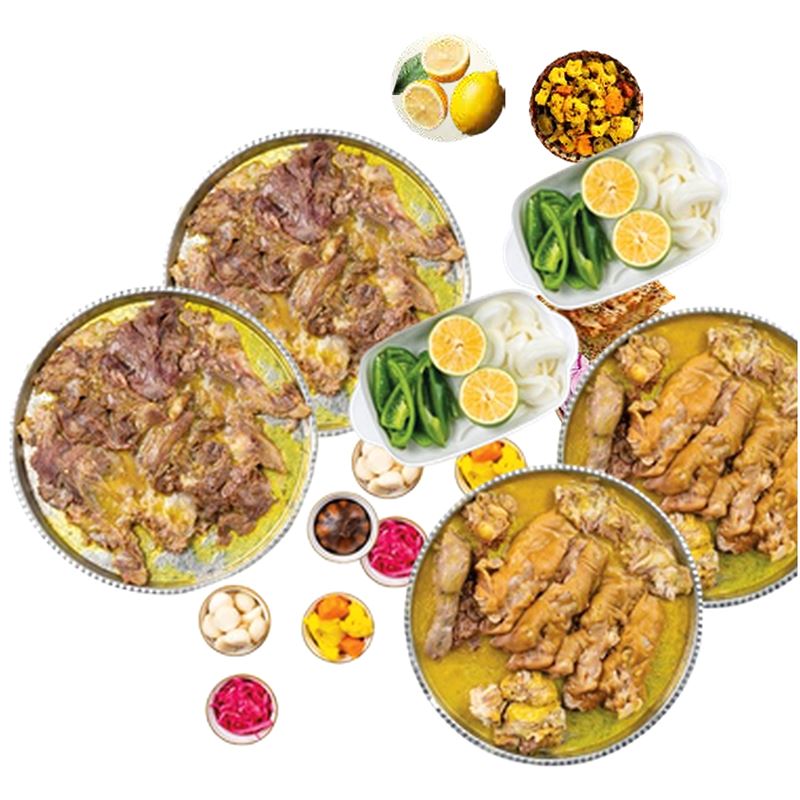
When a night crew finally calls a break at 3am, the useful question is not what is good. It is what is open. Shaun the Sheep is a kalle pache kitchen at 64 Jumeira Street, Jumeirah 1, open 24 hours a day, seven days a week, and the food fits that hour almost by accident: hot, shared from one platter, eaten with bread rather than cutlery, and set in the middle of a table so nobody portions anything out.
The rest of this is the unglamorous part. How much to order for a crew, how to schedule around a break that keeps moving, and how the handover works on a location or a build. One honest limit first: we sell food, we are not a catering company. Nobody arrives with tables, hot boxes or servers. Someone collects the order, or a rider hands it over at a gate. Inside those limits it works well.
Why is 3am the hardest meal on a night job?
Because the break gets called late, at an hour nobody predicted, and by then the choice has narrowed to a vending machine or the nearest petrol station. Dubai runs a real overnight economy: shoots waiting for the light to come back, exhibition build-ups that must hand over a finished stand by morning, installs that only get the floor once the building is empty. The people doing that work eat last, and they eat whatever survived the night in a carrier bag.
The pattern repeats. Everyone says they are fine, somebody buys three bags of crisps and a tray of energy drinks, and by 5am the mood on the floor is worse than the schedule deserves. A hot meal in the middle of a long night is a small piece of logistics that gives back more than it costs.
The measure of night food is not how good it is in the kitchen. It is whether one person, holding one phone, can get it from a gate to a table without stopping the work.
What actually helps at 3am on a job?
Hot food that arrives ready to eat, in shared platters, needing no plates, no cutlery and no reheating. That is the whole specification, and kalle pache meets it by tradition rather than by design: served hot, torn into with bread, shared from the middle instead of plated as individual covers.
Bread does most of the work. Sangak is flat, wide and strong enough to lift meat, and every platter on our menu already includes bread, from half a bread with the smallest to five with the largest. On a job that matters twice: you do not have to find plates, and you do not have to remember to add bread. If you want more, extra Sangak is there as an add-on, alongside Special Sangak. For anyone who has never met the dish, what kalle pache actually is beats a list of item names as an introduction.
Seasoning is the diner's job, not the kitchen's: lime, cinnamon and garlic go in at the table, to each person's taste, so nobody has to agree on anything before the order goes in.
What is in it, for anyone who has never tried it?
Heads and trotters are hand-cleaned and trimmed, then blanched with that first water thrown away. After that they go into a copper pot with onion, turmeric and garlic and simmer for about fourteen hours, skimmed again and again through the night. It works a night shift of its own. Our lamb is sourced to the UAE halal standard.
The result is rich, soft and savoury rather than sharp or heavily spiced, and each part tastes different from the one beside it. If someone wants to know what they are signing up for, what it tastes like, how it is made and the halal question each answer a different worry, and kalle pache in Dubai gives the wider picture.
How much do you order for a crew?
Start from the platters, then fill the gaps with singles. We only quote a share size for The Full Dish (about three) and The Khan's Platter; the smaller two are named for the appetite they suit. The table below is a guide rather than a rule, because appetites at 3am are unpredictable.
| Platter | What is in it | Roughly how many |
|---|---|---|
| Single Dish | Lamb cheek, 1 trotter, half a brain, half a bread | — |
| Double Dish | Lamb cheek, 2 trotters, half a brain, tongue, 1 eye, a whole bread | — |
| The Full Dish | 2 lamb cheeks, meat, 4 trotters, whole brain, tongue, 2 eyes, 2 breads | About three |
| The Khan's Platter | 4 lamb cheeks, 2 meats, 8 trotters, 2 brains, 3 tongues, 4 eyes, 5 breads | A bigger group |
For a crew of ten to fifteen, a sensible shape is two or three of The Full Dish plus The Khan's Platter, then a handful of singles for the people who want less: Soup, Brain Soup, Meat, Tongue, Trotters, Tripe, Lamb Cheek, Eye, Brain or the Special Mix. There is an Omelette for anyone who would rather skip offal, and Mixed Torshi and Garlic Torshi sharpen everything up. Tea travels well, and a Kettle of Tea covers a group, alongside Water, Black Tea, Lemonade, Doogh and soft drinks. For something larger, ordering for ten or more and the Khan's Platter guide go further, and the full menu guide covers every item by name.
Two counting mistakes are worth avoiding. The first is ordering bread separately when the platters already carry it, which is how a crew of twelve ends up with a table of bread and not much else. The second is ordering one platter per person: The Full Dish alone feeds about three.
One card pays for the whole order, so somebody fronts it and settles up with the crew afterwards. How groups organise and split an order is worth two minutes if that person is you.
How do you schedule when the break time keeps moving?
Schedule for a realistic window rather than an optimistic one. A scheduled order can be placed for a future time up to about two days ahead, which is genuinely useful when a night is planned. But a wrap slips, a break gets pushed, a truck arrives late, and the time you picked at 6pm is rarely the time the break lands.
Two approaches work. If the schedule is honestly unknown, order when the break is called: the kitchen is open at any hour, so waiting costs nothing. If you would rather have the food already on its way, pick the later end of your estimate, because food waiting a little is a smaller problem than a crew standing around with nothing. Scheduling ahead explains the mechanics.
And the part people forget: there is no self-service edit or cancel button, no account and no order history. If the time needs to move, phone 04 321 8882 straight away and speak to the kitchen. The earlier the call, the more can be done. That number is also our only contact channel, so there is no email and no chat, and any special request travels the same way.
How do ordering and payment work?
Ordering is online and payment is secure card prepay only. There is no cash on delivery and nothing is paid on arrival. There is no sign-up, no password and no saved cards or addresses, which helps on a job: a producer, a runner and a stage manager can each order without sharing a login. There is no invoicing, corporate account or bill-later arrangement either. The step-by-step ordering guide walks through the flow.
After payment the order gets its own page. The kitchen accepts it and sets an estimated time, which shows there, so send that link to whoever is holding the phone. We will not put a number of minutes in this article and you should not build a schedule on one. The estimate is an estimate, and the rider phones on arrival.
How does delivery work on a location or a build?
The rider phones on arrival, and cannot come onto a set, a stand, a closed floor or anywhere that needs a pass. Plan the last hundred metres yourself. In practice that means one thing above all: nominate a single person to meet the rider and put their number on the order, not the producer's, not one that will be on silent, and not one locked in a unit vehicle.
- Use the address of the gate or entrance people actually use, not the venue's headline address.
- Tell your nominated person the order exists and roughly when to expect a call.
- Make sure that phone can be answered. If they are on comms or somewhere with no signal, pick somebody else.
- Warn the gate or security desk that someone is coming out to collect, if that is the kind of place you are on.
- Agree where the food goes once it is inside, so it does not sit on a case going cold.
Delivery covers Dubai and is free over AED 300. Below that a fee applies and it varies by area, so it shows at checkout rather than here. How delivery works covers the rest.
When is pickup the surer option?
When a unit driver is already moving. If you have a vehicle and a driver with a gap in the schedule, pickup takes the whole last-mile problem off the table: no gate call, no nominated meeter, no address confusion. Order and pay online, then send the driver to 64 Jumeira Street, Jumeirah 1. The kitchen is awake all night.
Dine-in runs around the clock too, and tables can be reserved, which is worth knowing if a small unit finishes nearby. For the daytime version of the same problem, a long meeting or an office handover or a majlis, the office and majlis guide is the closer fit.
What happens if the kitchen cannot fulfil the order?
It rejects the order with a reason and the refund is automatic. That is a better outcome than a silent no at 3am, and another reason the order page matters, because that is where the status shows. We will not promise a number of days for the money to come back, since that part is not in our hands.
What we do not do
Worth stating plainly so nobody plans around something that does not exist. We do not provide catering services, crew catering, staff, servers, equipment, tables or hot holding. We do not deliver onto sets, backstage areas, loading bays or secure zones. There is no app, no account, no saved payment method, no order history, no notes field and no cancel button. Customising an order means choosing which parts and which items you want, not sending instructions to the kitchen. Anything that is not a straightforward order goes by phone to 04 321 8882.
Nothing here is medical or nutritional advice. If someone on your crew has a health or dietary question about eating on a night shift, that is a conversation for a doctor or a registered dietitian, not a restaurant blog.
A checklist for the night before
- Pick a realistic window, or plan to order the moment the break is called.
- Count platters, not people: The Full Dish for about three, The Khan's Platter for a bigger group.
- Do not re-order bread the platters already carry; add extra Sangak only if you want more.
- Add singles and an Omelette for lighter appetites, plus Torshi and a Kettle of Tea.
- Put the nominated meeter's number on the order, and tell them they are the nominated meeter.
- Use the gate or entrance address, not the headline one.
- Keep the order page open on one phone.
- If anything changes, phone 04 321 8882 immediately.
That is the whole method, and most of it comes down to one person and one phone number. Start an order on the menu whenever the night runs long. The kitchen is awake.
