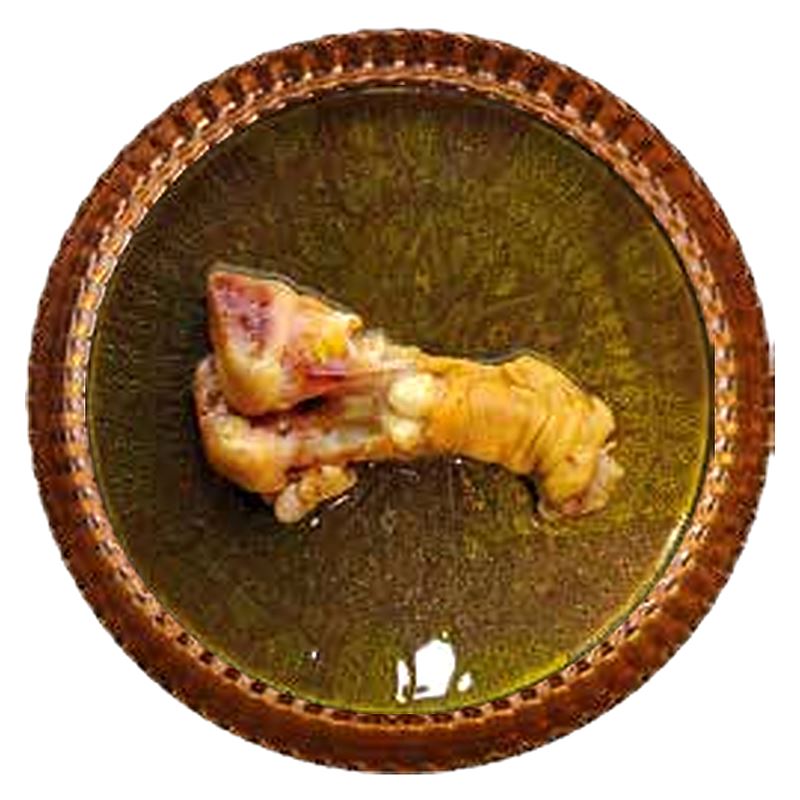
Long before the malls open, a different Dubai is already awake. Around Deira the market lanes and loading yards work under strip lights, vans are being packed, drivers are already out on empty roads, and by the time most of the city hears its first alarm that shift is hours old. Those hours need a breakfast too, and kalle pache is one of the oldest answers there is.
That is not a line invented for a website. In Iran, kalle pache has always been market food: cooked overnight, ready at first light, eaten hot and without ceremony at a shared table before the day starts. We cook it at 64 Jumeira Street in Jumeirah 1, and the kitchen is open twenty-four hours a day, seven days a week, so a four o'clock breakfast is an ordinary order here rather than an odd one. Everything we make sits on our menu and ordering page.
What does Dubai look like at four in the morning?
It looks like work. The malls are dark and the beach roads are empty, but around the creek and the old market streets of Deira there is light and movement: crates coming off vehicles, trolleys over wet concrete, shutters going up, tea in small glasses, someone counting boxes out loud. The fish is sorted while the rest of the city sleeps, and the produce that reaches a lunch table has usually been moved more than once. Bur Dubai has its own version of the same hour, and so do the yards, the airport roads and the back entrances of every shop that will look effortlessly full by ten.
We are not going to describe that shift as though we had lived it. If you are reading this at that hour you know it far better than we do, and it is not ours to narrate. The one practical point worth making is this: the city that starts at four still wants a hot breakfast, and it wants it at four, not at nine.
Why has kalle pache always been market food?
Because of when it is ready. Kalle pache is an overnight dish by nature: heads and trotters are cleaned and trimmed by hand, and the simmer that follows runs for about fourteen hours. A pot that starts in the evening comes right around dawn, which is exactly when a market is at its busiest and everybody in it has been up for hours.
Who it fed followed from that. In Tehran and in many other Iranian cities, the places that sold it commonly kept market hours rather than restaurant hours: open in the small hours, finished by mid-morning, and often eaten standing, or elbow to elbow at a shared table with people whose names you did not know. It was the breakfast of traders setting out their stalls, of porters, of drivers waiting their turn at the rank. That is the strongest thing this article has to say. The early hours are not a novelty for kalle pache; they are the point. There is more in the history of the dish and in why it is eaten at dawn.
What suits someone about to do physical work?
Something hot and substantial, which counts for more before a shift than at any other time of day. Long-simmered bones and trotters give the broth its body, and a platter with lamb cheek, meat and bread on it is a proper meal rather than something to see you through the next half hour. Bread comes with the platters, which is a practical detail when you are eating quickly or standing up.
Now the honest part: only you know what sits well before you work. Some people want The Full Dish. Some want a bowl of Soup or Brain Soup with a piece of Sangak Bread and nothing else. Some find brain heavy that early and stay with meat, tongue and trotters. If you have never eaten it before a shift, start smaller than you think you need. This is general information, not medical advice. If you have a health condition or any dietary concern, ask your doctor or a registered dietitian. For what to expect on the spoon, read what kalle pache tastes like.
How is it cooked here?
The same slow way, and it is worth knowing what you are being handed. Everything is hand-cleaned and trimmed before it goes near the pot. It is blanched first and that first water is thrown away. Then comes the long simmer: roughly fourteen hours in a copper pot with onion, turmeric and garlic, skimmed over and over so the broth stays clear. Our lamb is sourced to the UAE halal standard, which we go into in is kalle pache halal.
One thing we do deliberately: the seasoning goes on at the table, not in the kitchen. Lime, cinnamon and garlic are yours to add to your own taste, which matters more than it sounds when two people from the same crew want two different bowls out of the same pot. The full method is written out in how kalle pache is made.
Are you actually open at that hour?
Yes, twenty-four hours a day, seven days a week, with no closed window. That is the reason this article can exist at all. Three routes are open to you whatever the clock says:
- Dine-in at 64 Jumeira Street, Jumeirah 1. Tables can be reserved ahead if you are coming with a group.
- Pickup from the same address, which suits anyone whose route already passes Jumeirah 1.
- Delivery across Dubai, Deira and Bur Dubai included. It is free over AED 300; below that the fee depends on your area. There is more in our Dubai delivery guide and in our note on Deira and Bur Dubai.
We do not quote delivery in minutes and we would rather not invent a number. Once the kitchen accepts your order it sets an estimated time, and for delivery the rider phones you on arrival, so nobody has to stand watching a door. If you are behind the wheel yourself for most of the night, our piece for taxi and delivery drivers covers the same ground from the driver's seat.
Can you order the night before for four in the morning?
Yes. Scheduled orders are real: at checkout you can pick a future time up to about two days ahead, and the order simply waits instead of going to the kitchen straight away. For anyone whose day starts before the rest of the city's, this is the most useful thing on the site. You place it in a free minute the evening before, and the kitchen begins at the hour you chose rather than the hour you happened to be holding your phone.
It works the same way for pickup, which is worth knowing if you pass Jumeirah 1 at a fixed point in your morning. Planning a pre-dawn start covers the same idea for people leaving early on the road.
What does one person order?
Whatever part you actually like, because that is what customising means here. The singles are Eye, Brain, Meat, Tongue, Trotters, Tripe, Lamb Cheek, Brain Soup, Soup and Special Mix, and any of them can stand on its own with bread. The Single Dish is the smallest of the platters: lamb cheek, one trotter, half a brain and half a bread, which is a complete breakfast for most people.
Then add what makes it yours: Sangak Bread or Special Sangak, Mixed Torshi or Garlic Torshi, and Capsicum, Onion, Fresh Chili or Pickled Green Chili on the side. There is an Omelette for anyone in the group who does not want kalle pache at all, and Water, Tea, Black Tea, a Kettle of Tea, Lemonade, Doogh and soft drinks to go with it. Our complete menu guide walks through every item on the list.
How do you order for a whole crew?
By platter, and the number to watch is the bread. Four singles for four people usually leaves someone short; the platters are built to go in the middle of the table and be shared, and each one carries its own bread.
| Platter | What is in it | Bread included |
|---|---|---|
| Single Dish | Lamb cheek, 1 trotter, half a brain | Half a bread |
| Double Dish | Lamb cheek, 2 trotters, half a brain, tongue, 1 eye | 1 whole bread |
| The Full Dish | 2 lamb cheeks, meat, 4 trotters, whole brain, tongue, 2 eyes | 2 breads |
| The Khan's Platter | 4 lamb cheeks, 2 meats, 8 trotters, 2 brains, 3 tongues, 4 eyes | 5 breads |
Extra Sangak is on the menu as an add-on if the bread runs out faster than the meat, which with a hungry group it often does. A Kettle of Tea is easier to pass around than glasses ordered one at a time, and Doogh is the traditional partner for anyone who wants it. Delivery is free over AED 300, so one combined order is worth comparing against several small ones.
How does ordering work if you have never done it?
- Choose your items on the menu. Customising means choosing which parts and which items you want; there is no kitchen-instructions or delivery-notes box, so anything unusual goes by phone.
- Check out and pay by secure online card payment. That is the only way we take payment, so there is no cash on delivery and nothing to hand the rider.
- There is no account, no sign-up and no password, and no saved cards, addresses or order history. That also means there is nothing to remember at four in the morning.
- Your order then gets its own page. The kitchen accepts it and sets an estimated time, and you follow it there.
- For delivery, the rider phones you on arrival. For pickup, come to 64 Jumeira Street, Jumeirah 1.
If you want it spelled out screen by screen, we wrote a step-by-step ordering guide. If kalle pache itself is new to you, start with what kalle pache is and kalle pache in Dubai.
What if you need to change or cancel?
Phone 04 321 8882 immediately. There is no cancel or edit button on the site, and the phone is our only contact channel: no WhatsApp, no email, no chat window. That sounds old-fashioned, and at four in the morning it is an advantage. One number, the same number at every hour, and a real conversation instead of a form.
What if the kitchen cannot make your order?
Then it is rejected with a reason and refunded automatically, without you having to chase anything. We do not promise a number of days for the money to land, because that part is not ours to promise, but the refund is triggered by us rather than requested by you.
So is this a novelty breakfast?
Not for the person this article is written for. There is a version of kalle pache that gets treated as a dare, and this is not it. For a great many people it is simply what breakfast is: hot, filling, cooked slowly by someone who started the pot the night before, and eaten at the hour when the work starts.
Four in the morning in Dubai is not a scene. It is a working hour. The food that fits it is the food that was made for exactly that hour, in another city, a long time ago.
We are at 64 Jumeira Street, Jumeirah 1, all day and all night. Order from the menu page, schedule it for the hour you choose, or call 04 321 8882.
