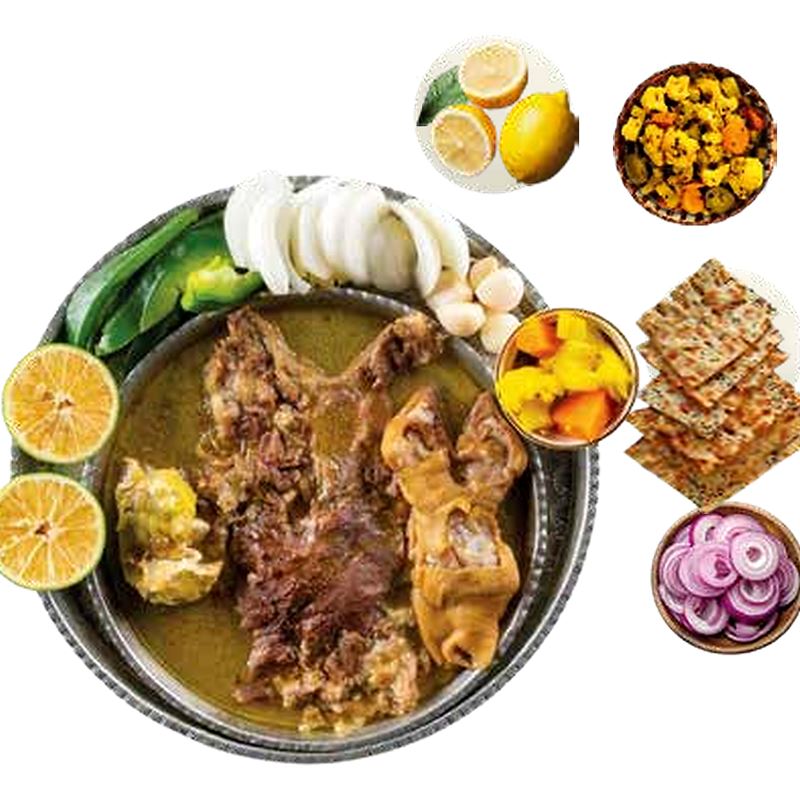
"Is it an acquired taste?" usually gets asked in a lowered voice, and what the person really wants to know is whether they will have to pretend. That deserves a straight answer, not a sales pitch: kalle pache is not one taste but a table of several, and they do not all land at once. Much of it is easy to like on the first spoonful, some opens up on a second visit, and one or two things stay a matter of personal taste.
What does "acquired taste" actually mean for a dish like this?
The phrase covers two different things. Sometimes the flavour itself is demanding — bitter, sour or sharp, something a palate must learn to read as pleasant, like black coffee or olives. Sometimes it means only that the food is unfamiliar: nothing in it is difficult, you simply have nowhere to file it yet.
Kalle pache is far more the second. The broth is not bitter, not sour and not hot: it is a long, slow, deeply savoury lamb broth with cinnamon, lime and garlic behind it, and nobody needs training to enjoy that. What is new is the spread of textures on one plate and, for most first-timers, knowing which part of the animal each came from. Those things get acquired faster than people expect. For the flavour itself, what kalle pache tastes like goes into it at length.
Which parts do most first-timers enjoy immediately?
More than they brace themselves for. The broth wins almost everyone over within three spoonfuls: rich from a very long night on the heat, never heavy on the tongue, lifted by a squeeze of lime. The plain meat is next — the best-behaved lamb stew you have eaten, leaving the bone without resistance. Trotters surprise people: faintly sweet, sticky rather than chewy. And tongue is the biggest single surprise on the menu, firm and clean, closer to a good slow-cooked beef than to anything alarming. People who announce that they will not touch it usually finish it.
Which parts more often take a second or third try?
Three, in a predictable order. Brain is the softest thing we cook, closer to a set custard than to meat, mild and faintly buttery — the taste is never the obstacle. The texture is, and usually only for a mouthful or two. Tripe has the opposite problem: the firmest, springiest thing on the plate, asking for a chew some enjoy at once and others need to meet twice. Eye is the smallest and the most talked about, traditionally offered to a guest as a mark of honour, and honestly the one most often left for another day.
The layer of fat is a question of portion, not texture: with hot broth and bread it is among the best things on the table, but eaten alone it is a lot. Our texture guide takes these one at a time.
| Part | First reaction | What it is really like |
|---|---|---|
| Broth | Liked at once | Deep and savoury, lifted by lime |
| Meat | Liked at once | Tender lamb, mild, nothing to negotiate |
| Trotters | Liked at once | Gelatinous, faintly sweet, sticky not chewy |
| Tongue | Better than expected | Firm and clean, like slow-cooked beef |
| Meat and fat | Depends on the eater | Rich; fine with bread, heavy alone |
| Tripe | Often a second try | Springy and mild, asks for a real chew |
| Brain | Often a second try | Very soft and buttery, mild in flavour |
| Eye | Most often postponed | Small and soft, the honour portion |
Is it the flavour people adjust to, or the texture and the idea?
Almost always the last two, and the idea more often than the texture. Hand somebody a spoonful of our broth with a little meat in it and say nothing, and a bad reaction is unlikely: it reads as lamb stew, and a very good one. Name the parts first and a different process starts, one with nothing to do with the tongue. That is no criticism of anybody: we taste with what we already believe about the food. Which is why the useful advice for a hesitant first-timer is rarely about seasoning, but about the order you eat in, how hot the bowl is, and who you sit with.
The aroma is worth being honest about too: a pot going all night smells strongly of lamb, and an unfamiliar smell makes people cautious before a spoon is lifted. See does kalle pache smell strong.
What familiar foods give you a useful reference point?
Kalle pache belongs to a very large family: nearly every food culture that has been poor and patient has a dish where bones are simmered overnight and eaten early in the morning. If you have had Korean seolleongtang, Mexican menudo, Greek patsas, Vietnamese pho at dawn, or Pakistani paya and nihari, you know where to file this — not a new idea, only a new accent of one you know. If none ring a bell: roasted bone marrow on toast, the sticky part of a slow-cooked lamb shank, chicken soup made from a whole carcass rather than a cube.
How can you set up a first visit so you get a fair impression?
A first plate can be set up to be fair, or to be a test. Five things make the difference.
- Come hungry. Richness that is welcome at appetite is tiring at half-appetite.
- Start light. Soup or brain soup is the gentlest way in, and a single dish is the next step up.
- Eat it hot. The best window is narrower than a grill's: broth, gelatine and fat all change as they cool.
- Sit with someone who eats it, and let them lead the order.
- Use the tools on the table. Lime, cinnamon and sangak, torshi and doogh are not decoration: warm bread makes each mouthful familiar, the pickles cut the richness, the cold yogurt drink resets the palate. The first-timer's method sets out the order.
And do not feel obliged to finish everything. Leaving the eye for another day is how most people who now love this dish began.
What if it never becomes your thing — is that a normal outcome?
Completely normal, and we would rather say so than pretend otherwise. Nobody owes a dish an appreciation, and a food culture loses nothing when somebody tries it honestly and decides it is not for them; we took that up in what if you do not like it. There is also a middle landing, more common than either extreme: people who find the broth and meat delicious, enjoy the trotters, take or leave the tongue, and never order brain or eye. That is not a half-hearted verdict but simply an order, and many of our regulars place it week after week.
Whichever way it goes, our kitchen at 64 Jumeira Street, Jumeirah 1, runs twenty-four hours a day, seven days a week, so a first try need not fit anybody's idea of a mealtime. Sit with us in Jumeirah, collect an order yourself, or have it delivered across Dubai — and if you want it at a particular hour, a future time can be chosen when you order. The full menu lists every part on its own, which is the point: start with as little or as much as you like.
