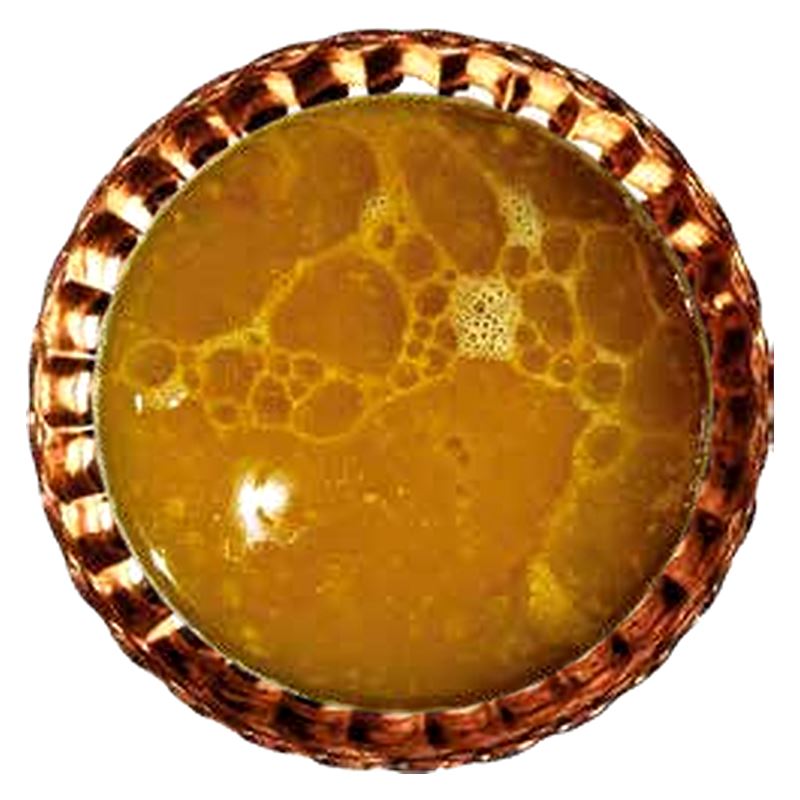
What actually floats on top
Put a bowl of kalle pache down and the first thing on show is not the meat but the film on the surface: golden, sometimes a single sheet, sometimes broken into coins that slide apart when you tilt the bowl. That layer is rendered fat, and it leaves the meat slowly, across the whole simmer. How thick that film comes out is not the same in every bowl, and why no two bowls of kalle pache are identical explains what varies from one pot to the next.
A lamb head and trotters are not fatty the way a shoulder is. The fat sits in particular places: a thin seam under the skin of the cheek, the soft tissue around the jaw and base of the skull, the pads of the trotters, the marrow inside the bones. Cold, it is solid and locked in place. Hours in water over low heat and it softens, melts, slips out and rises. Around fourteen hours is long enough for most of it to come out, one reason the long cook is a rule, not something to shorten — the slow logic behind how kalle pache is made.
Why it separates and sits above the broth
Melted fat and water do not dissolve into one another, and warm fat is lighter than the broth around it. Left still a minute, the droplets drift up, meet and join into larger ones until they spread into a continuous film across the top.
A rolling boil drives the fat through the liquid as tiny droplets, so the broth turns cloudy and generally stays cloudy; a quiet simmer lets the droplets gather on top and the broth below run clear. That is why the pot is generally kept just under a boil.
The fat is not the gelatin
The pot makes two rich things at once, easy to confuse. Head and trotters carry a great deal of collagen: in skin, tendons, the connective tissue of the joints. Long wet heat turns collagen into gelatin, which dissolves into the water itself. Fat never dissolves into water; it floats.
So the bowl holds two substances, not one. The gelatin is invisible while everything is hot — you feel it rather than see it, as weight in the spoon and a faint stickiness on the lips. The fat you can see. Cool the bowl and the difference is obvious: gelatin sets the whole broth into a soft jelly, while the fat firms separately into a pale cap on top. If it is the flavour of the two layers you want, what kalle pache tastes like covers that.
How the layer carries aroma
Much of the smell of kalle pache travels in that layer. Many aroma compounds dissolve more readily in fat than in water, so the fat collects and holds them as it renders, and the hot surface releases them into the steam. That is why the smell reaches you before the first spoon does, and why a bowl skimmed bare generally smells quieter than one left alone.
The table is built to work against it
None of the traditional accompaniments are decoration. Lime is squeezed over the bowl because acid cuts the coating the fat leaves on the tongue, so the next spoonful tastes like the first again. Torshi does the same work with more force, since vinegar and salt arrive together. Raw onion is sharp and slightly bitter, resetting the mouth between mouthfuls; green pepper adds a heat that works the same line.
Sangak is a tool as much as food. It tears rather than cuts, so a torn edge dragged across the surface lifts the film off the broth. Working bread, lime and torshi together is most of the method set out in how to eat kalle pache for the first time.
The white cap on a cold container
Kalle pache gone cold in the fridge shows the whole story in cross-section: a pale, firm, opaque cap on top, and under it a broth set into a wobbling jelly. The cap is the fat, solid again at fridge temperature. The jelly is the gelatin. Both are signs of a pot that ran long, not of anything wrong.
Warm it gently and it all comes back. Stir the cap in as it melts and the bowl is at its richest; lift it off first with a spoon and the bowl is lighter, the flavour cleaner. Fat is energy-dense and a broth built this way is generally a rich food, so how much of the cap you keep is a matter of preference; anyone with specific dietary needs should follow their doctor’s guidance. The singles on the menu — eye, brain, meat, tongue, trotters, tripe, lamb cheek, brain soup, soup and the special mix (mojoon) — all come out of the same pot, so the layer shows up on every one in some form.
