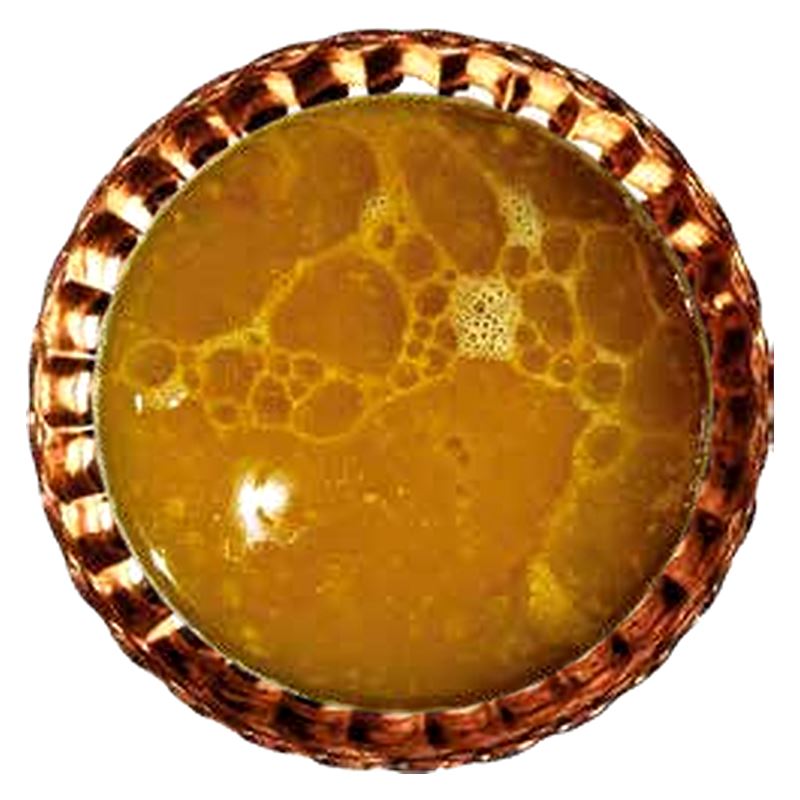
Eat kalle pache often enough and you notice something no menu prints: the bowl is never quite the same twice. One morning the broth is pale and light on the tongue. Another it is deeper, and the last of it sets overnight in the fridge into a soft jelly you can lift with a spoon. Same kitchen, same method, same long simmer. Different animal.
In a city full of food engineered to repeat itself exactly, that reads as a mistake. It is the opposite: proof that a person stood over a pot, and that what went in was an animal.
One pot, one night, one animal
Kalle pache is a whole-animal dish. Lamb head and trotters go into water for roughly fourteen hours. Nothing is portioned from a bag to a fixed gram weight, because a head does not arrive at one. Two heads a week apart can differ visibly, and everything downstream moves with them: how much cheek comes away, how long the tongue is, how much broth the pot gives. A factory holds a product still because it starts from powder and paste; a kitchen that starts from an animal cannot.
What the animal decides
- Size. A larger head gives more lamb cheek and a longer tongue; a smaller one gives less. Nothing is trimmed to match.
- Gelatin. Trotters are mostly skin, bone and connective tissue, which is where the body of a broth comes from. Some give it up more readily than others — the single biggest reason one day's broth sets firm in the fridge while the next day's stays loose.
- The fat cap. Fat sits differently on every animal. On one pot it gathers at the surface; on another it is thinner and spread out, and the first spoonful reads lighter.
- Texture. Age and movement show up in the meat. One cheek falls apart under a spoon, another wants a moment of pressure. Both are correct.
What the kitchen holds constant
The cleaning. The unglamorous half of kalle pache, and the half that separates a good bowl from a bad one. Heads and trotters are shaved, scraped, soaked and rinsed until nothing is left but clean skin, bone and meat. No variation is allowed here. A bowl that smells of the animal rather than the broth was cleaned badly — a failure of work, not a quirk of the lamb.
The simmer. Roughly fourteen hours, low and steady, skimmed as it goes, not shortened because a night is busy. A rushed head shows in the first spoonful: thin broth, meat that will not leave the bone.
The seasoning. Persian kalle pache is deliberately plain; the broth should taste of what was in it, not of spice. The sharpness arrives at the table — lime squeezed in at the last second, torshi, raw onion, green pepper, and sangak to carry it.
How the difference reaches your bowl
You meet it in three places. The body of the broth: how it coats the spoon, and how firmly it sets in the fridge by morning. The richness at the surface, which follows the fat cap more than anything the cook did. And the size of a single part, clearest when you order singles, because nothing else on the plate averages it out.
Singles put you face to face with one part of one animal; a platter, or the special mix (mojoon), does the opposite — several parts together, so a longer tongue or a leaner cheek is balanced by what sits beside it. Neither is better.
Variation, and what a fault looks like
Variation is a firmer or looser set in the fridge, a richer or leaner surface, a bigger or smaller tongue, a broth a shade darker than you remember.
A fault is grit or hair, an off or sour smell, meat that refuses to leave the bone, a bowl that arrives cold. None of that is the animal's doing, and none of it is character. Phone 04 321 8882 and say so plainly.
Ordering a dish that never repeats
The kitchen runs 24 hours a day, seven days a week, for dine-in and delivery across Dubai, and you can pre-order for a later time. Payment on the website is by card, in advance; there is no cash on delivery. Delivery is free over AED 300, and every part and platter is on the menu.
The next bowl you take home may set like jelly by morning, or it may not. That was the trotters, not the recipe. Fourteen hours went into both.
