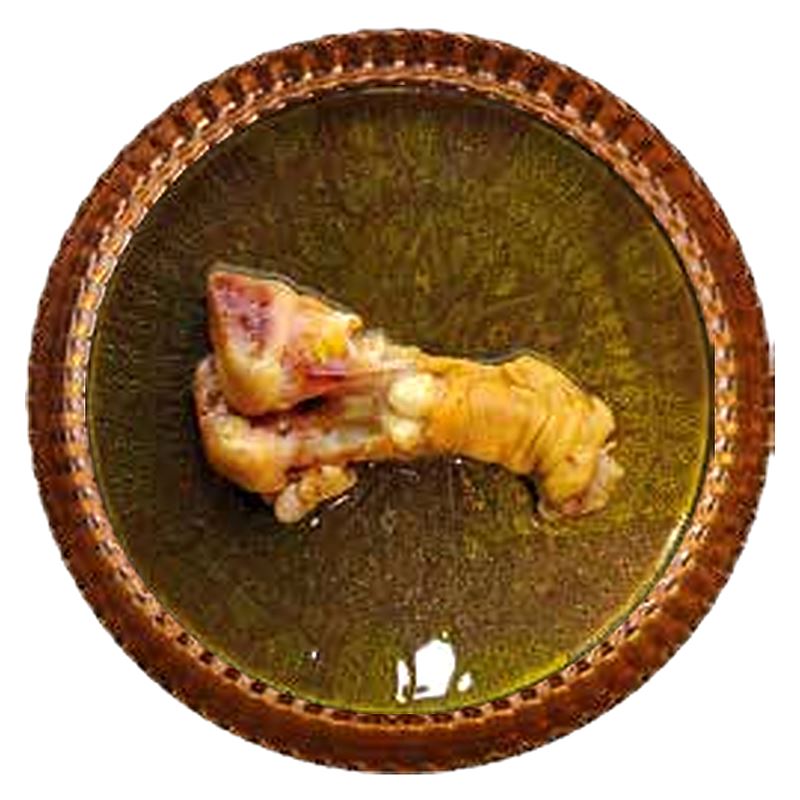
If you grew up in Tashkent, Samarkand, Bukhara, Khujand, Dushanbe, Osh or Almaty, there is a good chance you already know this dish — under a name that sounds almost exactly like ours. In Uzbek and Tajik it is kalla-pocha: kalla is the head, pocha is the trotter. In Persian it is kalle pache: kalle is the head, pache is the trotter. The same two words, in the same order, naming exactly what goes into the pot.
The direct answer: these are two branches of one family, not two unrelated dishes. Sheep head and trotters, cleaned by hand, simmered for many hours into a clear and heavy broth, eaten early in the day, eaten with bread. What changes from country to country and from house to house is the seasoning and the things set beside the bowl. We cook the Persian version and only the Persian version — but if kalla-pocha is the smell of a grandmother's kitchen on a cold morning, you will recognise almost everything on our table at 64 Jumeira Street in Jumeirah 1. The full menu is on our order page.
What do the words kalla-pocha and kalle pache actually mean?
Both names are simply a list of the two main parts, nothing decorative. Kalla and kalle mean head. Pocha and pache mean trotter — the foot and the shank just above it. The Persian pache is built from pa, foot, with a diminutive ending, closer to "little foot" than to anything poetic. Order kalle pache and you have ordered, quite literally, head and feet.
That is why the name travelled so easily. Tajik is a Persian language, so in Tajik these are not merely similar words — they are the same words. In Uzbek, kalla and pocha are commonly described as borrowings from centuries of daily contact between Persian-speaking and Turkic-speaking neighbours who shared the same cities, markets and often the same courtyard. A dish whose name plainly describes its own contents does not need translating when it crosses a border; it only needs pronouncing. For the wider map of these names, we set it out in the many names of kalle pache.
Is Central Asian kalla-pocha the same dish as Persian kalle pache?
They are cousins: the same core, set on a different table. The core is not in dispute — sheep head and trotters, cleaned properly, cooked gently and for a long time, until the broth turns rich and the meat leaves the bone without argument. That much is shared from Iran through Afghanistan and Tajikistan into Uzbekistan and further east.
They part company at the finishing: what goes into the pot alongside the meat, what sits next to the bowl, which bread is torn into it, and who seasons it — the cook, or the person eating.
Let us say this plainly. We are a Persian kalle pache kitchen, not authorities on the Uzbek, Tajik or Kazakh table. Everything we write about our own version is precise, because we cook it day and night. Everything we write about the Central Asian versions is deliberately general, because households differ and regions differ, and we would rather be vague and correct than specific and wrong.
Why did the name travel so far across the region?
Because people did, and words move with them. For centuries Persian was a language of writing and poetry across a wide stretch of Asia, while Persian-speaking and Turkic-speaking communities shared cities, bazaars and neighbourhoods. Food vocabulary travels fastest, because it is spoken out loud every day, in kitchens and markets rather than in books.
Kalle pache is not the only dish with relatives spread across a map. The same cuts and the same patient pot appear under names such as khash and pacha in the kitchens of Iran's neighbours, which we covered in kalle pache around the world, and even inside Iran the habits shift from city to city, as we describe in regional kalle pache styles across Iran. None of that is a competition. A dish with many names is simply one that enough people loved to carry with them when they moved.
What do the two traditions clearly share?
Almost everything that matters: the cuts, the hours, the broth, the bread and the hour of day it is eaten. Here is the shared ground.
- The parts. Sheep head and trotters — not an afterthought, but the entire point of the dish.
- Time. Long, slow, patient cooking. Nobody anywhere makes this quickly.
- A clear, heavy broth. The liquid is not a by-product. For many people it is the best part of the bowl.
- Bread. Flatbread is the essential partner in both traditions — torn, dipped, used as the spoon that matters.
- The early hour. Commonly a breakfast or before-dawn food rather than a dinner.
- The cold months. Both traditions tie it to winter mornings, though plenty of people eat it all year.
- A shared table. Rarely a dish for one person alone. It is set in the middle and worked through together.
One more thing readers ask about: in several traditions across the region a boiled sheep's head is presented whole to a respected guest as a mark of honour. That is a different preparation from a bowl of broth, it varies by country and occasion, and it is not what we serve. We mention it because it says something true about how these cuts are regarded here: with respect, never with embarrassment.
How does Central Asian kalla-pocha compare with what we cook?
The core is the same and the finishing is where they separate. The middle column below is general on purpose; the right column is exact, because it describes our own pot.
| Element | Commonly associated with Central Asian kalla-pocha | What we cook |
|---|---|---|
| The name | kalla-pocha in Uzbek and Tajik, with local spellings | kalle pache, the Persian form of the same two words |
| Main parts | sheep head and trotters, commonly cooked together | Eye, Brain, Meat, Tongue, Trotters, Tripe, Lamb Cheek and Special Mix — singly or as a platter |
| The cooking | long, slow simmering; in many households started the night before | hand-cleaned and trimmed, blanched with that first water thrown away, then about fourteen hours in a copper pot, skimmed repeatedly |
| Aromatics in the pot | varies by household and by region | onion, turmeric and garlic |
| The broth | clear and rich, commonly served with the meat | clear and rich; also on its own as Soup or Brain Soup |
| Bread | flatbread is the essential partner; baking styles vary widely | Sangak Bread and Special Sangak |
| Who seasons it | commonly adjusted at the table by each person | the diner, at the table — lime, cinnamon and garlic, never added by the kitchen |
| Served alongside | varies by country and household, commonly something sharp or fresh | Mixed Torshi, Garlic Torshi, Onion, Capsicum, Fresh Chili, Pickled Green Chili |
| When it is eaten | early morning, strongly associated with the cold months | 24 hours a day, seven days a week, in Dubai heat or winter |
| To drink | tea is near-universal | Tea, Black Tea, Kettle of Tea, Doogh, Lemonade, Water and soft drinks |
How exactly do we cook ours in Dubai?
Slowly, and mostly by hand. The heads and trotters are cleaned and trimmed by hand — unglamorous work that decides whether the broth comes out clean or muddy. They are blanched first, and that first water is thrown away. Then they go into a copper pot with onion, turmeric and garlic for about fourteen hours, skimmed again and again through the night, until the broth is clear and the meat gives way on its own.
What we do not do is season it for you. The lime, the cinnamon and the garlic go in at the table, by the person eating, in the amount they want. If you learned this dish in a Central Asian kitchen that habit will feel familiar, even where the seasonings differ — the eater finishing their own bowl is one thing this whole family has in common. More detail is in how kalle pache is made and in what kalle pache tastes like.
What should I order first if kalla-pocha was the food of my childhood?
Start with a platter rather than a single part: it puts the whole range in front of you at once and lets you find the piece your memory is reaching for. The Single Dish is the smallest way in, the Double Dish suits two sharing, The Full Dish is the complete spread, and The Khan's Platter is the large one, for a table of people who all know what they are doing. The differences are in our guide to the platters.
If you already know which part you want — and a lot of people from this region do — order it on its own: Tongue, Trotters, Lamb Cheek, Brain, Eye, Meat or Tripe. If the broth is what you came for, there is Soup and Brain Soup. Add Sangak Bread or Special Sangak, because bread is not a side here, it is half the meal. Add Mixed Torshi or Garlic Torshi for the sharp note against the fat, plus Onion, Capsicum, Fresh Chili or Pickled Green Chili. Add a Kettle of Tea, or Doogh if a salted yoghurt drink is the taste you attach to this meal. There is also Omelette for whoever in the group does not eat head and trotters.
Customising here means choosing which parts and items you want; for anything more specific, phone the kitchen.
Is the lamb halal?
The lamb is sourced to the UAE halal standard. That is the honest statement and we do not dress it up beyond it. For the longer answer, including how the cleaning and the long cook fit around it, read is kalle pache halal. Customs around this dish differ across the region and we describe them as customs, not rulings — questions of religious obligation belong with your own scholar, not a kitchen.
Is kalle pache good for you?
We will not answer that for you. People across this region talk about kalle pache and kalla-pocha as winter food, as the meal that opens a cold day, and that talk is part of the culture of the dish. We will not turn it into a health claim. This is not medical advice — for anything to do with your own diet or health, ask your doctor or a registered dietitian. What we can tell you is exactly what goes into the pot, and that is written above.
How do I get it in Dubai?
Order it for delivery, collect it yourself, or come and eat it at the source. We are one kitchen at 64 Jumeira Street, Jumeirah 1, open 24 hours a day, seven days a week, with no other branches. Delivery covers Dubai and is free on orders over AED 300; below that the fee depends on your area. Tables can be reserved on the reservation page.
Ordering is guest checkout with secure online card payment: no account to create, nothing to remember, no app, and no cash on delivery. After payment your order gets its own page. The kitchen accepts it and sets an estimated time, and the rider phones you on arrival, so keep your phone beside you. If you want it for a specific future moment — first light on a Friday, say — you can schedule it up to about two days ahead. Step by step, it is laid out in how to order online and in kalle pache delivery in Dubai.
To change or cancel anything, phone 04 321 8882 straight away. That is our only contact channel and there is no self-service button for it. Special requests go by phone too. If the kitchen cannot fulfil an order, it is rejected with a reason and the payment is refunded automatically.
Persian, Tajik and Uzbek kitchens have traded ingredients, words and habits for centuries. Kalla-pocha and kalle pache are two accents of one sentence.
New to the dish? Start with what is kalle pache and kalle pache in Dubai, then look at the menu on our order page.
