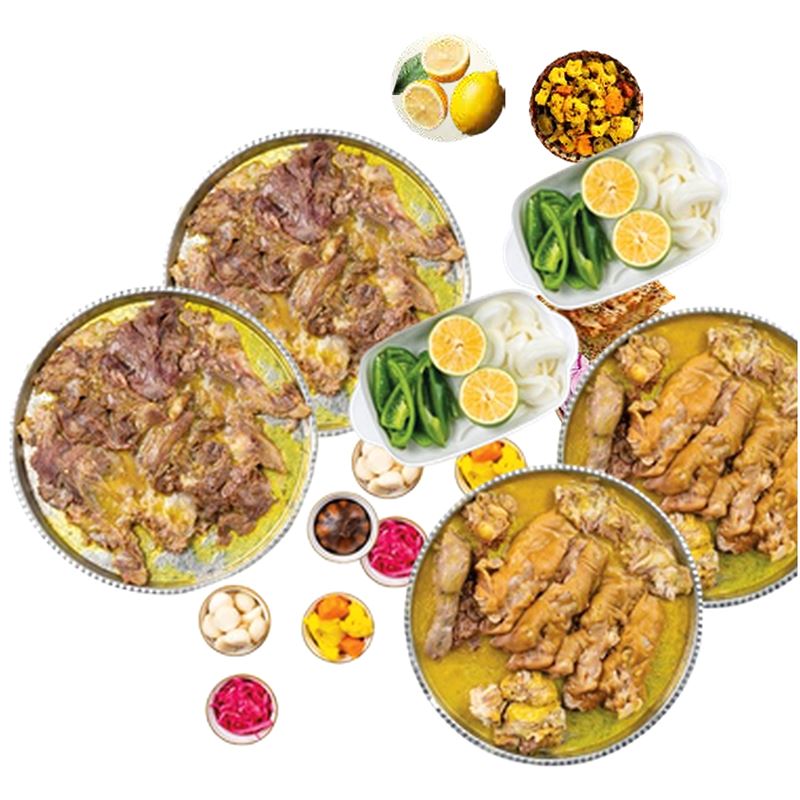
Bouzelouf and kalle pache begin from the same idea — a whole sheep's head is food, and it deserves to be cooked properly — and they finish as two completely different dishes. Bouzelouf, as it is commonly made in Moroccan homes, is a dry-ish preparation: the head is passed over a flame and cleaned, then steamed or slow-cooked for hours, and eaten with cumin and salt that each person adds at the table. Persian kalle pache is a broth. The head and trotters stay on the heat for most of a day until the liquid itself becomes the point, and what reaches you is a bowl with the parts in it and bread torn in afterwards.
So the difference is texture and moment, not ingredient. If you grew up on bouzelouf, none of the meat here will be strange — the cheek, the tongue, the small pockets of meat around the bone are things your hands already know. The hot bowl is the new part. We cook the Persian version only, at one kitchen at 64 Jumeira Street in Jumeirah 1, and we are not authorities on Moroccan cooking. Where this article talks about bouzelouf it stays general on purpose, because a Moroccan reader knows that dish far better than we do.
What do bouzelouf and kalle pache genuinely have in common?
They have the head itself in common, and everything that follows from taking it seriously. Both traditions treat the head as a real dish rather than an afterthought — the cheek, the tongue, the trimmed meat around the bone, the parts that reward slow heat and punish anyone in a hurry. Both need long, unglamorous work before any cooking starts: cleaning, trimming, checking, cleaning again. And both cook for hours rather than minutes, because the connective tissue in a head softens no other way.
They also share a social shape. Neither is really a solo dish. Bouzelouf is associated with a family gathering and a shared plate; kalle pache is eaten shoulder to shoulder in the early morning, often before the rest of the city is awake. Both belong to particular mornings and particular occasions rather than to any hour of any day, which is why people who grew up with either one react to the smell before they react to the plate. If you want the Persian side of that story, our explainer on what kalle pache is walks through it properly.
Underneath both there is an ethic older than either kitchen: an animal is expensive, so the parts that take work are worth the work. That is not nostalgia — it is the reason both dishes exist at all.
What is the biggest difference between bouzelouf and kalle pache?
The biggest difference is liquid. Bouzelouf commonly arrives dry-ish — steamed or slow-cooked head meat that you pick up, touch to cumin and salt, and eat more or less as it is. Kalle pache arrives wet: a bowl of broth with the parts in it, and the broth is not a by-product of the cooking, it is half the dish. Iranians tear sangak into the bowl and let it soak until the bread is soft and heavy, then eat bread and broth in the same spoonful. Someone raised on bouzelouf usually finds the meat familiar and the spoon unfamiliar.
Almost everything else follows from that one difference. Seasoning behaves differently, because a broth takes lime, cinnamon and garlic in a way dry meat does not. Bread behaves differently, because bread in a bowl carries liquid instead of lifting meat. Even the pace changes: kalle pache slows you to one spoon and one soaked piece of bread at a time. Neither is the better idea; they are cousins raised in different houses. To picture the bowl before you order it, what kalle pache tastes like is the plainest description we can give.
Bouzelouf vs kalle pache: how do they compare side by side?
Here is the comparison, with one caveat: the Moroccan column is deliberately general, because household practice varies by region and by family — and we are describing someone else's kitchen, not ours.
| Question | Bouzelouf, as commonly made | Kalle pache, the Persian version we cook |
|---|---|---|
| What reaches the table | Head meat, largely dry-ish, often on a shared plate | A bowl of broth with head and trotter parts served in it |
| How it is cooked | Cleaned first, then steamed or slow-cooked for hours | Hand-cleaned and trimmed, blanched with that first water thrown away, then simmered about fourteen hours in a copper pot with onion, turmeric and garlic, skimmed again and again |
| Who seasons it | The diner, commonly with cumin and salt | The diner, at the table, with lime, cinnamon and garlic |
| What the bread does | Carries and lifts the meat | Sangak is torn into the broth and left to soak |
| When it is eaten | Family gatherings; strongly associated with the days after Eid al-Adha | Classically early morning; with us at any hour, because the kitchen is open 24 hours a day, 7 days a week |
| How it is shared | From a communal plate, often with the hands | A bowl each, with platters that step up in size and variety for a table |
| Where to start with us | Not on our menu — we do not cook Moroccan food | Lamb Cheek, Tongue and Meat, with Sangak Bread |
How is kalle pache cooked in our kitchen?
Slowly, and with far more cleaning than most people expect. The heads and trotters are hand-cleaned and trimmed, then blanched — and that first water is thrown away, which is the step that decides whether the finished broth tastes clean or muddy. After that they go into a copper pot with onion, turmeric and garlic and simmer for about fourteen hours, skimmed again and again through the night.
Nothing else is added. There is no shortcut and no heavy spice mix hiding anything, which is exactly why the seasoning is left to you at the table. If you want the full sequence, how kalle pache is made covers each stage in order.
Why do many families eat the sheep's head after Eid al-Adha?
Because that is when a whole animal is in the house, and the head is one of the parts that has to be dealt with separately and carefully. In many Moroccan families the head becomes a dish in the days that follow, and a similar pattern shows up across a wide belt of countries, including Iran. We are describing a custom — not a rule, not an obligation, and not a religious ruling of any kind. Practice varies from family to family and from one region to another, and the people who keep the custom are the right people to explain it.
What we can say from our own side is that the days around and after Eid are busy here, and a lot of the people who walk in are eating something their grandparents ate. We wrote about the Persian version of that season in kalle pache, Eid al-Adha and the qurbani lamb in Dubai.
If I love bouzelouf, what should I order first?
Start with the parts you already know, so the only new thing on the table is the broth. That means three items and a bread:
- Lamb Cheek — dense and threaded, the sweetest meat on the head, and the cut a bouzelouf eater recognises instantly. We gave it its own guide in the lamb cheek and bonagoosh guide.
- Tongue — firm, sliceable, and it behaves the way you expect it to.
- Meat — the trimmed head meat, the safest possible starting point.
- Sangak Bread — tear it into the bowl. Add Mixed Torshi or Garlic Torshi if you want something sharp alongside.
On a second visit, move to Brain, Eye, Trotters or Tripe — our guide to brain, tongue and trotters explains each texture honestly before you commit.
If you are feeding a group, the platters do the choosing for you: Single Dish, Double Dish, The Full Dish and The Khan's Platter step up in size and variety, and the platter comparison lays out what sits on each one. There is also Brain Soup and plain Soup for anyone who wants something gentler, Special Mix for the person who wants a bit of everything, and an Omelette for whoever came along for the company.
Do I season the bowl myself, the way cumin and salt go onto bouzelouf?
Yes, and that is the habit that carries over most neatly. Our kitchen does not season the bowl for you. Lime, cinnamon and garlic go in at the table, by the diner, to taste — a squeeze of lime to cut the richness, a little cinnamon, garlic if you want it forward. Iranians argue about the proportions the way other families argue about how much cumin belongs on a piece of cheek.
Beyond that you can add Capsicum, Onion, Fresh Chili, Pickled Green Chili, extra Sangak or Special Sangak. To drink, Doogh is the traditional partner, Lemonade the easy choice for children, and Black Tea or a Kettle of Tea what most tables finish on. One practical note: customising your order here means choosing which parts and items you want. There is no free-text box for kitchen instructions, so anything special goes by phone, on 04 321 8882.
Is the lamb halal?
Our lamb is sourced to the UAE halal standard. That is the plain statement, and we keep it plain rather than dressing it up. If you want the longer answer, is kalle pache halal covers it.
How do I order, and what happens after I pay?
You order from the menu page as a guest — there is no account to create, no password, and nothing to download. Payment is secure online card prepay only; there is no cash on delivery and nothing to pay the rider on arrival. Once payment goes through, your order gets its own page. The kitchen accepts it and sets an estimated time, and the rider phones you when they arrive, so keep the number you entered switched on.
You can also place a scheduled order and pick a future time up to about two days ahead, which is useful when a house is full of guests and you know exactly when everyone will sit down. Delivery runs across Dubai and is free on orders over AED 300; below that the fee depends on the area. If the kitchen cannot fulfil an order, it is rejected with a reason and the payment is refunded automatically. There is no self-service cancel or edit button anywhere — to change an address, a time or an item, phone 04 321 8882 straight away.
Two guides go deeper: ordering online step by step and kalle pache delivery in Dubai.
Can I eat it at the restaurant instead?
Yes. Pickup and dine-in are both available at 64 Jumeira Street, Jumeirah 1, and the kitchen does not close — 24 hours a day, every day. You can reserve a table on the reservation page if you are bringing a group, or phone 04 321 8882. For the wider picture of where this dish sits in the city, kalle pache in Dubai is the one to read.
So what are we honestly offering a bouzelouf lover?
A kitchen that gives the head the same seriousness you were raised to expect, and a bowl that holds a familiar animal in an unfamiliar form. We cook the Persian version only; we do not serve bouzelouf and would not claim to, and nothing here is a verdict on which tradition does it better. Bring the cumin habit with you if you like, then reach for the lime instead, tear the sangak in, and see what fourteen hours in a copper pot does to a cut you already love.
