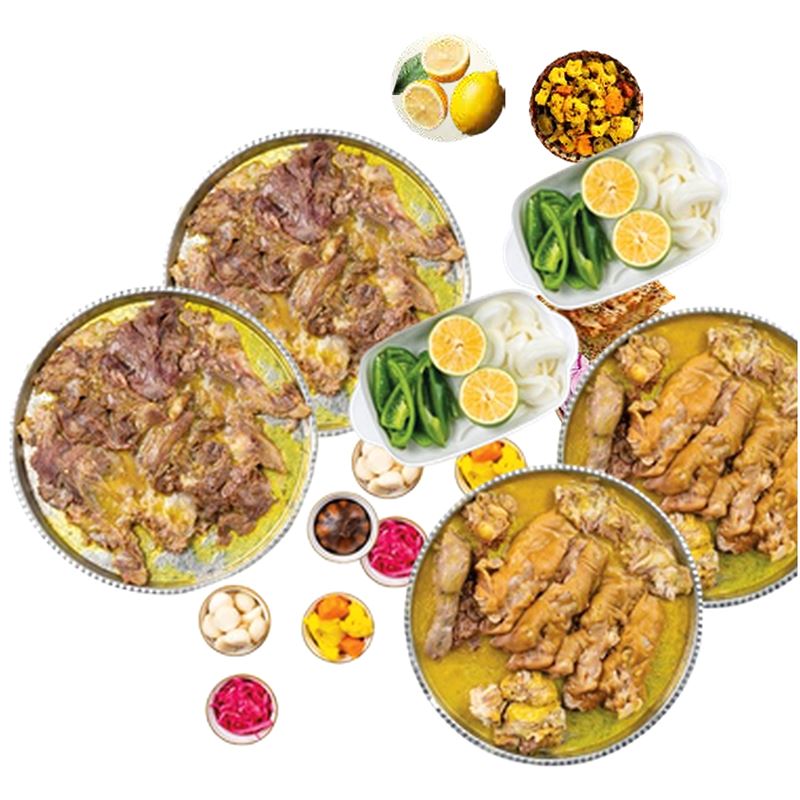
Iraqi pacha and Persian kalle pache are close relatives rather than rivals: both are built on a sheep's head and trotters, cleaned with care and simmered most of a night until the broth carries everything the bones give up. What changes between them is mostly the company those parts keep in the bowl and the moment the bread goes in, so if you grew up on pacha you already know this food, only under another name.
One thing plainly, before anything else. We cook the Persian version only. Shaun the Sheep is a kalle pache kitchen at 64 Jumeira Street, Jumeirah 1, and we do not serve Iraqi pacha or tashreeb. We are not an authority on Iraqi cooking either. Everything written here about pacha is only what we are sure of, described the way a neighbour describes a neighbour's table.
Is it really the same dish?
Close enough that the honest headline is the one at the top of this page. Even the name travelled with the pot. In Persian, kalle means the head and pache means the lower leg, the trotter, and it is that second half of the word the dish answers to in Iraq. Two kitchens, one animal, one shared conviction: the parts most cooking is too impatient for turn into the best thing on the table if you give them the hours they ask for.
The two separate at the edges: in what else arrives beside the head parts, and in when the bread meets the broth. That makes them two different mornings, not a better one and a worse one.
What do the two genuinely share?
Far more than divides them.
- The cuts. Head and trotters at the centre of both: cheek, tongue, brain and eye on one side of the bowl, the stickiness of the feet on the other.
- The patience. Our own method is the one both traditions describe: heads and trotters cleaned and trimmed thoroughly, blanched with that first water thrown away, then simmered about fourteen hours and skimmed again and again. There is no fast version of this in any language.
- The set. Collagen out of bone, skin and trotters makes both broths firm into a soft jelly as they cool. Anyone who has looked into the pot the next morning knows exactly what we mean.
- The bread. Neither dish is finished without it. Bread here is not a side. It is cutlery, sponge and half the meal.
- The hour. Dawn, or very late. The weekend. The cold months. In both countries it is food you go out for, to a specialist kitchen that is awake while the city is still dark.
That last point is why so many Iraqi families in Dubai recognise the smell of this kitchen before the name on the menu. The nostalgia is the same nostalgia.
Where do they differ?
Households and cities vary, so read the middle column as commonly associated with, never as a rule; an Iraqi cook knows their own family's version better than we do. The right-hand column is exactly what leaves our kitchen.
| Compare | Iraqi pacha (commonly) | Persian kalle pache (what we cook) |
|---|---|---|
| What is on the plate | Head parts and trotters, very often alongside stuffed stomach | Head parts and trotters: cheek, tongue, eye, brain, meat, plus tripe served plain in its own bowl. No stuffed stomach. |
| The broth | Rich and full; in many bowls it arrives already over the bread | Can be ordered as its own bowl of Soup, so you taste it clear before anything goes in |
| The bread | Torn in and soaked right through: tashreeb | Sangak, either torn in the same way, which Persians call tilit, or kept dry beside the bowl for dipping |
| At the side | Varies from household to household and city to city | Raw onion, Mixed Torshi or Garlic Torshi, fresh or pickled chili, and more sangak |
| The occasion | Early morning, the weekend, the winter; a dish you go out for | Dawn or late night, the weekend, the winter; also a dish you go out for |
Is tashreeb the same as tilit?
Yes, and it is the friendliest thing in this whole comparison. Tearing bread into the bowl and letting the broth soak all the way through it is tashreeb in Iraqi Arabic and tilit in Persian. Two languages, one instinct, and the same happy collapse of dry bread into something you can eat with a spoon.
The only real difference is timing. Some people tear the sangak in from the first minute and eat the bowl as one soft thing; others keep the bread dry, take the broth clear first, and dip. Both are completely normal here, and nobody will blink if you order extra Sangak Bread and build a proper tashreeb in front of you.
What will feel missing if you grew up on pacha?
Honesty is more useful here than salesmanship. Stuffed stomach is not on our menu. If that is the part you love most, we cannot give it to you, and we would rather you knew now than found out at the table. We do serve Tripe (sirabi) as its own bowl, cleaned and simmered along with everything else, but it arrives plain.
The second surprise is usually the broth. Ours can be ordered on its own as Soup. If you are used to a bowl that arrives already dense with bread, order the bread separately the first time and decide for yourself when it goes in. Our soup-only guide is written for exactly that first bowl.
What should a pacha eater order first?
| If what you miss is... | Order |
|---|---|
| The soft, sweet head meat | Lamb Cheek (bonagoosh), by the bowl |
| The trotters and their stickiness | Trotters (pacheh) |
| Broth and bread, nothing complicated | Soup with Sangak Bread, torn in |
| The texture of the stomach | Tripe (sirabi): plain, in its own bowl, not stuffed |
| A little of everything | Special Mix (mojoon), or a Double Dish to share |
| A full family table | The Khan's Platter: 4 lamb cheeks, 8 trotters, 2 brains, 3 tongues, 4 eyes, 5 breads |
If you want to read further before choosing, our guide to picking a single bowl and the texture guide both go part by part.
Is it a morning food in Dubai too?
It can be any hour you like. We are open 24 hours, every day, so the old rhythm works perfectly well: the weekend morning, the cold months, the table that fills before sunrise. So does two in the morning at the end of a long shift. If you eat in, a Kettle of Tea is dine-in only, reason enough to sit down.
In both cultures this bowl has a reputation as strengthening winter food, and that is part of why families keep the tradition alive. It is culture, though, not medicine. Nothing here is medical advice, and any question about your health, your digestion or your diet belongs with your doctor or a registered dietitian. The lamb we cook is sourced to the UAE halal standard.
How do you order it in Dubai?
From our website, in English, Arabic or Farsi, whichever you prefer. Delivery, pickup or dine-in, and a table can be reserved if you want to eat with us. There is no account, no sign-up and no app: just your name and phone number, plus the Dubai area from the list and a pin on the map if you want it delivered. Payment is by secure online card at checkout, and that is the only method we take. Delivery is free over AED 300.
You can also schedule an order for a future time, up to about two days ahead, so the bowl arrives at the start of a weekend morning rather than the middle of it. After you pay, the kitchen confirms your order and sets an estimated time, the order gets its own page to follow, and the rider phones the number on the order when they arrive. If the kitchen has to reject an order, it is refunded automatically to the card that paid, with the reason shown on that page.
Anything the website does not answer, a question about a particular cut or about your card, is one phone call away: 04 321 8882. That is our only contact channel, and someone is there around the clock. New to ordering from us? The step-by-step guide covers it.
