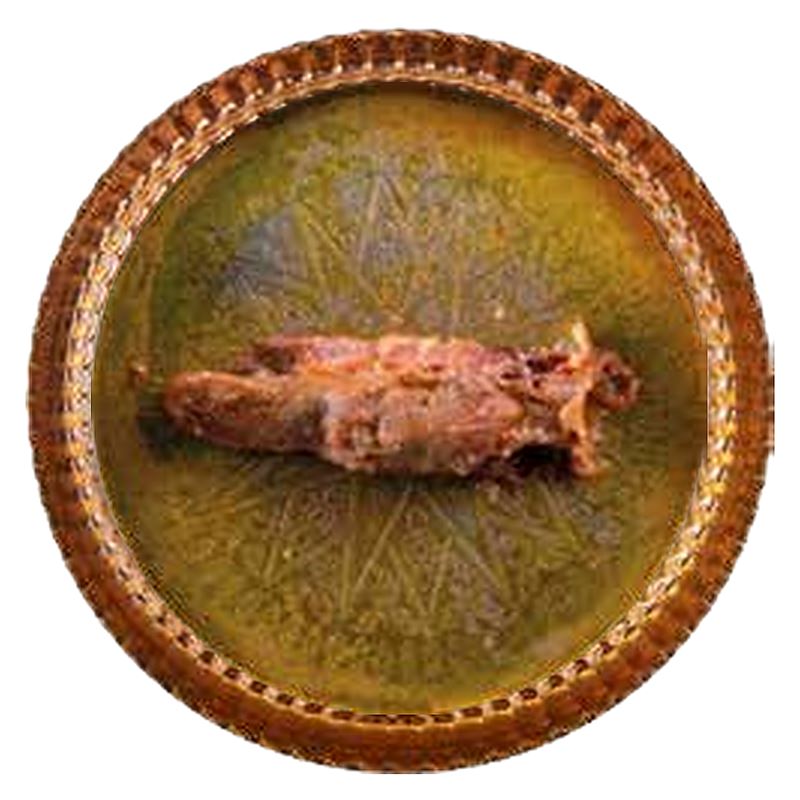
If you are Iranian and you have never eaten kalle pache, nothing has gone wrong. Plenty of people who grew up in Dubai, or in Europe or North America before moving here, know the word perfectly well. They know the exact tone of voice relatives use when they say it. They have simply never had a bowl in front of them.
Food is learned, not inherited. Nobody is born knowing how to eat a sheep's head, in the same way that nobody is born knowing how to get the crisp layer at the bottom of the rice right. What follows is the vocabulary, so you can order without explaining yourself; a first order small enough that nothing is at stake; and some sense of what your relatives are remembering when they talk about it. The whole menu sits on the Shaun the Sheep home page whenever you want it, and there is no exam at the end.
Why does not knowing this dish feel like a small failure of belonging?
Because families treat kalle pache as fundamental rather than optional, and standing outside something fundamental can feel like standing slightly outside the family story. The feeling usually arrives as a question at a gathering, you are Iranian, surely you love it?, and answering honestly costs something.
Worth saying plainly: the feeling is real, and the conclusion it points at is wrong. Nobody picks the city they grow up in. A child in Sharjah or Hamburg or Vancouver had no dawn kitchen within walking distance and no older relative to take them there half asleep. That is circumstance. It is not a measurement of anybody's identity, and it is not a gap that has to stay open. The whole distance is one order long.
There is a quieter version of the same feeling that has nothing to do with family: the worry that you will not know how to eat it properly in front of people who do. That one has an easy fix, and most of this article is that fix.
What do kalle, pache, maghz and the rest actually mean?
Kalle means the head and pache means the trotters; nearly every other word you have heard is the name of one specific part. Once the words are plain, a menu that felt like a private code becomes an ordinary list of things to choose from.
| Word | What it points at | On our menu |
|---|---|---|
| kalle (kal-LEH) | the head, and the parts that come from it | Brain, Eye, Tongue, Lamb Cheek, Meat |
| pache (pa-CHEH) | the trotters, meaning the lower legs and feet | Trotters |
| maghz (maghz) | brain; soft and mild, commonly eaten with a squeeze of lime | Brain, Brain Soup |
| zaban (za-BAAN) | tongue, sliced; often the most familiar texture for a first-timer | Tongue |
| bonagoosh (bo-na-GOOSH) | commonly used for the cheek and the meat around the jaw and the base of the ear | Lamb Cheek |
| sirabi (see-raa-BEE) | tripe; in many Iranian kitchens it is also served as a dish of its own | Tripe |
| tilit (tee-LEET) | not an item at all, but the practice of tearing bread into the broth and letting it soak | any bread with any broth |
The name of the dish itself shifts from region to region and family to family, which is the subject of the piece on its different names. Said out loud it is roughly kal-LEH pa-CHEH, and nobody on the phone is counting your vowels. For more of the vocabulary there is a longer glossary of kalle pache terms, and a short guide to saying it and ordering it.
What should a first order be?
Order the Soup on its own, or a Single Dish, and stop there. Those are the two gentlest doors into the dish, and neither one commits you to anything.
Soup is broth-led: the long-simmered liquid, which is the part most people like first and the part that tastes closest to what your family describes. Add Sangak Bread and you have the whole ritual in miniature. If you would rather meet maghz on easier terms, Brain Soup is its own item on the menu.
The Single Dish is the smallest platter: lamb cheek, one trotter, half a brain and half a bread. The bread comes with it, which surprises people who assume they have to order it separately. Its real virtue is proportion. The lamb cheek is straightforwardly meat and tends to be the piece people finish first; the half brain is small enough to try a spoonful of and leave, which is a perfectly normal thing to do. There is a fuller menu guide if you want to plan more carefully.
Where is the least self-conscious place to try it?
At home, on your own, with nobody reading your face. That is the honest advantage of delivery across Dubai: the first bowl can be a private event. The kitchen runs twenty-four hours a day, seven days a week, so two in the afternoon on a Tuesday is as legitimate a time as dawn. The traditional hour is a custom, not a rule you are breaking.
If you would rather not be alone with it, one friend beats five relatives. A friend has no expectations for you to disappoint, and no memory of the dish that yours has to measure up to.
What are your relatives remembering when they talk about it?
Usually a time of day, a table and a particular street. The dish is a memory as much as a meal. In many households it belonged to the early morning, before work, often in winter, and the details people repeat are rarely about flavour at all. They are about the cold walk, the shop they always went to, the specific neighbourhood, the uncle who ordered for everybody and would not let anyone else pay.
That is why the reverence can sound out of proportion to a bowl of broth. It is not only the broth. Knowing this takes the pressure off, because nobody is asking you to reproduce a morning in a city you have never lived in. You could not, and neither can they. You are being invited to like the thing that sat at the centre of it. Why it is eaten at dawn explains where the custom comes from, and this piece on Iranians in Dubai covers the wider business of looking for a taste of home.
What does it taste like before you season it?
Milder than most people expect. The broth is the spine of the dish, and long simmering with onion, turmeric and garlic gives it body rather than heat. The trotters lend it a soft, gelatinous weight, and that faintly sticky feeling on the lips is the sign of a broth that has been given time.
The seasoning is your job, not the kitchen's. Lime, cinnamon and garlic go in at the table, added by the diner, to taste. This is the part nobody explains to newcomers, and it is why two people at one table can be eating noticeably different bowls. Tear bread into the broth for tilit, keep torshi on the side to cut the richness, and adjust as you go. There is more in the piece on what it actually tastes like.
Is it all right to like some parts and not others?
Yes, and it is how most people eat it, in Iran very much included. The idea that a real enthusiast finishes everything on the platter is a story told at tables, not a description of what happens at them.
Households sort themselves out. Someone always takes the brain, someone waits for the tongue, someone quietly builds a plate of nothing but trotters and bread, and the eye goes to whoever wants it. Preferences are the normal condition, not a failure of nerve. Since ordering here means choosing which parts and items you want, you can build a plate of exactly the things you like and never explain the omissions to anyone.
What happens in the kitchen before it reaches you?
Heads and trotters are cleaned and trimmed by hand, then blanched with that first water thrown away. After that comes the long simmer, about fourteen hours in a copper pot with onion, turmeric and garlic, skimmed again and again as it goes. Nothing about it is quick, which is much of the reason it has commonly been a dish people went out for rather than made on a weekday morning.
Our lamb is sourced to the UAE halal standard, a question taken at more length in is kalle pache halal. If the process itself interests you, how it is made goes through it step by step.
How do you order without having a conversation about it?
Entirely online, with no account and no sign-up. You choose the parts and platters you want, then pay by card online. Payment is prepaid online only, so there is nothing to settle at the door. After payment your order gets its own page, the kitchen accepts it and sets an estimated time, and the rider phones you on arrival.
Delivery covers Dubai and is free over AED 300; below that the fee varies by area. You can also schedule an order for a future time, up to about two days ahead, which is useful if you want it at an hour you have heard about but never experienced. The step-by-step ordering guide walks through the screens.
What if you need to change something?
Phone 04 321 8882 straight away. It is the only contact channel and it is answered around the clock. There is no self-service cancel or edit button and no notes field on the order, so anything unusual, including a change of mind and including a question you would rather not type, goes by phone. If the kitchen cannot fulfil an order, it rejects it with a reason and refunds it automatically.
What if you would rather eat it in?
The kitchen is at 64 Jumeira Street, Jumeirah 1, and you are welcome to eat in or to collect. Tables can be reserved in advance. Eating in has one advantage worth naming for a first-timer: you can ask out loud about anything you are unsure of while you order, instead of guessing from a screen.
Is ordering it for the family a good idea?
It is often how the whole conversation starts. Ordering kalle pache for your parents, or for an aunt who has been talking about it for years, is a small and unmistakable gesture, and it tends to produce the stories you have only ever heard in fragments. It also means you are not the only person at the table deciding what to try.
| Platter | What is in it |
|---|---|
| Single Dish | lamb cheek, one trotter, half a brain, half a bread |
| Double Dish | lamb cheek, two trotters, half a brain, tongue, one eye, a whole bread |
| The Full Dish | two lamb cheeks, meat, four trotters, a whole brain, tongue, two eyes, two breads |
| The Khan's Platter | four lamb cheeks, two meats, eight trotters, two brains, three tongues, four eyes, five breads |
Add Mixed Torshi or Garlic Torshi, extra Sangak, and a kettle of tea for the table, and the meal assembles itself.
You are not late to this. The pot has been on all night, and it will be on again tomorrow night.
If you want the background first, what kalle pache is and where it sits in Dubai are both worth reading before you order. And if it turns out that you like the tongue and not the brain, or the broth and none of the rest, that is not a half-success. That is simply how people eat kalle pache.
