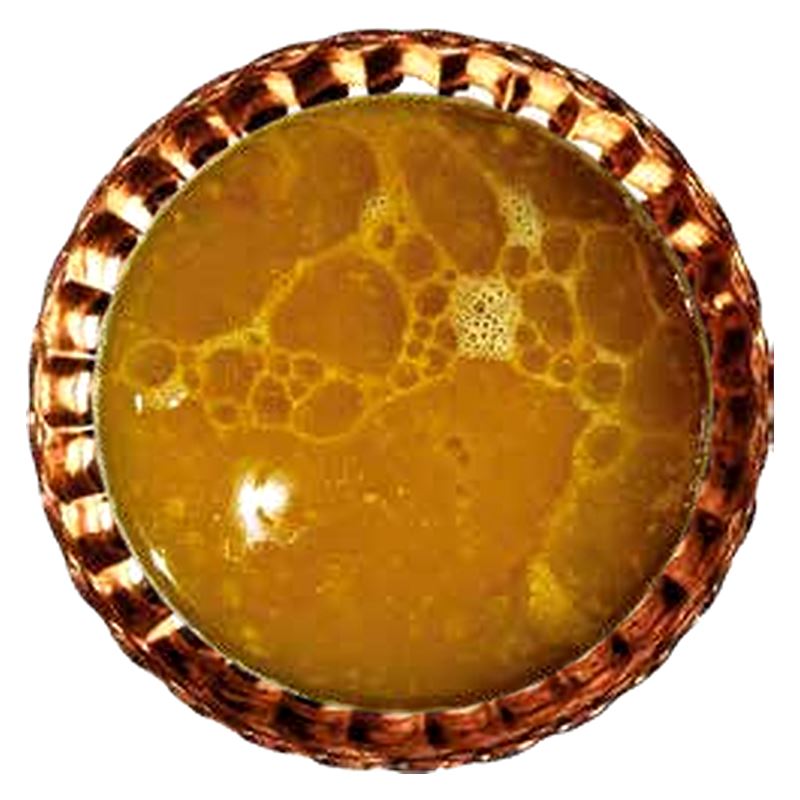
If you are watching your salt and wondering where a bowl of kalle pache fits, the honest starting point is this: we do not publish a sodium figure for our food, and we will not estimate one. We have never had the dish laboratory-tested. A number with no test behind it is marketing dressed as data, and a page that promises honesty should not open with a guess.
What we can tell you is more useful in daily life anyway. In this dish, the seasoning happens at your table, not in our kitchen. Salt, lime, cinnamon and garlic sit in front of the diner and go into the bowl by the diner's own hand. With most restaurant food the salt decision was made hours before you sat down; here a real part of it is still yours. This guide explains how the dish is cooked, which items on the table are salty, and what you genuinely control. It is not medical advice; that line appears in full further down.
Why won't you publish a sodium number for kalle pache?
Because we do not have one. We have not sent our broth to a food laboratory, so there is nothing to report, and we are not going to fill the gap with a confident-sounding estimate that a reader might make a real decision on.
There is a second reason, and it matters just as much: there is no single serving of kalle pache to measure. One person orders The Khan's Platter with bread and pickles beside it; the next has a bowl of Soup and nothing else. One reaches for the salt twice; the other never touches it. A figure taken from one bowl on one day would not describe either fairly. So if you find a sodium value online next to the words kalle pache, read it as a generic estimate for a generic recipe, not a measurement of our pot.
We know a number would look better on this page. It would also be the one thing here we could not stand behind.
Who adds the salt, the kitchen or the diner?
The diner does, at the table. This is the piece of genuine control the whole article is built on, so it is worth being precise.
Our method is deliberately plain and slow. Heads and trotters are hand-cleaned and trimmed. They are blanched, and that first water is thrown away. Then they go into a copper pot with onion, turmeric and garlic and simmer for about fourteen hours, skimmed again and again as the hours pass. That is the whole technique, described step by step in how kalle pache is made.
The finishing flavours are not part of that stage. Lime, cinnamon, garlic and the salt live on the table, and each person seasons their own bowl to their own taste. This is not a health feature we invented for a blog post; it is how the dish has always been eaten, because no two people want the same balance. If you have never done it, our guide to seasoning with lime, garlic and cinnamon walks through the order most people follow, and what kalle pache tastes like describes what you are seasoning.
Be careful about what that does and does not mean. It means the last word on seasoning is yours: taste first, decide second. It does not mean the broth arrives unseasoned, or that your bowl is low in anything, or high in anything. We have no test, so we make no claim in either direction. What we are handing you is a decision, not a promise.
Which things on the table are the salty ones?
The pickles. Torshi is salty by nature, because that is what a pickle is: vegetables kept in vinegar and salt until they turn sharp. Mixed Torshi and Garlic Torshi are both on our list. If sodium is something you track, this is the part of the spread most worth being deliberate about: order it, share one dish across the table, or leave it off.
Here is how a table divides up, and who decides what.
| On the table | Who decides | Honest note |
|---|---|---|
| Salt | You, at the table | Added by the diner, never by the kitchen. Taste the broth first. |
| Lime | You | The seasoning most people underuse. It brightens rather than salts. |
| Cinnamon | You | Warmth and aroma. Nothing salty about it. |
| Garlic | You | Pungent and sharp. A small amount changes the whole bowl. |
| Mixed Torshi and Garlic Torshi | You, when you build the order | Pickles are salty by nature. Vinegar and salt are how they are made. |
| Sangak Bread and Special Sangak | You | Bread is commonly a salted food in general. No test data on ours, so no number. |
| The broth and the parts | Our kitchen | Copper pot, onion, turmeric, garlic, about fourteen hours. No sodium figure, no claim in either direction. |
The kitchen decides the pot; you decide the rest.
Are broths generally salty foods?
Broths and soups are commonly seasoned foods in most kitchens that make them. Salt is one of the ordinary tools of a stockpot, and it would be misleading to let you walk away thinking broth is automatically a salt-free category. That is a general statement about how people cook, not a measurement of our pot, and we are not using it to hint that ours sits high or low on any scale. We have no data, so we sit nowhere on that scale.
The modest point is this: if sodium is something you watch, broth is a food to look at rather than assume about.
What can I actually control if I am watching my salt?
More than you might expect, though everything below is a personal choice about how you eat, not a health claim. None of it is a statement about your body.
- Start with Soup on its own. A bowl of Soup and some bread is the smallest, plainest way into this dish, and the order we would suggest to anyone approaching kalle pache carefully. We wrote a whole piece on it: the soup-only order.
- Choose which parts you order. Singles exist precisely so you can order one thing instead of a spread: Tongue, Meat, Lamb Cheek, Brain Soup, Soup and the rest. If a full platter feels like too much, lightening your order is a real option.
- Taste before you salt. The habit worth breaking is salting the moment the bowl lands. Try lime first; many people find the sourness gives them what they were reaching for.
- Decide about the torshi on purpose. Not out of fear, just deliberately, because it is the salty element on the table and you choose whether it is there.
- Drink water with the meal. Water, tea, black tea and a kettle of tea are all on the list.
- Think across the day rather than the single meal, if that is the approach your doctor or dietitian has given you. That framing is theirs to set, not ours.
Notice what is not on that list: any instruction to the kitchen.
Can I ask the kitchen to cook mine with less salt?
No, and we would rather say so plainly than let you assume otherwise. There is no kitchen-instructions box and no delivery-notes field in our ordering flow.
When we say you can customise your order, we mean something specific and limited: you choose which parts and which items you order. Which singles, which platter, bread or no bread, torshi or no torshi, which add-ons. The seasoning stage belongs to the table. If you have a question this page does not answer, the honest route is the phone. 04 321 8882 is our only contact channel, there is no WhatsApp, email or chat window, and the kitchen is open around the clock.
What if I am ordering for someone who has been told to watch their salt?
Then the person to ask is their doctor or a registered dietitian, not us. We can tell you what is on the table and who controls each part, but not what is right for someone's health.
The practical levers are the ones listed above, and all of them are decisions made when the order is built or at the table, not requests made of the kitchen: order a single item instead of a spread, let them season their own bowl at their own pace, and treat the torshi as a separate decision. For a factual question, such as what a platter contains, phone 04 321 8882 before you order.
What should I order if I want to start small?
Start with a single item rather than a spread. Soup and Brain Soup are the gentlest entry points. The singles are Eye, Brain, Meat, Tongue, Trotters, Tripe, Lamb Cheek, Brain Soup, Soup and Special Mix, each orderable on its own. The platters, from Single Dish and Double Dish up to The Full Dish and The Khan's Platter, are built for sharing and for appetites that already know this food.
On the side there is Sangak Bread and Special Sangak, Mixed Torshi and Garlic Torshi, and add-ons such as capsicum, onion, fresh chili, pickled green chili and extra Sangak. There is an Omelette for anyone at the table who does not eat offal, and drinks run from water and tea to lemonade, doogh and soft drinks. Everything is laid out on the menu and order page, so you can see what a small order looks like before you commit to anything. If you are new to the dish, what kalle pache is is the better place to begin.
Is any of this medical advice?
No. This is not medical advice. If you have high blood pressure, kidney concerns, follow a sodium-restricted diet, or take any medication, speak to your doctor or a registered dietitian before you change what you eat. We cook food. We are not qualified to advise you on your health, and we make no claim that this dish helps, harms, raises or lowers anything.
We will not tell you how often to eat this, and we will not compare our salt level to anyone else's food, because we have no basis for either. For companion pages in the same spirit, see cholesterol and heart health and blood sugar, written with the same refusal to invent numbers.
How do I order, and what happens after I pay?
Ordering is guest checkout on our order page. There is no account, no password, no saved card or address, no order history and no app, so there is nothing to sign up for. Payment is secure card prepay online and the only way to pay, so there is no cash on delivery and nothing to settle with the rider at the door. Delivery covers Dubai and is free on orders over AED 300; below that the fee depends on your area.
After payment your order gets its own page. The kitchen accepts it and sets an estimated time, and the rider phones you on arrival, so keep your phone within reach. If we cannot fulfil an order we reject it with a reason and the payment is refunded automatically. You can also pick a future time up to about two days ahead if you want the order scheduled. There is no cancel or edit button, so if something needs to change, phone 04 321 8882 straight away. The step-by-step version lives in how to order online, and delivery in Dubai covers the rest.
If you would rather eat it where it is cooked, we are at 64 Jumeira Street, Jumeirah 1, open twenty-four hours a day, seven days a week, with pickup and dine-in and tables that can be reserved on the reservation page. Our lamb is sourced to the UAE halal standard, explained in is kalle pache halal. Whichever way you eat it, the last part is the same: the salt arrives in front of you, and what happens next is your call.
