Short answer: you will be welcomed more warmly than you expect, you will be offered more food than you can eat, and nobody at that table needs you to finish everything. Take a little, say what you honestly liked, be kind about what you did not try, and the morning will go well.
Meeting your partner's Iranian family over kalle pache is a real moment, and the nerves are fair: the dish is unfamiliar if you did not grow up with it, and you want to get it right. What follows is a briefing rather than a rulebook: what will actually be in front of you, what you will be offered and why, how people eat it, and what to say in either direction. If you want the dish itself explained first, start with what kalle pache is.
What will actually be in front of you?
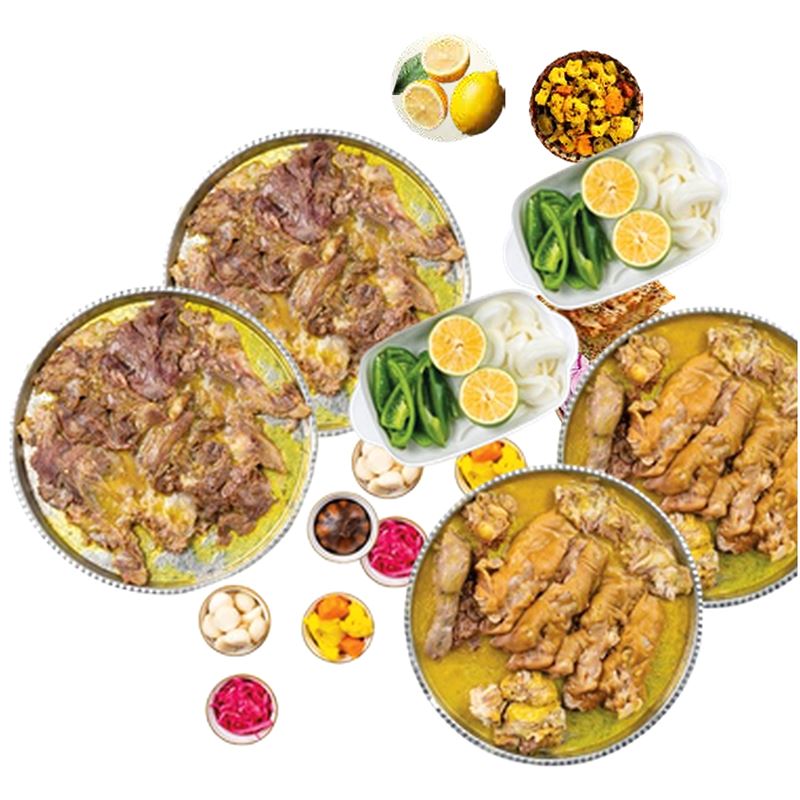
Broth, bread, several lamb parts served separately, pickles, seasonings you add yourself, and tea. Nothing arrives disguised, and nothing on a kalle pache table needs decoding.
The broth is the centre of it. It comes from heads and trotters that are hand-cleaned and trimmed, blanched with that first water thrown away, then simmered about fourteen hours in a copper pot with onion, turmeric and garlic, skimmed again and again. Whether or not you eat any of the parts, the broth is the thing most newcomers fall for, and it is safe ground to enjoy out loud. Our guide to how it is made walks through the steps if knowing beforehand settles you.
Around the broth: Sangak bread, torn rather than sliced. The parts, lamb cheek, meat, tongue, trotters, brain, eye and tripe, usually arrive in their own dishes, so each person takes what they want. There will be pickles nearby, mixed or garlic, along with wedges of lime, a small shaker of cinnamon, and sometimes raw onion, capsicum or fresh chili. Tea gets poured before, during and after. Doogh may appear too.
Portions at a table like this are generous by design. On our own menu, the Double Dish is lamb cheek, two trotters, half a brain, tongue, one eye and a whole bread, and The Khan's Platter is the largest thing we make, built for a full table. If the family has ordered in, expect something on that scale rather than a plate each.
| What you will see | What it is | How people usually take it |
|---|---|---|
| The broth (on our menu: Soup, Brain Soup) | The long-simmered liquid, in individual bowls | Everyone has some; this is the heart of the meal |
| Sangak bread | Persian flatbread, usually served warm | Torn by hand, into the broth or alongside it |
| Lamb cheek and meat | The softest, most familiar-tasting parts | The easiest place for a newcomer to start |
| Trotters | Cooked long enough to turn soft and gelatinous | Eaten with bread; the texture is the surprise, not the flavour |
| Tongue | Sliced, firm, mild | Often the part people are surprised to enjoy |
| Brain | Very soft, mild, rich | Usually taken in small amounts with lime and bread |
| Eye | The part newcomers ask about most | Often offered to a guest as a mark of honour; declining warmly is normal |
| Mixed torshi, garlic torshi | Sharp, acidic pickles | A little between bites, to cut the richness |
| Lime, cinnamon, garlic | Seasoning, added by each diner | Into your own bowl, to your own taste |
| Tea, doogh | Drinks that run through the whole meal | Tea before, during and after; accept it |
Do I have to eat everything?
No. This is the single most useful thing to know: you are not required to eat every part, and nobody is keeping score.
What actually lands badly is not "I didn't try the eye." It is a pulled face, a joke at the dish's expense, or a plate pushed away in silence. What lands well is taking a little, eating it properly, and being straightforward about the rest: "I loved the broth and the cheek, I'm going to leave the brain for another time." That sentence is honest, complete and warm, and in most households it will be answered with more bread.
Forcing something down is worse than declining it. If you go pale halfway through a mouthful you did not want, everyone notices, and the person who cooked feels it. The longer version is in what to do if you don't like it.
You are not required to eat everything. You are only required to be warm.
What is tarof, and what do I do when I'm offered more?
Tarof is courtesy: an offer made generously and then repeated, because repeating it is a way of saying you are wanted at the table. It is not a test and it is not a trick, and treating it as one is the only real way to get it wrong.
In practice, someone will put food on your plate before you ask, offer again once you have eaten it, and offer once more as you say you are full. The offering is affection in a practical shape. You are free to accept and free to decline; what matters is that you do either warmly, and more than once.
Accepting gracefully. "Yes, a little more, it's very good." Move your plate slightly towards them as you say it. That small gesture reads as pleasure rather than greed.
Declining gracefully. Pair the no with something that is also a compliment: "I genuinely can't, I've had two bowls." "Truly full, but I'd love more tea." Expect the offer to come once or twice more. A repeated, cheerful no is completely normal and is not rudeness. What feels cold is a single flat no followed by no further engagement.
If someone offers you the piece they are proudest of, taking even a small amount is a kind gesture. And accept the tea, which is almost never a real question. There is more on the customs of the table in our piece on sofreh and tarof.
How do people actually eat it? Is there a technique?
Yes, and it is easy to learn: tear bread into the broth, season your own bowl, and take your time.
Tearing bread into broth is called tilit. You pull Sangak into rough pieces, drop them into your bowl, and let them soften for a moment before you eat. Do it with your hands. Nobody will think it untidy, because it is how the dish is meant to be eaten.
Seasoning is yours to do. The kitchen does not finish your bowl for you: lime, cinnamon and garlic go in at the table, by each person, to taste. Start with a squeeze of lime and a small pinch of cinnamon, taste, then adjust. Copying your partner's amounts is a perfectly good strategy, and asking them to show you is better still: it makes them a guide rather than a translator.
And it is slow. Kalle pache is a long, communal, talkative meal, traditionally eaten early in the morning, and there is no reason to hurry. If you finish first, sit with your tea. Our first-timer's guide covers the mechanics slowly.
What do I say if I love it, and what if I don't?
If you love it, be specific. "The broth is so much deeper than I expected." "The bread soaked in the broth is the best part." "The cheek is unbelievably soft." Specific praise is believable praise, and it tells whoever cooked or ordered that you were paying attention.
If you do not love it, do not pretend. Pretending is hard to sustain across a long meal. Say the true part of the truth instead. Almost everyone finds something they honestly like, and it is usually the broth, the bread or the pickles. "The broth is much better than I expected, the brain wasn't for me" is a real sentence, and it respects both the food and the family. If you want to know what you are walking into, what kalle pache tastes like describes it part by part.
Avoid comparisons that rank one cuisine against another, and avoid jokes about the parts. Curiosity travels better: ask who cooked, ask how long it simmered, ask which part they each liked as a child. Interest is its own compliment.
If some part of you is wondering whether you belong at that table at all, you do. We wrote about eating kalle pache when you are not Persian for exactly this worry.
Should I try it once before the family meal?
Yes, and it is the best preparation available to you. Eating it once quietly, with no audience, turns the family occasion from a first encounter into a second one, and second times are far easier to be relaxed in.
Order small. Just Soup is the gentlest possible start: the broth on its own, and you can add Sangak Bread alongside it. A Single Dish, which is lamb cheek, one trotter, half a brain and half a bread, gives you a proper cross-section without committing you to a table full of parts. If you want to compare before choosing, our menu guide lays the options out plainly.
Do it at home, in your own clothes. Taste it, season it, work out what you like and what you would rather leave. Then you arrive at the family table already knowing your answer to "what would you like?", which is, by itself, a quiet act of respect.
How do I order it, practically?
We cook kalle pache at 64 Jumeira Street, Jumeirah 1, and the kitchen runs 24 hours a day, seven days a week, which suits a dish traditionally eaten before sunrise. You can have it delivered anywhere in Dubai, collect it yourself, or eat with us, and tables can be booked in advance if you would rather sit down. There is more in our guide to kalle pache delivery in Dubai.
Ordering happens on the website, and payment is secure online card prepay only: no cash on delivery, no paying on arrival. You do not need an account, a password or an app. After payment your order gets its own page. The kitchen accepts it and sets an estimated time, and the rider phones you when they arrive. Delivery across Dubai is free over AED 300.
If you are planning around a family gathering, scheduled orders let you choose a future time up to about two days ahead. To change anything after ordering, or to ask the kitchen a question, phone 04 321 8882, our only contact channel and the fastest way to sort anything out. Customising here means choosing which parts and items you want, so special requests go by phone rather than through a form. If we cannot fulfil an order, we reject it with a reason and refund automatically. There is a step-by-step in our ordering walkthrough, and you can see the full menu and order here.
One practical note: if you have an allergy or a medical dietary restriction, mention it to your partner in advance rather than at the table. Nothing in this article is medical advice; for anything to do with your health or your diet, ask your doctor or a registered dietitian.
Five small things that go a long way
- Arrive hungry. It is the most fluent compliment available to you.
- Accept the tea, every time it is offered.
- Learn one phrase: nooshe jan, said to others as they eat. It travels well.
- Praise one specific thing rather than everything vaguely.
- Don't rush, and don't check your phone. The length of the meal is the point of it.
The family is not assessing your palate. They are watching whether you are easy to sit at a table with, and that is a much simpler test to pass. Take a little, ask a question, hold your bowl out for more tea, and let the morning be long.
