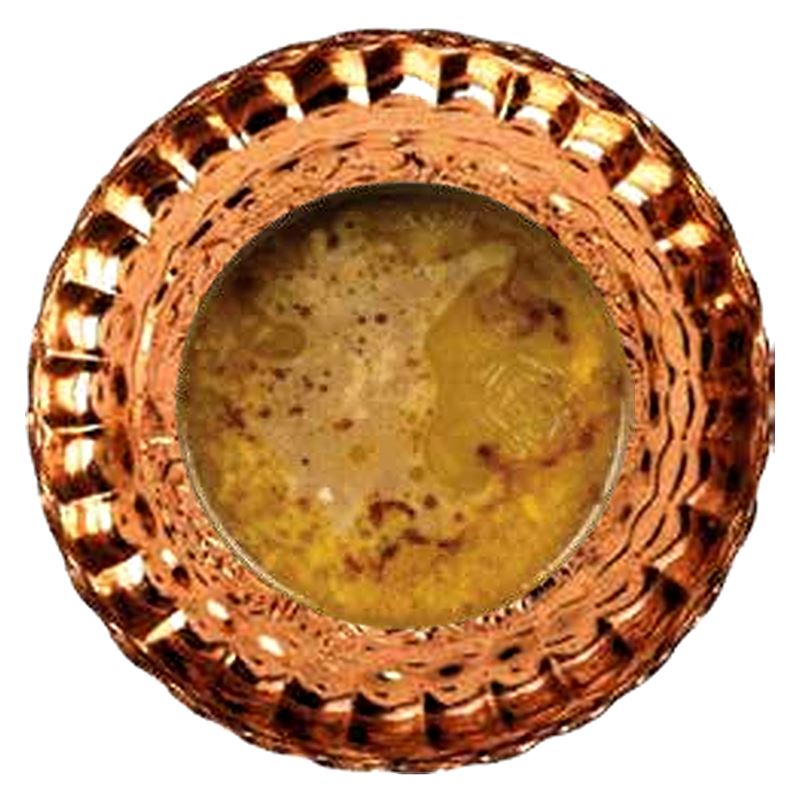
A kalle pache broth is good for one reason above all others: time. Bone, marrow, cartilage and trotter give up their collagen only under a long, gentle simmer — hours of barely moving liquid, skimmed patiently — and that slow extraction is what gives a broth body, clarity and a flavour that keeps opening after you swallow. Everything else is finishing work on that foundation. At Shaun the Sheep in Jumeirah 1 the pot is never hurried, and because the kitchen runs 24 hours a day there is always one that started long before you got hungry.
Why does time matter more than any single ingredient?
Collagen is the connective tissue holding a joint together, and it does not dissolve into water on request. It has to be coaxed out: low heat, many hours, until it converts into gelatin and moves into the liquid. That conversion is the whole game — gelatin is what makes a broth feel like something in the mouth instead of flavoured water.
You cannot speed it up with a harder boil. More heat extracts no extra collagen; it agitates the pot and breaks fat into tiny droplets that drive into the liquid, which is exactly how a broth turns cloudy, greasy and muddy. A gentle simmer, the surface barely trembling, is the difference between a clear golden broth and a grey one.
Trotters are the richest source of gelatin; head, cheek and tongue carry the deeper meaty flavour. A pot with both is why classic kalle pache broth tastes rounder than one built from meat alone. If the dish itself is new to you, start with our explainer on what kalle pache actually is.
Why does a good broth set like jelly when it cools?
This is the simplest honesty test in the kitchen. Leave real kalle pache broth to go cold and it stops behaving like a liquid: it sets into a soft, wobbling jelly you can lift on a spoon. Warm it and it flows back into broth as though nothing happened.
That set is gelatin, and gelatin is a receipt — it can only be there if the bones and trotters were simmered long enough to give it up. A broth that stays watery in the fridge never had it, however savoury it tasted hot.
What does skimming have to do with the taste?
In the early hours a greyish foam rises: proteins and impurities coming out of the bones. Stir it back in and it stays in your bowl as cloudiness, a faintly muddy smell and a heaviness that never lifts. Lift it off, again and again, and the broth clears.
Fat is handled the same way, with judgement rather than zeal: some belongs there as golden droplets on the surface, but too much coats the palate, so the excess comes off.
The cleaning before the pot matters just as much: heads and trotters are cleaned by hand before anything goes near the heat, because no later skimming rescues a pot that started dirty.
Which aromatics go in, and when?
Kalle pache is not a heavily spiced dish, which surprises people. The aromatics are few and quiet — onion, garlic, a little turmeric, a piece of cinnamon. Their job is to shape the broth around the lamb, not to stand in front of it. If the first thing you taste is spice, something is usually being covered up.
Salt goes in late rather than early. A pot loses volume over a long cook, so seasoning at the start tells you nothing about where it lands by morning. Salting near the end means the broth is judged exactly as it will be eaten.
The rest is finishing at the table, and it is yours to control: fresh lemon, a pinch of cinnamon, a piece of Garlic Torshi or Mixed Torshi, and warm Sangak Bread torn into the bowl so it drinks up the broth.
Why does a rushed broth taste thin?
Because the structure never arrives. Cut the simmer short and the collagen stays in the joint. What you get is water that has been near lamb: it can smell right, but it has no weight, no lingering finish, and it will not coat the spoon.
Then the corrections begin: more salt so it tastes of something, more fat so it feels like something, a thickener or powdered base so it looks like something. Together they make a bowl that is loudest at the start and gone the moment you put down the spoon.
How is a slow broth different from an instant or packet one?
To be fair, a packet broth is useful in a home kitchen. But it is a different product, not a rival: salt and dried flavourings, engineered to win the first sip.
The honest difference comes after that sip. A packet broth holds one intensity from start to finish and then stops; a slow broth starts quieter, builds as you eat and stays with you afterwards. And one of them sets in the fridge; the other never will.
What should you look for in your own bowl?
You do not need a kitchen background to read a broth: a look and one sip tell you most of it.
| What you notice | What it tells you |
|---|---|
| It sets to a soft jelly in the fridge | Real collagen was extracted: a long simmer, real bones and trotters |
| Clear and tea-coloured rather than grey | Simmered gently and skimmed, never boiled hard |
| It faintly coats the spoon and the lips | Body from gelatin, not from fat, starch or a thickener |
| The flavour grows after you swallow | Depth from hours of extraction, not from late seasoning |
Does the broth survive a drive across Dubai?
Better than most food, and gelatin is part of the reason: a broth with real body holds heat and texture on the road far better than a thin one. It travels hot and sealed, with bread and drinks packed apart so nothing goes soft — there is more in our guide to how delivery arrives hot.
You order on the website for delivery, pickup or dine-in, and pay by secure online card payment at checkout. For delivery, pick your Dubai area from the list and drop a map pin — both are required, because the pin is what puts the rider at your actual door. Delivery is free on orders over AED 300. Once payment goes through, the kitchen confirms and sets an estimated time, you can follow the order's progress on the site, and the rider calls when they arrive. For broth at dawn, use the scheduled-order option and pick a future time up to about two days ahead. The site is in English, Arabic and Farsi, and the kitchen is open 24 hours.
Is a collagen-rich broth actually good for you?
Kalle pache has always been treated as restorative food, and it is genuinely rich in protein and minerals as well as gelatin. But we will not turn that tradition into a health claim. This is not medical advice. It is a rich, fatty dish, so if you have a health condition or any dietary restriction, ask your doctor rather than an article.
So what should you order if the broth is the point?
Almost everything on the menu sits in the same broth, but some choices put it further forward than others.
| If you want… | Order |
|---|---|
| The broth at its purest | Soup — the abgoosht broth itself — with Sangak Bread |
| The silkiest, most gelatinous texture | Trotters (pacheh) |
| Something delicate, with broth as the carrier | Brain Soup, or Brain (maghz) on its own |
| Deep, meaty flavour | Meat, Lamb Cheek (bonagoosh) or Tongue (zaban) |
| A little of everything in one order | Special Mix (mojoon) |
| A table for one, two, three or six | Single Dish, Double Dish, The Full Dish, or The Khan's Platter |
| Something to cut the richness | Garlic Torshi or Mixed Torshi, Doogh, or fresh Lemonade |
Still deciding between the singles? Our guide to choosing a single goes bowl by bowl. A Kettle of Tea is dine-in only — it cannot be delivered — so reserve a table for the full sitting. Otherwise the whole menu is waiting on the homepage, at whatever hour hunger finds you.
