What is Persian dining etiquette, and what should a first-timer know?
If you have been invited to share kalle pache, or you are about to gather around a Persian spread for the first time, the good news is that Persian dining etiquette is built to put a guest at ease, not to test them. Persian hospitality treats the visitor as a small blessing on the house. Still, a few gentle customs make the meal flow more warmly: the shared cloth called the sofreh, the graceful back-and-forth of tarof, bread that is torn rather than cut, and tea that never quite seems to run out. Learn a handful of these and you will feel at home from the first bite. At Shaun the Sheep on Jumeira Street, we set the same welcoming table every single day.
What is the sofreh, the Persian spread?
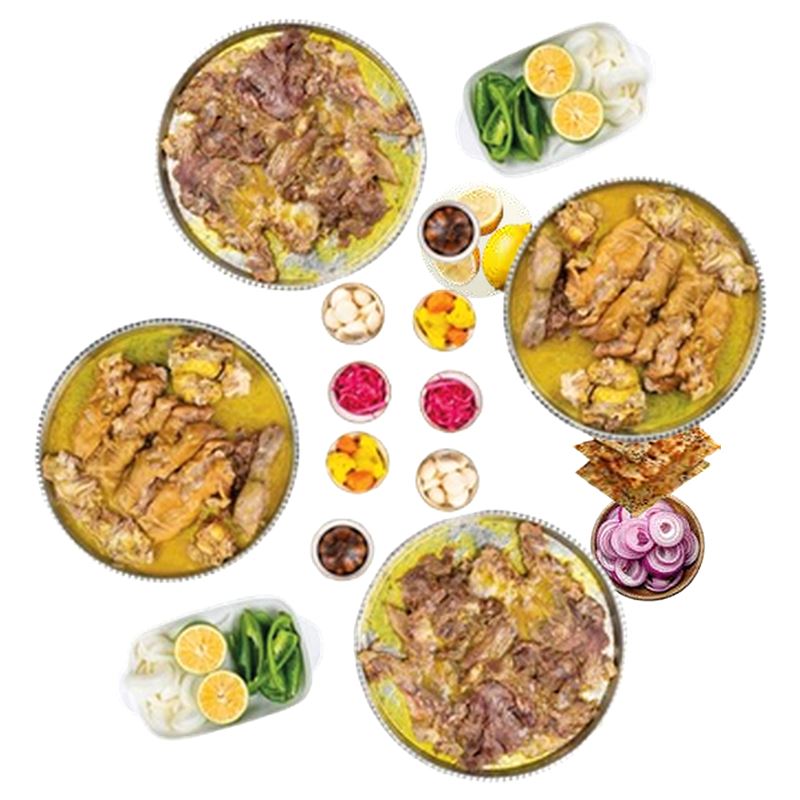
The sofreh is the spread itself, traditionally a cloth rolled out on a carpet and today just as often a laid table, where everything for the meal is placed within everyone's reach. Rather than a single plate set in front of each diner, a Persian sofreh is communal: warm sangak bread along the edge, fresh herbs, a dish of mixed torshi, seven-year garlic pickle, cold doogh, and the hot dishes set in the middle so every hand can reach them. Eating this way turns a meal into a shared moment rather than a private plate. You can see the full range on the menu and order page.
Where does everything sit on the sofreh?
There is no strict grid, but there is a rhythm. Bread lines the edges because it is touched most often. Pickles, herbs and torshi cluster in small dishes so they can be passed hand to hand. The centre is reserved for the star, a steaming platter of brain, tongue, cheek and trotters, or a bowl of the tea-coloured broth, because it belongs to the whole table. When you sit down, take a moment before reaching in, and let the host gesture you toward the food first.
What is tarof, and how do I handle it gracefully?
Tarof is the ritual politeness that runs through every Persian gathering: the warm dance of offering, refusing and insisting. The host will press more food on you, and the good guest first demurs, then accepts. Someone may offer you the best piece, the tender cheek or the last of the brain, and mean it sincerely even while you protest that you could not possibly. None of this is a trap. It is a shared language of generosity in which everyone signals that the other matters more than themselves.
The trick for a newcomer is simply to play along lightly. If you are offered more and you do want it, a soft "no, thank you" followed by a smiling "well, just a little" is exactly right. If you truly are full, decline warmly two or three times and your host will understand. Never feel you must eat past comfort to be polite; a sincere hand on the heart and a thank-you carries more grace than a cleared plate you did not want.
How does tarof sound in practice?
| The moment | What you might hear | A relaxed response |
|---|---|---|
| Being served | "Please, eat, eat — you have had nothing!" | Accept a little and let them refill once. |
| The best piece offered | "This cheek is for you, the guest." | Demur once, then accept with thanks. |
| Reaching for the bill | "No, no, you are my guest today." | Offer sincerely, then let them host you. |
| When you are full | "Just one more spoon of broth!" | Decline warmly two or three times. |
Why is bread torn and shared, not cut?
At a Persian table, sangak, the long stone-baked flatbread, is torn by hand and never sliced with a knife. Bread carries a quiet reverence in Iranian culture; it is treated with care, not left on the floor and not cut as if it were something to be divided by force. You tear a piece about the size of your palm, use it to scoop soft brain or wrap a ribbon of tongue, and reach for more as you go. Tearing keeps the bread warm and pliable, and it makes the sofreh feel shared: one loaf, many hands. If a piece falls, the old custom is to pick it up gently, a small sign of respect for the bread on the table.
How does tea work at a Persian table?
Tea, or chai, is not an afterthought; it frames the meal. It is served in small glasses, usually amber and clear, and often comes after the food rather than during it, so the rich broth is not diluted. You may be offered a sugar cube to hold between the teeth, or a piece of rock sugar (nabat) to stir. Take the tea when it is offered, since refusing outright can feel abrupt, and know that a second glass is almost always on its way. The pouring of tea is itself an act of care, and letting your host refill your glass is a quiet way of accepting their welcome.
Who sits where, and who is served first?
Seating carries gentle meaning. The seat farthest from the door, often called the bala or head of the room, is the place of honour, usually offered to the eldest or to the guest, and you may be waved toward it with insistence, which is tarof once again. Elders are served first, then guests, then everyone else, and children are looked after throughout. If you are unsure where to sit, wait a beat and follow your host's hand. Letting an elder begin, and not reaching across someone for a dish, are small gestures that are noticed and appreciated. If you know the Gulf custom of honouring a guest with the sheep's head, from the honour tray to the dawn bowl compares that table with the Persian one.
What are the gentle do's and don'ts at a Persian table?
Keep it simple and warm. Do arrive a little hungry, accept the tea, tear your bread by hand, and compliment the food, because praise for the cook is always welcome. Do let elders and guests go first, and share from the communal platter rather than guarding a portion. Don't rush, as a Persian meal is unhurried by design. Don't feel pressured to over-eat to prove your manners, and don't wave away every offer so firmly that your host cannot show their hospitality, because a little give-and-take is the whole point. Above all, relax: the table wants you to enjoy yourself.
If you would like to experience all of this in person, you can reserve a table and let us lay the sofreh for you, or order for delivery to bring the same spread home, with communal platters for one, two, three or six alongside sangak, torshi and doogh, anywhere across Dubai. Delivery is free on orders over AED 300, and the pot has been simmering since long before you arrive.
