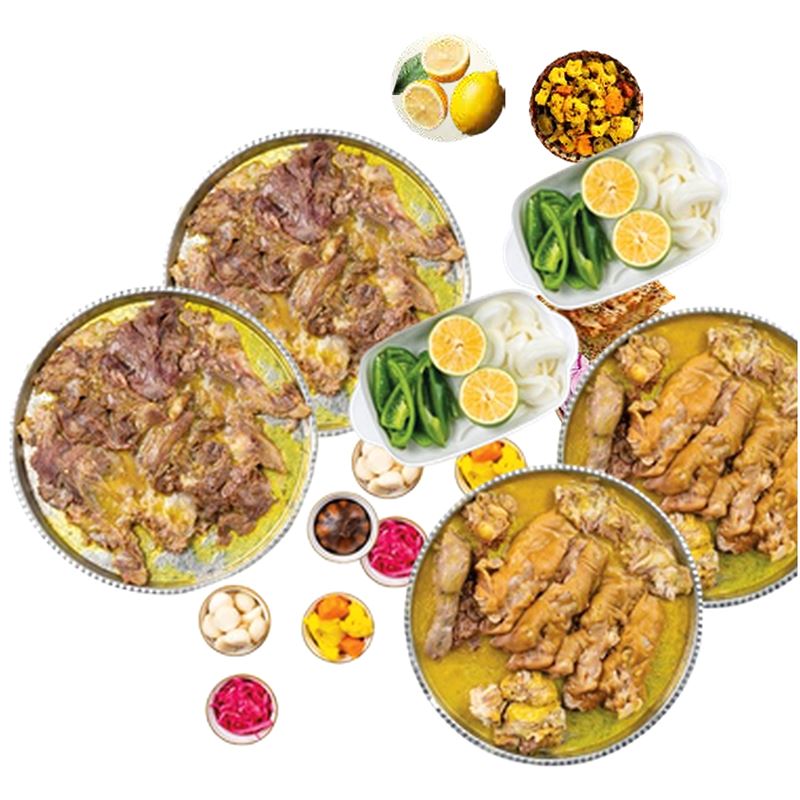
Why the platter looks like a puzzle
When the lid comes off a kalle pache platter, the steam lifts and the table goes quiet. One person ordered, everyone else was talking, and now there is a tray of pale, glossy, ribbed and gelatinous pieces in front of six hands, and nobody wants to serve the eye to the person who asked for tongue. Every part of the lamb head and trotters has a shape that gives it away.
At Shaun the Sheep in Jumeirah, Dubai, heads and trotters simmer for about fourteen hours. That slow heat leaves everything paler, softer and glossier than it looked raw, so you read the platter by shape and texture rather than by colour.
Six pieces, six giveaways
Brain
Pale ivory, almost white, and clearly two halves joined along a centre seam, the surface finely folded in soft lines. It wobbles when the tray is set down; nothing else does. Custard-soft, so it comes whole or halved, never sliced.
Tongue
A smooth tapering muscle, one thick rounded end narrowing to a blunt tip, with a matte grain running lengthwise. Peeled and cooked through, it cuts like a dense terrine and the slices hold their shape.
Cheek
The dark one: a compact nugget, browner than anything near it, dense enough to sit up on its own, with visible fibres. No bone, no gelatin sheath. Two forks pull it into strands.
Trotters
Glassy and amber, translucent gelatin around white tendon and small bones, so light passes through the thin edges. The stickiest thing on the table. If you can see a bone through the flesh, it is a trotter.
Tripe
Ribbed honeycomb: a pale grey-white sheet with a regular cellular pattern pressed into one face, usually cut in strips. Springy rather than soft, and the one piece you genuinely chew.
Eye
Small, round, and usually the only one of its kind, sitting apart from the rest. Spotting it is never the problem; remembering who asked for it is.
Two others may appear: plain head meat, loose shredded strands with no shape of its own, and the special mix (mojoon), where the parts are combined on purpose. Brain soup and soup arrive in bowls, not on the platter.
Serving each part without guessing
Start with the trotters while they are hottest, because gelatin stiffens as it cools; use a spoon and take broth with each portion. Lift brain with a flat spoon in one movement; chasing it with a fork is how it ends up in pieces. Tongue cuts against the side of a spoon. Tripe is easier cut into short strips first. Cheek separates with two forks. The eye goes whole onto one plate; it is not a piece you divide.
Ladle broth over every plate, tear the sangak rather than cut it, and keep torshi, raw onion and green pepper at the side of the plate, not in the broth, so they stay sharp. Lime belongs above all on the brain and the trotters. It is generally a rich, protein-heavy meal, so a platter shared by the number of people it is built for is usually enough; dietary questions belong with your own doctor, not your cook.
Pointing at what you want, in Farsi or Arabic
If the words fail you, point at the piece and name it — Farsi first, then Arabic.
- Brain — maghz (مغز) / mokh (مخ)
- Tongue — zaban (زبان) / lisan (لسان)
- Cheek — lap (لپ) / khadd (خد)
- Trotters — pache (پاچه) / kawari (كوارع)
- Tripe — sirabi (سیرابی) / kirsha (كرشة)
- Eye — cheshm (چشم) / ayn (عين)
Add in ro, lotfan in Farsi or hadha, min fadlak in Arabic and you have said everything you need to.
Sharing when nobody remembers the order
Sizes on the menu settle the split before anything is served: Single Dish for one, Double Dish for two, The Full Dish for three, The Khan's Platter for six. Singles exist for every part — eye, brain, meat, tongue, trotters, tripe, lamb cheek, brain soup, soup and the special mix — so a table that argues over the brain can order two. We are open around the clock for dine-in and for delivery across Dubai, pre-orders for a later time are possible, the website takes card payment in advance only and there is no cash on delivery, and delivery is free over AED 300. Questions before you order: 04 321 8882.
