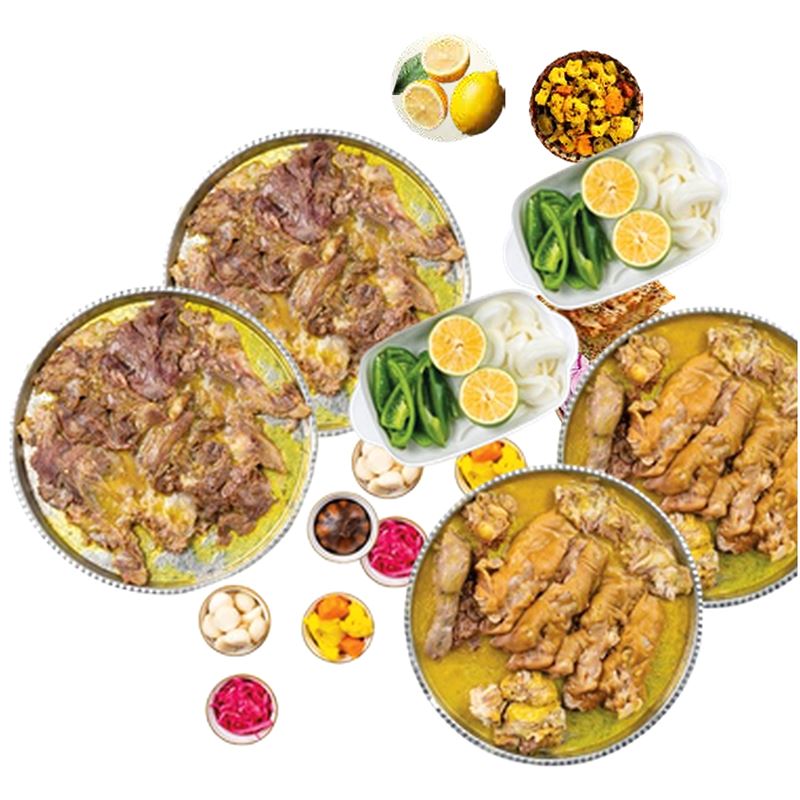
The pot is not one uniform stew
A finished plate of kalle pache reads as one dish: broth, bread, a heap of soft things under a squeeze of lime. In the kitchen it is closer to four or five separate operations finishing at the same table. A lamb head and its trotters are not one material. They are bone, skin, tendon, working muscle, fat and very delicate tissue, each reaching its best point at a different moment. Cook them all the same time and something is always wrong: either the trotters are still tight or the brain has fallen apart. So the parts are timed individually. That is a cooking necessity before it is a way of serving. The full sequence is in how kalle pache is made; this piece is only about the clock.
Trotters, skin and tendon set the outer limit
The trotters decide how long the night runs. Their value is collagen — skin, tendon, the connective sheets around the joint — and collagen does not give up quickly. It needs many hours of low, steady heat to turn into gelatin, and that gelatin puts body into the broth and leaves the faint stickiness on the lip. Heat cannot be traded for time: a hard boil clouds the liquid and drives the fat into it instead of letting it rise to be skimmed. The roughly fourteen-hour simmer is set by these parts and nothing else on the plate.
Brain is handled briefly, and on its own
Brain sits at the opposite end. It is soft tissue in a thin membrane, and it sets the way a custard sets: gently, quickly, and then it is finished. Left in the main pot for the full simmer it would dissolve into the broth and be gone. So it is cleaned, its membrane dealt with, and cooked briefly in its own liquid, where it can be watched. That short, separate handling keeps the shape intact and the flavour mild and clean rather than heavy. It is why brain can be served as a single, and why brain soup exists as a dish in its own right.
Tongue is cooked first and peeled afterwards
Tongue carries a rule the others do not. Its outer skin has to come off, and only comes off after cooking. Raw, it is bonded tight to the muscle; after a long enough simmer it lifts away in one sheet. Peeling has to happen while the tongue is still hot, because a cooled tongue grips its skin again. So tongue is cooked to its own point, lifted out, peeled straight away and sliced. Underneath is dense, even-grained muscle, which is why sliced tongue eats firmer and cleaner than anything else on the platter.
Cheek and head meat loosen at their own pace
Cheek is a muscle that has worked its whole life and is laced with connective tissue, so it wants length, though not the length the trotters want, and is watched separately. The rest of the head meat comes free in stages: some loosens early, some has to be worked off the bone at the end, and it is picked over by hand once it can be handled, because the best pieces come away in shapes a ladle would never find. The eye sits in its own pocket and is lifted out whole, the only way it stays whole.
Why the platter is assembled, not ladled
Once the parts finish at different moments, the way a platter is built follows. Nothing is dipped out of one vessel and poured into a bowl. Each part is held at its own point and brought together on the plate as the order is made, with hot broth over the top. That is why one plate can carry so much range at once: gelatinous trotter, firm slices of tongue, soft brain, shredded cheek meat, tripe with its own chew. The special mix, mojoon, is that idea taken to its conclusion. It also explains why singles exist at all: eye, brain, meat, tongue, trotters, tripe and lamb cheek are each timed separately anyway, so any one can be served alone, and the guide to the singles goes part by part. The platters are the same assembly scaled for one, two, three or six people, and the whole range is on the menu.
The Jumeirah kitchen runs around the clock, so this timing is running whatever hour you read this. Dine-in and delivery run across Dubai, with delivery covered here, and it is free on orders over AED 300. Website orders are card prepay only; there is no cash on delivery. If you want a plate ready at a set time, at dawn or the end of a shift, a pre-order can be placed for a future time, or call 04 321 8882.
