Why does bread belong in every kalle pache order?
Ask anyone who grew up with kalle pache and they will tell you the same thing: the broth and the bread are one dish, not two. A bowl of slow-simmered lamb head and trotters is rich, silky and deep, but on its own it is only half the ritual. Bread is what carries the broth to your mouth, soaks up the last of the golden liquor, and turns a spoonful into a proper mouthful. At our kitchen the broth is simmered for around fourteen hours until it runs the colour of strong tea, and it deserves bread that can keep up. That is where sangak comes in — and where the Special Sangak earns its place on your order.
What is tilit, and why does everyone do it?
The classic way to eat kalle pache is called tilit: you tear warm sangak into small pieces, drop them straight into the broth, and let them drink it in. Within a minute the bread softens into something between a dumpling and a spoon, heavy with flavour. You scoop, you fold in a piece of tongue or cheek, and you chase it with broth. Nothing is wasted — the bread mops up every last bit at the bottom of the bowl, the part most people agree is the best. If the dish is new to you, our first-timer guide walks through tilit step by step. Either way, no bread means no tilit, and no tilit means missing the heart of the meal.
What makes Special Sangak different from plain sangak?
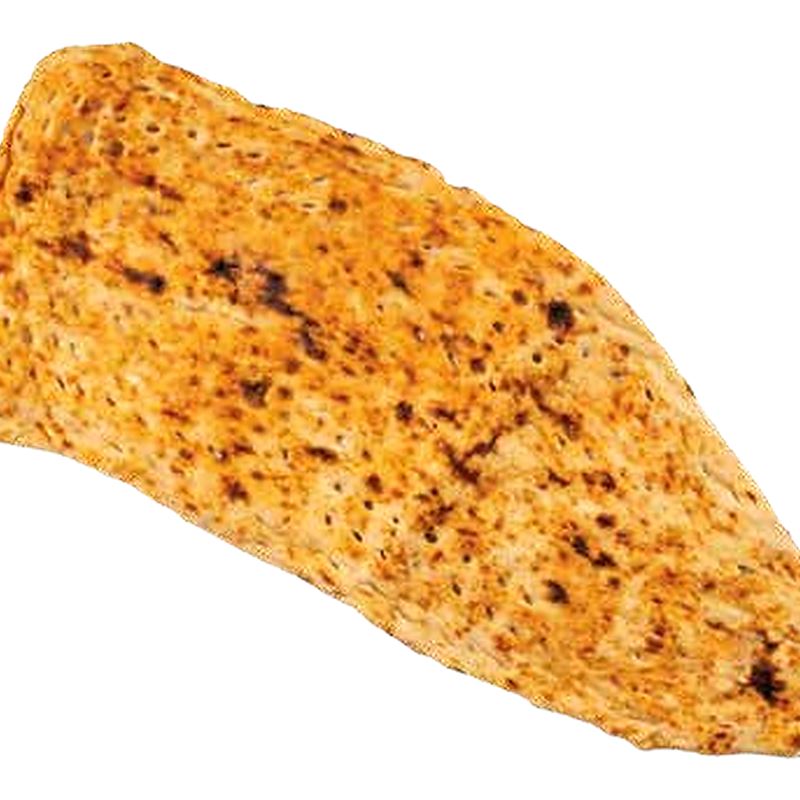
Both are the same honest thing at heart: whole-wheat flatbread, stretched out and baked on a bed of hot stones so it comes out blistered, chewy and warm. Plain sangak is exactly what a Tehran breakfast table has always had — simple, lightly seeded, made to be torn and dipped. Special Sangak is the more generously topped version: a heavier, more even scatter of sesame and nigella (black) seeds across the surface, so every piece you tear off carries that toasty, nutty crunch instead of just the plain wheat. It is the same bread, treated like a treat. For a broth this rich, that extra layer of seeds and toasted flavour is the difference between good bread and bread you keep reaching for.
Plain sangak vs Special Sangak: which should you add?
| Feature | Plain Sangak | Special Sangak |
|---|---|---|
| Base bread | Stone-baked whole-wheat flatbread | The same stone-baked flatbread |
| Topping | A light scatter of seeds | A generous, even layer of sesame and nigella seeds |
| Flavour | Clean, wheaty, classic | Toastier, nuttier, more aromatic |
| Best for | A light, traditional bite; smaller orders | Groups, sharing platters, and anyone who loves seeded bread |
| The idea | The everyday staple | The little upgrade, treated like a treat |
When is Special Sangak worth adding?
Honestly, almost any time you order kalle pache — but a few moments make it an easy call:
- When you are sharing. A Double, a Full platter for the family, or the big Khan for a group means more broth on the table, and more broth means more bread. Passing torn sangak around is half the fun. If you are working out quantities, our how-much-to-order guide helps.
- When the broth is the star. If you have gone for a plain broth bowl, brain soup, or the Special Mix, you will want plenty of bread to soak it all up.
- When you love seeded bread. If a nutty, toasty crust is your thing, the special version is simply the better plate of bread.
- When it is a treat. A dawn kalle pache with friends, a weekend spread — the upgrade lifts the whole table.
How do you order it in Dubai?
It could not be simpler. Head to our online menu, choose your parts or a sharing platter, and add Special Sangak — along with the classic sides, torshi and doogh — to your order. For delivery, pick your Dubai area and drop a map pin so the rider finds your door; you pay securely online by card, and the rider calls you when they arrive. Delivery reaches every corner of Dubai, and it is free over AED 300. Prefer a specific time? You can schedule your order ahead and follow its status on the confirmation page after you pay. We are at 64 Jumeira Street, Jumeirah 1, open 24 hours a day, seven days a week, for delivery, pickup and dine-in — or book a table and tear fresh sangak with the broth still steaming.
