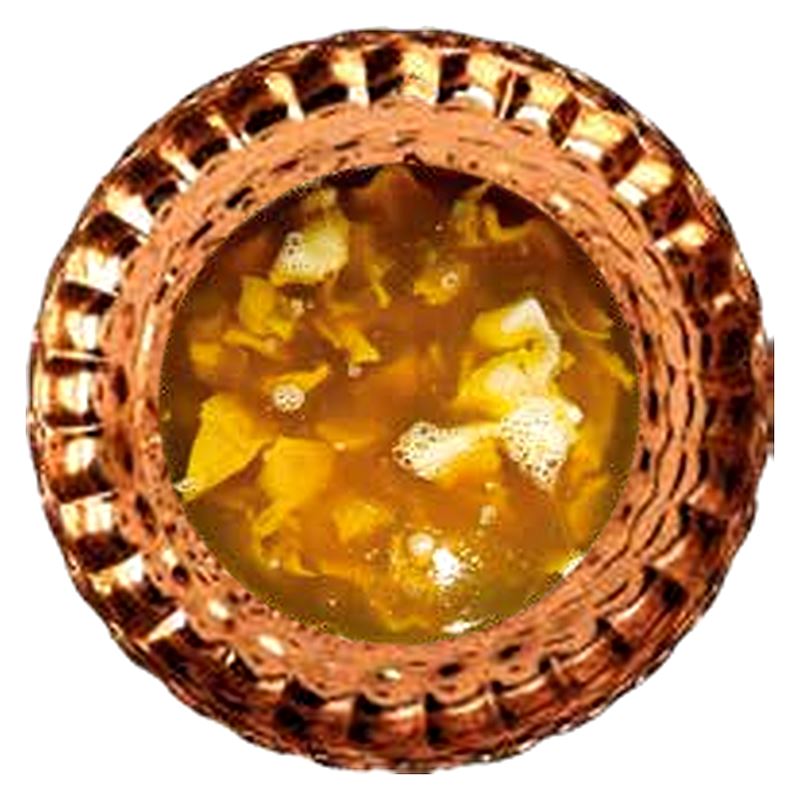
Turkey has two well-known dishes in this family, and they are not the same thing. Kelle paça is head and trotters. İşkembe çorbası is tripe. This article is about the tripe soup, because that is the bowl Turkish readers in Dubai most often set beside ours.
The short version is that the two share the cut, the patience and the hour: tripe, cooked long and slow, eaten very late or very early, in kitchens that stay open after the rest of the city has closed. What separates them is mostly the finish. İşkembe çorbası is commonly served pale and creamy, then sharpened at the table with garlic and vinegar. Our tripe — sirabi in Persian — arrives in a clear savoury lamb broth, and the person eating it brings it into focus with lime, cinnamon and garlic. We cook the Persian version and only the Persian version, at our kitchen on 64 Jumeira Street in Jumeirah 1, open around the clock.
Doesn't Turkey have kelle paça as well?
It does, and it deserves more than a footnote, which is why it already has an article of its own. If head and trotters is what you came for, read kalle pache next to Turkish kelle paça instead — that piece does the head-to-head properly, and this one will not repeat it. We raise it here for one reason only: so that nothing below can be read as a claim that Turkey lacks a head-and-trotters tradition of its own. It plainly has one. From this point on, this article is about tripe.
What exactly is işkembe çorbası?
It is a Turkish soup built on tripe: cleaned, cooked until it is tender, and served very hot in a bowl that is commonly pale and thick rather than clear. Two things are almost always attached to it in people's memory. The first is the table — a small parade of seasonings, above all garlic steeped in vinegar, spooned in by the eater until the bowl tastes the way that particular eater wants it to taste. The second is the shop itself: a dedicated place, often doing this one thing and little else, with its lights on in the small hours while the street outside is empty.
Past that we would rather be vague than wrong. Kitchens differ, families differ, cities differ, and the recipe is not ours to hand down. If you grew up on it, you know your own version better than we ever could, and nothing written here is trying to correct you.
What do the two bowls genuinely share?
More than most people assume — four things, and none of them small.
- The cut. Tripe on both sides. Everything difficult about tripe — the cleaning, the trimming, the slow conversion of something tough into something soft — is a shared problem with closely related answers.
- The patience. Neither dish can be hurried. On our side, the heads and trotters are hand-cleaned and trimmed, blanched with that first water thrown away, then simmered about fourteen hours and skimmed again and again.
- The hour. Both are eaten at the edges of the day: before dawn, after a long shift, at the end of an evening that simply ran long.
- The kitchen that stays open. Both belong to places keeping hours nobody else keeps. We are open 24 hours a day, seven days a week, at 64 Jumeira Street, Jumeirah 1 — the same social habit, transplanted to a different city.
What is the clearest difference between them?
The broth, and what happens to it at the table. İşkembe çorbası is commonly finished pale and creamy — a soup that arrives already thick — and is then cut through with garlic and vinegar by the person eating it. Our tripe is served in a clear savoury lamb broth. It looks like broth rather than cream, and it is finished by the diner as well: lime for sharpness, cinnamon for warmth, garlic for depth. The kitchen deliberately does not season it for you.
So the instinct behind the two is identical — the eater completes the dish — but the tools on the table are different. Someone reaching for vinegar and someone reaching for lime are doing the same job with whatever each tradition put within arm's reach.
How do the two compare side by side?
| Aspect | İşkembe çorbası — commonly associated with | Our tripe — what we cook |
|---|---|---|
| Main part | Tripe | Lamb tripe, called sirabi in Persian |
| The broth | Commonly pale, thick, creamy | Clear, savoury lamb broth |
| In the pot | Varies by kitchen — not ours to state | A copper pot, with onion, turmeric and garlic |
| The cooking | Long and slow | Blanched with the first water discarded, then about fourteen hours, skimmed again and again |
| Seasoned at the table with | Commonly garlic and vinegar, added by the eater | Lime, cinnamon and garlic, added by the diner |
| Bread | Commonly eaten with bread | Sangak — and bread is included in every platter |
| When people eat it | Very late or very early | Any hour: we are open 24/7 |
| Do we serve it? | No — we do not cook Turkish dishes | Yes — Tripe is on the menu as a single; the Special Mix is the sampler if you want the range. |
You already eat tripe. What should you order first?
Start with Tripe on its own, or with the Special Mix. Texture is what stops most newcomers to kalle pache, and tripe is the texture they find hardest — you cleared that hurdle years ago, which makes your first order here easier than almost anyone else's.
If you are eating alone
- Tripe on its own, for the most direct comparison with the bowl you already know. There is a longer piece on it: lamb tripe, sirabi, explained.
- Special Mix, if you would rather taste the range than one part. It is what we point experienced offal eaters toward, and there is a guide to it here.
- Soup, or Brain Soup, if you want to stay closest to a bowl-and-spoon meal rather than a plate.
If you are ordering for a table
The platters are the simpler route, and they include bread, which matters when you are working out how much to order.
- Single Dish — lamb cheek, one trotter, half a brain, half a bread.
- Double Dish — lamb cheek, two trotters, half a brain, tongue, one eye, a whole bread.
- The Full Dish — two lamb cheeks, meat, four trotters, a whole brain, tongue, two eyes, two breads.
- The Khan's Platter — four lamb cheeks, two meats, eight trotters, two brains, three tongues, four eyes, five breads.
The full menu guide walks through the singles one at a time: Eye, Brain, Meat, Tongue, Trotters, Tripe, Lamb Cheek, Brain Soup, Soup and Special Mix.
What if you bring someone who has never eaten tripe?
Order for them the way a good tripe shop eases someone in: start soft, start familiar. Lamb Cheek and Meat are the least surprising parts on the menu and read simply as slow-cooked lamb. Soup gives a newcomer broth without asking for a decision — add Sangak Bread alongside it. Keep the Eye and the Brain for later, or take a spoonful yourself and let them ask. What kalle pache is is a fair thing to send them beforehand, and kalle pache in Dubai explains why the dish has the following it does here.
How is our tripe actually cooked?
Heads and trotters are hand-cleaned and trimmed, blanched with that first water thrown away, then simmered about fourteen hours in a copper pot with onion, turmeric and garlic, skimmed again and again as the hours pass. That is the method, stated plainly and kept short; how kalle pache is made takes it more slowly. Our lamb is sourced to the UAE halal standard, and the halal question has an article of its own.
What we will not do is claim more than that. We have not published an ingredient list, so we are not going to start telling you what is absent from the pot either. The fourteen hours and the copper are real; anything past them would be a guess.
What sits on the table alongside it?
The seasoning is yours to do: lime, cinnamon and garlic, added at the table by the diner rather than by the kitchen. Around that sit Sangak Bread and Special Sangak, Mixed Torshi and Garlic Torshi for pickled sharpness, and add-ons that let you build the plate you want — capsicum, onion, fresh chili, pickled green chili, extra Sangak. To drink there is tea, black tea or a whole kettle of it, doogh, lemonade, water and soft drinks. If you have ever tuned a bowl of tripe soup to your own taste from whatever was on the tray, you will recognise the habit instantly, even though the tray holds different things. What kalle pache tastes like goes further into that.
Is it heavy? What about nutrition?
On taste, it is rich the way any long-cooked broth is rich, and most people find that one part plus bread is a full meal, while a platter is built for sharing. On nutrition we will go no further, because we have not published an ingredient or nutrition breakdown and inventing one would help nobody. This is not medical advice — if you have a health question about offal, ask your doctor or a registered dietitian.
Where and when can you eat it in Dubai?
One kitchen, at 64 Jumeira Street, Jumeirah 1, open 24 hours a day, seven days a week. There are no branches. You can dine in, collect it yourself, or have it delivered across Dubai — delivery is free over AED 300, and below that the fee depends on your area, so checkout shows it rather than a guess here. Tables can be reserved. The phone, 04 321 8882, is our only contact channel: no email, no chat, no messaging apps. Delivery across Dubai has the rest of the practical detail.
How does ordering work?
Ordering is online, with secure card prepayment. There is no cash on delivery and nothing to settle with the rider. There is no account, no password and nothing saved between visits, so you enter your details each time. Once payment goes through, the order gets its own page; the kitchen accepts it and sets an estimated time there, and the rider phones on arrival — which is why the number you type matters more than anything else on the form.
You can also schedule an order for a future time up to about two days ahead, which suits a pre-dawn bowl planned the evening before. Customising here means choosing which parts and items you want; there is no notes field for the kitchen, so anything unusual has to go by phone. There is no button to cancel or edit either, so if something needs to change, call 04 321 8882 straight away. If the kitchen cannot fulfil an order it rejects it with a reason and the refund is issued automatically. The step-by-step ordering guide covers each screen.
Are you experts on Turkish cooking?
No, and we would rather say so plainly than pretend otherwise. We cook the Persian version, in one kitchen, and that is the whole of our authority. Everything written above about işkembe çorbası is an outsider describing something he admires and eats, hedged wherever we are unsure. It is not a recipe, not a ruling and not a verdict. Neither bowl outranks the other. They are two answers to the same question — what do you do with tripe, time and a very late hour — arrived at independently.
If you want the wider set of comparisons, the comparison hub gathers them in one place, including the Greek tripe soup in kalle pache next to patsas. And if you would rather stop reading and start eating, the tripe is on the menu, at whatever hour you happen to be reading this.
