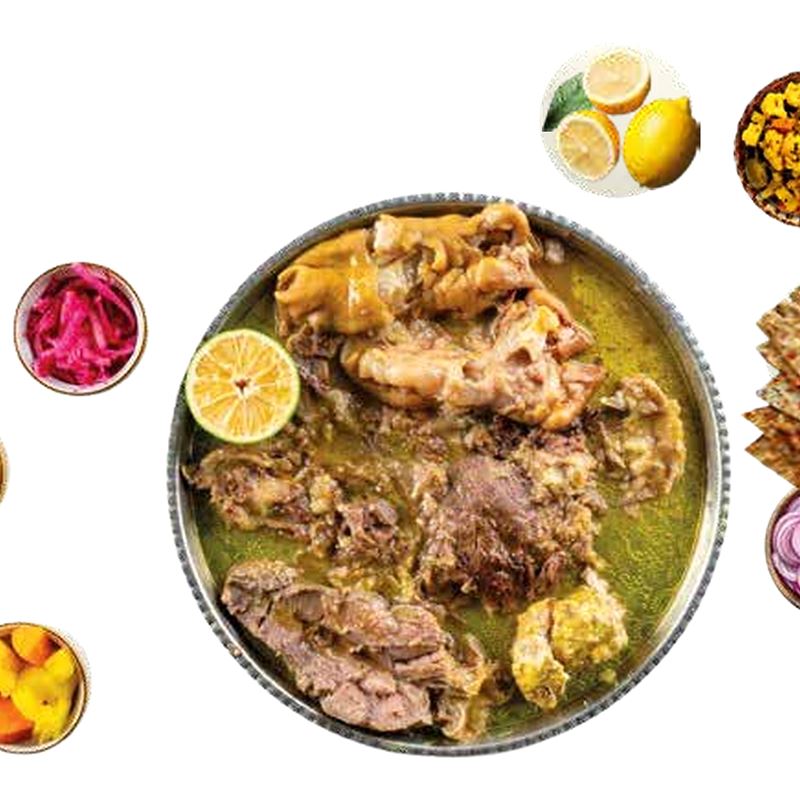
What is barbacoa de cabeza, and how close is it to kalle pache?
Barbacoa de cabeza is a whole head cooked slowly in a sealed pit until the meat comes away from the bone, then pulled apart and eaten in tortillas. Kalle pache is a whole lamb head and trotters simmered in water — about fourteen hours in our pot — and served as broth with the parts in it. The same raw material, the same patience, two opposite conclusions.
The difference is not spice or seasoning. It is structural. One tradition cooks in trapped steam and eats the meat. The other cooks in water, and the water becomes the dish.
A sealed pit or an open pot: how is each one cooked?
Barbacoa, as it is generally described, is pit work. A hole is dug, a wood fire is burned down in it over stones, the pit is lined with maguey leaves, the wrapped head goes in, and a cover and a layer of earth seal it overnight. Nothing is stirred, nothing is skimmed, nobody lifts the lid to look. The head cooks in its own trapped steam, and the leaves mark the meat. Many cooks now use a covered pot or a steamer in place of a pit, so what arrives under the name is not always pit-cooked.
Kalle pache is the opposite discipline: an open pot, a flame someone can see, and a cook who never really leaves. The first water is thrown out, the grey foam that rises early is skimmed away, and the pot is held at a lazy movement rather than a hard boil for the best part of a day. It is attentive rather than sealed. How the heads are cleaned before any of that begins is the part of the work nobody sees.
Why does one dish end up shredded and the other stay in pieces?
Because of where the meat has to go next. Barbacoa meat is headed for a tortilla, so it is lifted out, chopped and pulled apart on a board into a pile you can take by the handful. Once it is shredded, the cheek and the tongue and the rest stop being separate things and become one filling.
Kalle pache goes the other way. The parts stay whole and stay named all the way to the table, which is why our menu reads as it does: Lamb Cheek, Tongue, Brain, Eye, Meat, Trotters, Tripe. You do not order a head; you order the parts you want. If you would rather not choose part by part, the platters are Single Dish, Double Dish, The Full Dish and The Khan's Platter.
Is consomme the same thing as kalle pache broth?
This is the hinge of the comparison. In the barbacoa tradition the juices that drip out of the head are caught below and served as a cup of consomme beside the tacos, often with chickpeas or rice and a little chilli in it. It is a companion. You could wave the cup away and still have eaten barbacoa.
Wave the broth away in kalle pache and you have not eaten kalle pache. The broth is not a by-product served on the side; it is the dish, and everything else sits in it. It is a different liquid, too — pale and clouded rather than clarified, because skin, bone and trotter give up gelatin and fat into it all day. Cloudy is the intended result here, not a fault.
Put simply: one tradition eats the meat and drinks the broth beside it, the other drinks the broth and eats the meat out of it.
Tortilla or sangak: what is the bread actually doing?
Both traditions put bread on the table, and use it in opposite ways. A tortilla is a container. It holds the meat, keeps your hands out of it, and is meant to stay in one piece until you finish it. Sangak is a sponge. It is torn and pushed under the surface until it is heavy with broth, and that soaked bread — tilit, in Persian — is a large part of the appeal.
The sharp things land in a similar place. Lime, raw onion and chilli finish a taco. Kalle pache is finished with lemon squeezed into the bowl, raw onion, and torshi — Mixed Torshi or Garlic Torshi — with Fresh Chili or Pickled Green Chili if you want heat. Neither pot is cooked spicy; in both traditions the heat is added by the person eating.
Kalle pache and barbacoa de cabeza, point by point
| Feature | Barbacoa de cabeza | Kalle pache |
|---|---|---|
| Vessel | Sealed pit, or a covered pot in its place | Open pot on a flame, watched and skimmed |
| Medium | Trapped steam; no water on the meat | Water, which becomes the broth |
| Animal | Commonly a beef head; lamb and goat too | Lamb head and trotters |
| Trotters | Not part of the dish | Half the reason the broth works |
| The liquid | Caught underneath, served alongside as consomme | The dish itself, with everything in it |
| Meat at the table | Shredded into a single filling | Separate parts, ordered by name |
| Bread | Tortilla holds the meat | Sangak soaks up the broth |
Why are both weekend food, sold by people who cook nothing else?
Two traditions on opposite sides of the world arrived at the same timetable. Barbacoa is widely a weekend-morning trade: cooked overnight, sold in the morning, finished when it is finished, from a stall or shop that does nothing else. Kalle pache has the same shape at home, where the kalle-pazi opens in the dark hours with its windows fogged and closes when the pot is empty.
Both are also dishes that tend to read as confronting from outside and ordinary to anyone raised on them. A head is a head. For the people eating one at first light it tends to be breakfast before work rather than a statement. You can see the same pattern in the other Mexican comparison, kalle pache and menudo, another dawn bowl with a weekend habit attached.
Dubai changes one thing. Our kitchen runs 24 hours a day, seven days a week, so dawn is a choice rather than a constraint, and an order can be scheduled ahead if you want it waiting at first light.
If you know barbacoa, what should you order first?
Start with what you already recognise. Lamb Cheek is the closest thing on our menu to the meat you pull out of a barbacoa taco: slow, soft, plainly meat, nothing strange about it. Meat and Tongue are the sensible next steps. Brain and Eye can wait, or never happen at all.
Then think of the broth as food, not a drink. Take Sangak Bread with it, tear it in, and give it a moment to swell. To be plain about what this kitchen does: kalle pache and a Persian breakfast, all halal. If you want to see where the dish sits among its relatives, every comparison we have written is collected in one place.
Ordering is on the website in English, Arabic or Farsi: delivery to 141 Dubai areas with the fee for your area shown at checkout, pickup, or eat in at 64 Jumeira Street in Jumeirah 1. If you have a question the site does not answer, call 04 321 8882 and ask.
