What is Muharram, and why does food matter during it?
Muharram is the first month of the Islamic lunar calendar. Its first ten days, ending on Ashura, are days of mourning for Shia Muslims, observed by a large part of the Iranian community in Dubai: gatherings, recitation, black clothing, and a quietness that changes the rhythm of ordinary life. How a family observes is its own matter; this article makes no rulings and only describes what a newcomer notices.
The kitchens never stop. Pots are set up in courtyards and side streets, cooking runs through the night, and trays go out to whoever passes. Grief and feeding are held in the same pair of hands.
What does nazri actually mean?
Nazri is food cooked and given away freely to fulfil a nazr: a vow made privately, in a moment of worry, illness in the family, or plain gratitude. The vow is private; nobody else needs to know what it was for. What the neighbours see is only the result: a pot, a queue of containers, and someone ladling.
Three habits define it. It is never sold. It is never means-tested: the tray goes to neighbours, drivers, workers coming off a shift and passing strangers. And accepting a portion is understood as a kindness done to the giver, not charity received. The longer story of that custom is in our piece on nazri and the charity-food tradition.
Which dishes are most associated with nazri?
A few dishes come up again and again, because they scale to hundreds of portions and hold heat in a tray.
| Dish | What it is | When it appears |
|---|---|---|
| Gheimeh | Split pea and lamb stew with dried lime and fried potato | Evening gatherings |
| Ash reshteh | Herb, bean and noodle soup finished with kashk | Afternoon and evening |
| Halim | Wheat and meat pounded for hours into a porridge | Dawn |
Sholeh zard, a saffron rice pudding, often goes round beside them. The pattern holds: slow, one-pot, generous, easy to hand over at a door.
How does kalle pache relate to these days?
Kalle pache is not a nazri dish in the way gheimeh is; it belongs to a different tradition. But it keeps the same clock and much of the same logic, which is why it belongs to the same mornings.
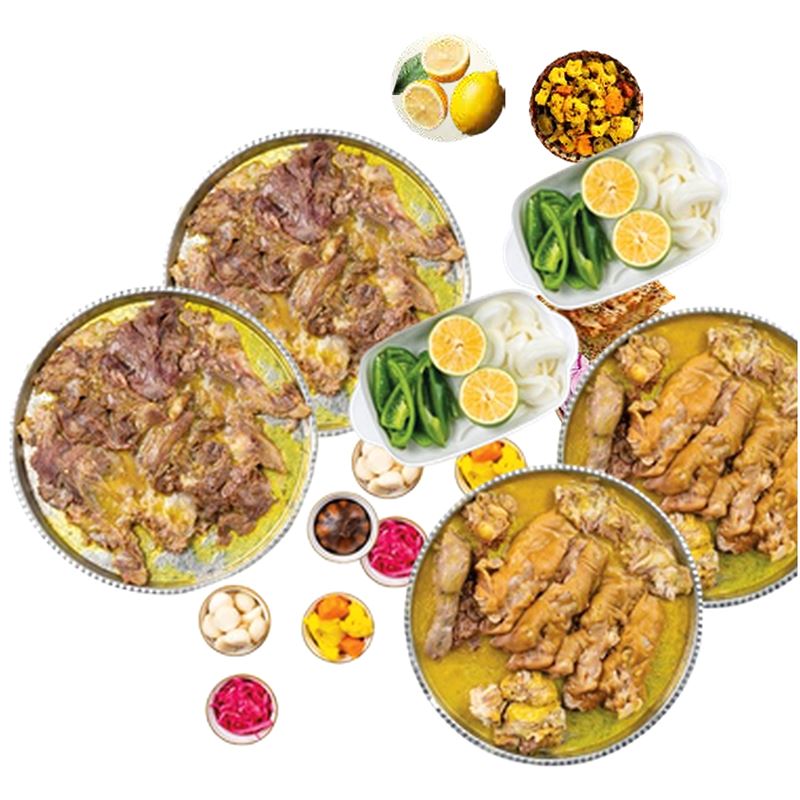
It is a dawn food. Lamb head and trotters are simmered all night so the broth is ready while the city is still dark, the hour when people are coming home from a long night, eating before a fasting day, or simply awake when nobody else is. It is communal by construction: a head does not divide into single servings, so the sofreh is laid for a group and three- and six-person platters exist. And it uses the whole animal, from cheek and tongue to trotters and brain, an ethic of nothing wasted that sits close to these days.
Where can you eat before dawn in Dubai during Muharram?
Shaun the Sheep at 64 Jumeira Street, Jumeirah 1, is open 24 hours a day, seven days a week, one of the places families turn to when the meal falls at three or four in the morning. The lamb is halal. You can sit in, collect an order, or have it delivered across all 141 Dubai areas, with the fee for your area shown at checkout. Call 04 321 8882 to ask about a large table.
To be clear: the restaurant does not run, organise or sponsor nazri. Nazri belongs to households, mosques and hosseiniyehs, and it is given, never bought. What a kitchen that never closes offers is somewhere to be at an hour when almost nothing else is open, which for many Iranians far from home is its own comfort.
How should a guest behave at the table?
If you are handed a container at a door, the rules are simple. Accept warmly, eat what you are given, and do not ask what the vow was for. The wider grammar of the table, from the sofreh to tarof, is covered in our guide to sofreh and tarof. During Muharram it is the same grammar, only quieter.
